If you need to identify a snake, try the Snake Identification Facebook group.
For professional, respectful, and non-lethal snake removal and consultation services in your town, try Wildlife Removal USA.

Tuesday, May 28, 2013

Basics of Snake Taxonomy


A while back, medical-doctor-turned-snake-blog-post-translator-extraordinaire1 Alvaro Pemartin asked me to write an article covering basic snake taxonomy. Taxonomy is the branch of biology that deals with naming and classifying organisms. Biologists still use the Linnean hierarchical system for taxonomy, which is convenient for grouping organisms, but there is a move towards using phylogenetic systematics and the evolutionary species concept in taxonomy, particularly in the sense that recognizing and giving names to non-monophyletic groups is discouraged.2 We'll primarily stick with the Linnean system in this article, which uses particular suffixes to denote the taxonomic level (for example, all animal families end in '-idae' and all subfamilies end in '-inae'). However, I've also included some cladograms, which are the most useful figures for understanding evolutionary relationships. If you haven't read one before, you can read up on them here, here, or here, but just know that they essentially work just like a family tree.

Snake Diversity

My only criticism of this film:
not enough snakes
There are about 3,400 species of snakes in the world. All are placed in the suborder Serpentes (aka Ophidia) of the order Squamata, which also includes lizards, from which snakes evolved about 190 million years ago during the Jurassic Period. Extant (modern or living) snakes are divided into two major groups, the blindsnakes (aka threadsnakes or scolecophidians) and the advanced or true snakes (alethinophidians). Advanced snakes are also divided into two non-monophyletic groups, the "older snakes" (henophidians) and the "recent snakes" (caenophidians). The vast majority of all living snakes, about 77% or 2,650 species, are caenophidians, including most of the snakes you've probably heard of: rattlesnakes, cobras, kingsnakes, and many others. A few well-known snakes are henophidians, namely boas and pythons. Most scolecophidians are poorly known. Let's break down each of these groups in slightly more detail.

Scolecophidians

Ramphotyphlops braminus,
a parthenogenetic blindsnake
There are about 400 species of scolecophidians, divided into five families and found mostly in the tropics. They are commonly called blindsnakes, because many have vestigial eyes as a result of their fossorial lifestyle, or threadsnakes, because most are very thin. Most have unspecialized ventral scales, shed in thick rubbery rings, and have a spine at their tail tip. Many eat termites and ants. Most are probably oviparous, or egg-laying, but their reproductive biology is poorly known. Scolecophidians diverged from alethinophidians about 125 million years ago during the Cretaceous Period. You can read more about a fascinating mutualism between a blindsnake and an owl here, or about basic blindsnake biology here.


Phylogenetic tree showing currently accepted hypotheses of snake relationships. Figure from Lee et al 2007.
Thick lines are supported by both morphological and molecular studies, thin solid lines are supported
primarily by similarity of morphology, dotted lines are supported primarily by molecular analyses.


"Henophidians"

Anilius scytale
Red Pipesnake
"Henophidians" are a diverse, if species-poor, group of snakes. I mentioned earlier that they are non-monophyletic, meaning that some henophidians are more closely related to caenophidians than others, which is why the name of their group is in quotation marks. All henophidians shared a common ancestor about 98 million years ago, during the Cretaceous Period. There is some pretty major uncertainty about how henophidians are related to one another, but many taxonomies divide them into four superfamilies (which end in '-oidea' under the Linnean system). The most primitive, the Uropeltoidea, is comprised of five families (Aniliidae, Tropidophiidae, Anomochilidae, Cylindrophiidae, and Uropeltidae) that lack the ability to open their mouths very widely. These snakes have stout skulls with few lizard-like teeth, short tails, and poorly developed ventral scales. Most are viviparous, meaning that they give birth to live young, except the anomochilids, which are oviparous. There is better evidence linking the former two and latter three groups than there is for combining all five families together into a single superfamily. Also, two enigmatic species in the genus Xenophidion might belong somewhere in here.

Calabaria reinhardtii,
the Cameroon Burrowing Boa,
the only oviparous booid
The rest of the henophidians together with the caenophidians are often called the macrostomatans, because they have the ability to open their mouths (Greek: stomata) very wide and consume very large (Greek: macro) prey items. The most primitive of these are the oviparous Pythonoidea, a superfamily including true pythons (Pythonidae) as well as two small lesser-known groups respectively known as the Asian and Neotropical sunbeam snakes, the xenopeltids and the loxocemids. Pythonoids and a superficially similar but surprisingly unrelated group, the  viviparous booids (consisting of true boas and their less well-known relatives, the ungaliophine dwarf boas and the erycine sand boas),  diverged from other henophidians about 75 million years ago. Finally, the most advanced henophidians, the oviparous splitjaw snakes (aka Round Island "boas" or bolyeriids), diverged just slightly later than or around the same time as the true boas. Because the splitjaw snakes constitute only a single family and were historically considered boas, you don't usually hear them referred to as a fourth superfamily.

Caenophidians


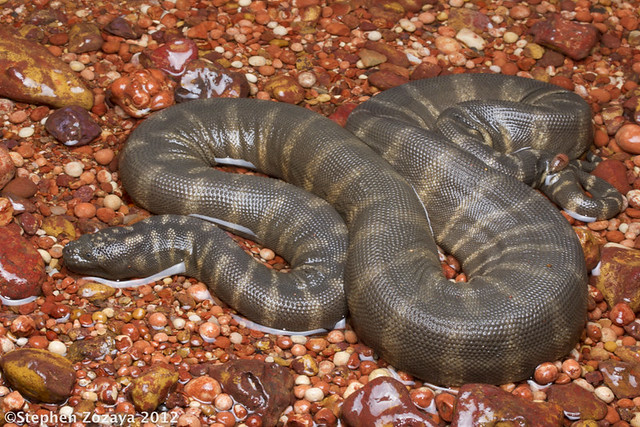
Acrochordus granulatus
Little Filesnake
This huge group is divided into two superfamilies, called Acrochordoidea and Colubroidea. The first is small, containing only three species of Acrochordus, the filesnakes of southeast Asia and north Australia. These diverged from other caenophidians about 60 million years ago. The second is huge and there is some uncertainty about the relationships therein, although thanks to recent work by Alex Pyron and his colleagues, the picture is becoming more clear. Traditionally, colubroids have been divided into groups based on their tooth morphology: those with fixed fangs were placed into Elapidae, those with folding fangs into Viperidae, and those without fangs lumped into Colubridae. The first two of these groups have proven to be for the most part monophyletic, certain exceptions notwithstanding. However, a more nuanced and accurate view of colubroid snake taxonomy is emerging thanks to a combination of molecular tools and decades of careful work by snake morphologists. Ready for it? Here it is:

Figure from Pyron et al. 2011
These snakes are exciting! These snakes have venom, excellent color vision, and sophisticated chemosensory, prey acquisition, and antipredator abilities. Also they have spines on their hemipenes. Also they are awesome. Can you tell which group is my favorite?

Dendrelaphis punctulatus
Common Treesnake
The traditional three-family tooth-morphology arrangement of colubroids has been replaced by the seven family arrangement seen above.3 Three of those seven families include several subfamilies. The most primitive colubroids are the xenodermatids, or odd-scaled snakes, which diverged from the others about 47 mya. The snail-eating pareatids are next, a group you'll be familiar with if you've been following this blog since the beginning. Next diverged the viperids or vipers, about 35 million years ago. There are three subfamilies of vipers: the old world viperines, the widespread crotalines (or pit vipers), and the monotypic Azemiopsinae, or Fea's Viper. True colubrids are still a large group, even though many species have been removed to the "new" families. The subfamilies are large and diverse, although most lack dangerous venom (a few species notwithstanding). You can read the story of the evolution of some of the subfamilies here. There are many well-known colubrids, including ratsnakes, kingsnakes, racers, hog-nosed snakes, and many others. Homalopsids, including some that chew their food, are a small but interesting group of semi-aquatic snakes found in southeast Asia. The front-fanged elapids (including cobras and coral snakes) have retained their monophyly, and little support has been found for recognizing the sea snakes as a separate family. Finally, we have the Lamprophiidae, a new family erected to contain former colubrids that turned out to be closer relatives of elapids. Lamprophiids also represent several interesting subfamilies, including the side-stabbing atractaspines, scale-polishing psammophines, and Malagasy pseudoxyrhophiines. I think Darren Naish would agree that there's plenty of fodder for future articles in these groups.

One a closing note, some non-snakes that are commonly mistaken for snakes, primarily because they have no legs, include:
  • Legless lizards: There are several groups of legless lizards. The North American glass lizards are among the most familiar. All have external ear openings and most have eyelids. In one sense, snakes are but one very diverse group of legless lizards.
  • Amphisbaenians: These are also technically lizards, but under some older taxonomies they are referred to as a separate group of reptiles, because they have a vestigial right lung and have a unique skeletal structure.
  • Caecilians: These most primitive of amphibians have slimy skin and are found underground in the world's tropics. Many are common prey of coral snakes.
  • Eels: Elongate fishes that actually do have limbs in the form of fins. There are several groups of fishes that are all colloquially called eels, including spiny eels, fire eels, electric eels, and true eels (Anguilliformes). Some amphibians are also sometimes called eels, including amphiumas or conger eels, sirens or mud eels, and rubber eels, a kind of caecilian.
  • Worms: There are several different major groups of worms, including roundworms (nematodes), flatworms (platyhelminths), and segmented worms (annelids).
Snake taxonomy is a complicated field and there is still much disagreement among experts. I have made several oversimplifications above, so if this is your area of expertise feel free to chime in with a comment or two. I hope you're looking as forward to reading more about many of these groups as I am looking forward to writing about them.


1 His wife tells me that mediocre is actually more accurate↩


2 A monophyletic group is one that contains a common ancestor and all of its descendants. Examples include groups like animals, vertebrates, mammals, birds, amphibians, primates, and snakes. A non-monophyletic group is one that either omits some descendants (e.g., "reptiles", which does not include birds, or "fishes", which does not include tetrapods) or omits the common ancestor (e.g., warm-blooded vertebrates, which includes mammals and birds but not their cold-blooded common ancestor). ↩


ACKNOWLEDGMENTS

Thanks to ptrick127, Gary Nafis, Tein-Shin Tsai, and Stephen Zozaya for use of their photos.

REFERENCES

Lee, M. S. Y., A. F. Hugall, R. Lawson, and J. D. Scanlon. 2007. Phylogeny of snakes (Serpentes): combining morphological and molecular data in likelihood, Bayesian and parsimony analyses. Systematics and Biodiversity 5:371-389 <link>

Pyron, R. A., F. Burbrink, and J. J. Wiens. 2013. A phylogeny and revised classification of Squamata, including 4161 species of lizards and snakes. BMC Biology 13. DOI: 10.1186/1471-2148-13-93 <link>

Pyron, R. A., F. T. Burbrink, G. R. Colli, A. N. M. de Oca, L. J. Vitt, C. A. Kuczynski, and J. J. Wiens. 2011. The phylogeny of advanced snakes (Colubroidea), with discovery of a new subfamily and comparison of support methods for likelihood trees. Molecular Phylogenetics and Evolution 58:329-342 <link>

Zaher, H., F. G. Grazziotin, J. E. Cadle, R. W. Murphy, J. C. Moura-Leite, and S. L. Bonatto. 2009. Molecular phylogeny of advanced snakes (Serpentes, Caenophidia) with an emphasis on South American Xenodontines: A revised classification and descriptions of new taxa. Papeis Avulsos de Zoologia (Sao Paulo) 49:115-153. <link>


Creative Commons License

Life is Short, but Snakes are Long by Andrew M. Durso is licensed under a Creative Commons Attribution-NonCommercial-NoDerivs 3.0 Unported License.

Wednesday, May 15, 2013

Tibetan Hot-spring Snakes


Everyone likes a good soak in a hot spring now and again, but imagine spending your whole life in one! Now imagine being the size of a pencil and unable to regulate your own body temperature, and you're doing a pretty good approximation of a Tibetan Hot-spring Snake (Thermophis). These tiny snakes reach only 2.5 feet in length and are found at fewer than ten sites on the Tibetan plateau in the Himalayan Mountains of south-central China, all above 14,000 feet elevation. For comparison, that's at least as tall as Mt. Rainier in Washington, Pike's Peak in Colorado, or Mont Blanc in the Alps. To cope with the cold, hot-spring snakes inhabit marshes, rivers, and rocky areas around sulfur-free hot springs, where they eat amphibians and fishes, including the dicroglossid frog Nanorana parkeri, the minnow Schizothorax oconnori, and elongate stone loaches in the genus Triplophysa. As you can see from this video, these are highly charismatic snakes.

Frank Wall
Hot-spring Snakes were first described in 1907 by a physician and herpetologist living in India named Frank Wall. Wall received specimens of this snake sent  from Tibet by Lieutenant F. M. Bailey, who reported that local people familiar with the snake told him that it could be found within half a mile of certain hot springs at any time of the year (although he stated that they did not enter the spring water, which has since been shown to be false). Wall was impressed by the altitude at which the snakes were found, which to date is still higher than any other snake known! Wall named the snake Natrix baileyi after Bailey, and in 1953 herpetologist Edmond Malnate moved it into a newly erected genus, Thermophis, meaning "heat snake" in Greek, giving it the name is has today: Thermophis baileyi. In 2008 a second species of Thermophis was discovered which differs slightly in scale characters and body proportions. Peng Guo of Yibin University named it Thermophis zhaoermii for preeminent Chinese herpetologist Zhao Ermi.

Just how remarkable these snakes are was not fully realized until recently. In the past, analyses of evolutionary relationships were limited to comparisons of morphological characteristics (for snakes, early taxonomists primarily relied on features of the scales and of the male reproductive organs, called hemipenes, to inform their hypotheses on how snakes were related to one another). Modern advances in molecular biology have enabled taxonomists to compare genetic sequences of related organisms and discover the intricate branching pattern of the evolutionary tree of life, essentially the family tree of all life on Earth. Although molecular phylogenetics, as this branch of science is called, is not flawless, it can provide incredible insight into the ancestry of species that have no close living relatives and therefore are very unique morphologically, making them difficult to compare with other organisms. Hot-spring Snakes are in this very situation, and although to a non-specialist they look pretty much like any other snake, their evolutionary history remained a mystery until 2009, when a group of biologists led by Zhao Ermi published two papers on the evolutionary origins of Thermophis.

Thermophis baileyi
As it turns out, Hot-spring Snakes are most closely related to South American snakes called xenodontines. Xenodontinae is one of the largest subfamilies of colubrid snakes, with about 90 genera and more than 500 species known. They are primarily tropical snakes previously thought to be restricted to the Americas, and they include several well-known (and many poorly-known) species, among them the South American Hog-nosed Snakes (genus Xenodon). Similarities of hemipenal morphology had hinted at a relationship between these taxa, but who would have guessed that the closest relatives of Hot-spring Snakes lived nearly 10,000 miles away on the tropical other side of the world? Not I, for one.

Thermophis baileyi
Hot-spring Snakes probably diverged from their "nearest" relatives about 28 million years ago. Despite the strengths of molecular phylogenetics, there is still some uncertainty about the position of Thermophis relative to other colubrid snakes because their branch of the tree arises near the base of a major clade (Xenodontinae), meaning that, as suspected, they have no close living relatives. In some phylogenies, Hot-spring Snakes are clustered with the "relict snakes of North America": Carphophis, Contia, Diadophis, Farancia, and Heterodon. Some of my favorite snakes, these are thought to have dispersed from Asia into North America during the Miocene, about 16 million years ago. (Diligent readers will recall that I've told this story before in my post on Rainbow Snakes, although I didn't know then about the involvement of Thermophis.)

Reproduced with permission from
Story in the Stone: The Formation of a Tropical Land Bridge
by Tom Gidwitz, illustration by David Stevenson & Greg Wenzel
Probably the common ancestor of all modern colubrids (Thermophis and NA relicts included) lived in Asia more than 30 million years ago. When the Bering Land Bridge connected North America and Asia, some of these snakes dispersed eastward across it, just like the ancestors of sabre-toothed tigers, woolly mammoths, and even Tyrannosaurus rex1. These evolved into a North American snake fauna, now largely extinct except for the few aforementioned relicts, and a hugely successful South American snake fauna, which was isolated from North America for a 5 million year period during the late Miocene-early Pliocene when the Isthmus of Panama was submerged by the ocean. One reason for this disparity is that two other groups of colubrid snakes, which are today the dominant colubrids of North America, the colubrines and the natricines, dispersed from Asia to North America around the same time as the xenodontines. Apparently ancestral colubrines and natricines dispersed more slowly than xenodontines, because they didn't reach South America before it separated. Instead, they only moved into South America following the most recent closing of the Isthmus of Panama in the late Pliocene, in an event known as the Great American Biotic Interchange. The GABI was responsible for allowing toads, treefrogs, opossums, armadillos, hummingbirds, and vampire bats to colonize North America, and salamanders, pit vipers, rabbits, squirrels, raccoons, deer, and jaguars (and colubrine and natricine snakes) to colonize South America. Assuming that Thermophis are all that's left of the original Asian proto-xenodontine snake stock, this pattern explains the evolutionary and biogeographic relationships of the Hot-spring Snakes and their relatives. However, given other recent discoveries in Asia, I wouldn't rule out the future discovery of another Asian proto-xenodontine more closely related to Thermophis than to any other known snake.

One reason we know only a little about Thermophis is its high mountain habitat. Most of the mountain ranges in China run east-west, but the Hengduan Mountains, where Hot-spring Snakes are found, stretch north-south (the name "Hengduan" means "to transect" and "cut downward" in Chinese). Parallel north-south sub-ranges of the Hengduans are separated by deep river valleys through which flow the famous Three Parallel Rivers: the Nujiang (Salween), Lantsang (Mekong), and Jinshajiang (Upper Changjiang or Yangtze). Thermophis baileyi is distributed west of the Salween, whereas T. zhaoermii is distributed east of the Changjiang. Geologic uplift of the intervening region of southern Tibet has lasted for about the last 20 million years, about the same age as the divergence between the two extant species of Thermophis. It is hypothesized that refuges in the Kyi Chu/Lhasa and Yarlung Zhangbo valleys during the last glacial maximum probably allowed T. baileyi to persist in the west, alongside such glacial relicts as neo-endemic ground beetles, juniper trees, and even humans. Following the end of the last Ice Age, they dispersed to other hot spring sites, and today connectivity among these sites is maintained when male snakes make rare movements among them, probably facilitated by the rivers and streams that connect the sites. Female snakes are less likely to disperse, because the plateau's short summers necessitate highly seasonal reproduction. Whether Thermophis are oviparous or viviparous is still unknown.

Sylvia Hofmann's photo of T. baileyi
made the cover of  the
Herpetological Bulletin
in 2007
Although the advantages of living around hot springs at high altitudes, where the temperature is relatively cold, are pretty obvious, recent surveys by Ding-qi Rao found that Hot-spring Snakes also live in fields and other areas far from hot springs, suggesting that the species' ecological niche may be wider than previously thought. This is fortunate, both because the growing exploitation of geothermal energy has led to destruction and degradation of hot spring habitats, and because global climate change will likely continue to cause mountaintop habitats around the world to shrink, necessitating a shift upward in elevation by high-altitude species in order to follow their habitat. This problem has been documented for pikas and for birds and will likely affect Hot-spring Snakes too. Because the ability of mountaintop species to disperse across intervening areas to higher mountain ranges is limited, many may go extinct. Will we one day see the top of Mount Everest as the last foothold for Hot-spring Snakes? Let's hope not.


1 Not all of these dispersal events happened at the same time. Evidence suggests that the Bering Land Bridge has connected North America with Asia several times over the last seventy million years: at least once during the time of the dinosaurs, again about 55 million years ago, another 20-16 mya, and more recently both 35,000 and 22-7,000 years ago. The ancestors of the New World xenodontines probably came across 20-16 million years ago.↩


ACKNOWLEDGMENTS

Thanks to photographers Kai Wang, Daniel Winkler, Sylvia Hofmann, Brian McDiarmant, and Gavin Maxwell for use of their photographs, and to Tom Gidwitz, David Stevenson, and Greg Wenzel for allowing me to reproduce their artwork.
REFERENCES

Guo, P, Liu S, Feng J, He M (2008) The description of a new species of Thermophis (Serpentes: Colubridae). Sichuan Journal of Zoology 27:321 <link>

Guo, P., S. Y. Liu, S. Huang, M. He, Z. Y. Sun, J. C. Feng, and E. M. Zhao. 2009. Morphological variation in Thermophis Malnate (Serpentes: Colubridae), with an expanded description of T. zhaoermii. Zootaxa 1973:51-60 <link>

He M, Feng J, Zhao E (2010) The complete mitochondrial genome of the Sichuan hot-spring keel-back (Thermophis zhaoermii; Serpentes: Colubridae) and a mitogenomic phylogeny of the snakes. Mitochondrial DNA 21:8-18 <link>

Hofmann S (2012) Population genetic structure and geographic differentiation in the hot spring snake Thermophis baileyi (Serpentes, Colubridae): indications for glacial refuges in southern-central Tibet. Molecular Phylogenetics and Evolution 63:396-406 <link>

Hofmann S, Fritzsche P, Solhøy T, Dorge T, Miehe G (2012) Evidence of sex-biased dispersal in Thermophis baileyi inferred from microsatellite markers. Herpetologica 68:514-522 <link>

Huang S, Liu S, Guo P, Zhang Y, Zhao E (2009) What are the closest relatives of the hot-spring snakes (Colubridae, Thermophis), the relict species endemic to the Tibetan Plateau? Molecular Phylogenetics and Evolution 51:438-446 <link>

Pinou, T., S. Vicario, M. Marschner, and A. Caccone. 2004. Relict snakes of North America and their relationships within Caenophidia, using likelihood-based Bayesian methods on mitochondrial sequences. Molecular Phylogenetics and Evolution 32:563-574 <link>

Sekercioglu, C. H., S. H. Schneider, J. P. Fay, and S. R. Loarie. 2008. Climate change, elevational range shifts, and bird extinctions. Conservation Biology 22:140-150 <link>

Wall, F. 1907. Some new Asian snakes. The Journal of the Bombay Natural History Society 17:612-618 <link>

Creative Commons License

Life is Short, but Snakes are Long by Andrew M. Durso is licensed under a Creative Commons Attribution-NonCommercial-NoDerivs 3.0 Unported License.

Tuesday, April 30, 2013

Spider-tailed Adders


This species was brought to my attention about two years ago by a friend who, like me, was working on completing her Master's thesis at that time. In the post-script of her message, titled 'Probably the coolest thing I've learned in weeks', she wrote "PS I swear this started out as a legitimate search for information for my thesis." In addition to being a welcome distraction from my writing, the story of the Spider-tailed Horned Viper, Pseudocerastes urarachnoides, is, in my opinion, one of the most interesting recent discoveries in herpetology.

The tail in question
The first specimen of P. urarachnoides was collected in 1968 by the Second Street Expedition, mounted on behalf of Chicago's Field Museum of Natural History by a retired businessman and activist couple, William and Janice Street. The primary purpose of the expedition was to collect mammal specimens, but reptiles were also collected, including the first specimen (also known as a type specimen or holotype) of P. urarachnoides. Because only a single specimen was collected, its unusual tail morphology was thought at first to be a solfugid clinging to the tail. Solfugids (also called solpugids, camel spiders, wind scorpions, or sun spiders) are members of the same arthropod class, the Arachnida, as spiders and scorpions, although they are neither spiders nor scorpions. Upon closer examination, the Field Museum's Steven Anderson found that the tail of the snake bore a peculiar structure with an uncanny resemblance to a solfugid that could have been a tumor, congenital defect, or growth caused by a parasite. The snake was identified as Pseudocerastes persicus, the Persian Horned Viper, and entered into the Field Museum collection, where it was almost, but not quite, forgotten.

Egyptian Giant Solfugid (Galeodes arabs)
The story ended there, until 2001, when Hamid Bostanchi collected a second specimen with identical tail morphology to the first. A third specimen was later discovered in the collection of the Poisonous Animal Section of the Razi Institute in Karaj, Iran, in 2008; it had been misidentified as a Desert Horned Viper, Cerastes cerastes. Together with Anderson, who had described the first specimen, and their colleagues Haji Gholi Kami of Gorgan University and Ted Papenfuss of the Berkeley Museum of Vertebrate Zoology, they described the new species in 2006, naming it Pseudocerastes urarachnoides, from the Greek ura (tail), arachno (spider) and ides (similar to). In their paper, Bostanchi et al. described the structure of the tail, which is formed of the last pair of subcaudal scales, much enlarged, and a single enlarged dorsal scale. The elongated components are modified lateral scales. X-rays taken by the team showed that the caudal vertebrae extend well into this structure and are not deformed or modified. Bostanchi et al. also speculated that the function of the modified tail might be to augment caudal luring behavior exhibited by many vipers. By mimicking a solfugid, birds or other would-be solfugid predators could be enticed to approach within the viper's striking distance.

Behavioral observations made in 2008 of a live P. urarachnoides captured in western Iran and maintained in captivity confirm these ideas. Closed-circuit video was used to record behavior, and the results published in the Russian Journal of Herpetology by Behzad Fathinia of Razi University and his colleagues. They observed the snake, a juvenile male that regurgitated a Crested Lark, using its caudal lure to attract sparrows and baby chickens that they introduced into its enclosure. When the birds approached and pecked the tail, the snake struck and envenomated the birds, a process taking less than one half second. A bird was also found in the stomach of the paratype specimen, further evidence that this species might feed heavily on birds in the wild with the aid of its spectacular caudal lure. The tail of P. urarachnoides probably represents the most elaborate morphological caudal ornamentation known in any snake, with the possible exception of the sound-producing rattles of rattlesnakes.


Within its restricted range in the mountainous terrain of western Iran, P. urarachnoides inhabits rock crevices in the gypsum formations that comprise its hilly, arid habitat. Adaptations of the genus Pseudocerastes to desert life include supralabials (upper lip scales) with a serrated lower margin and a groove to accommodate the lower lip, which provide complete closure of the mouth and prevent sand from entering. The nostrils also have a valvular prominence to the same effect. The other two species of Pseudocerastes, P. persicus and P. fieldi, share these characteristics. These two species are sometimes combined, although differences in venom chemistry and scalation, along with the fact that their ranges are separated by the Zagros Mountains, suggest that they are probably distinct species (and they are certainly distinct morphologically from P. urarachnoides). Both overlap in range with P. urarachnoides in places.

P. urarachnoides

Two other recent and noteworthy discoveries of Old World pitvipers are worth a mention. One, Protobothrops mangshanensis, is a large and beautiful pitviper discovered in 1990 in mountainous regions in southern Hunan and reputed to be the only non-cobra capable of spitting venom. The other, Atheris matildae, discovered in 2011, is a member of an especially popular genus in the pet trade (although this could be said of many of the most beautiful vipers). The exact type locality of A. matildae, in the southern highlands of Tanzania, was concealed in order to limit collection for the pet trade. In addition, a novel strategy is being tested: A. matildae is being bred at a facility in Tanzania and the first few dozen offspring are being given away to collectors in order to reduce the market for illegally collected specimens. Whether this strategy will succeed remains to be seen, but hopefully A. matildae can be saved from the same sad fate as the Lao Newt, Roti Island Snake-necked Turtle, Chinese Leopard Gecko, coelacanth, and other species that have been overcollected almost as soon as they were described.

Atheris matildae
Protobothrops mangshanensis


Check out another amazing new snake discovery at Greg Laden's blog: once thought to be a single deadly sea snake, Enhyrina schistosa is actually two!


Update 1/16/2015: Check out this video of a P. urarachnoides actually caudal luring and catching a bird!

ACKNOWLEDGMENTS


Thanks to Heather Heinz for bringing P. urarachnoides to my attention, and to photographers and videographers Michael Kern, Behzad Fathinia, Michael & Patricia Fogden, Omid Mozaffari, and Alireza Shahrdari.

REFERENCES

Bostanchi H, Anderson SC, Kami HG, Papenfuss TJ (2006) A new species of Pseudocerastes with elaborate tail ornamentation from western Iran (Squamata: Viperidae). Proceedings of the California Academy of Sciences 57:443-450 <link>

David P, Tong H (1997) Translations of recent descriptions of Chinese pitvipers of the Trimeresurus-complex (Serpentes, Viperidae), with a key to the complex in China and adjacent areas. Smithsonian Herpetological Information Service 112:1-31 <link>

Fathinia B, Anderson SC, Rastegar-Pouyani N, Jahani H, Mohamadi H (2009) Notes on the natural history of Pseudocerastes urarachnoides (Squamata: Viperidae). Russian Journal of Herpetology 16:134-138 <link>

Fathinia B, Rastegar-Pouyani N (2010) On the Species of Pseudocerastes (Ophidia: Viperidae) in Iran. Russian Journal of Herpetology 17:275-279 <link>

Menegon M, Davenport T, Howell K (2011) Description of a new and critically endangered species of Atheris (Serpentes: Viperidae) from the Southern Highlands of Tanzania, with an overview of the country’s tree viper fauna. Zootaxa 3120:43-54 <link>

Stuart BL, Rhodin AGJ, Grismer LL, Hansel T (2006) Scientific description can imperil species. Science 312:1137 <link>


Creative Commons License

Life is Short, but Snakes are Long by Andrew M. Durso is licensed under a Creative Commons Attribution-NonCommercial-NoDerivs 3.0 Unported License.

Wednesday, April 10, 2013

Fea's Pitless Pitvipers


Leonardo Fea
Late one spring night in 1887 in the Kakhyen Hills of Burma, 35-year-old Italian explorer Leonardo Fea crested a karst outcrop and entered a bamboo thicket. He barely noticed the rain, because before him lay a two-foot long snake of indescribable beauty. It was shiny, dark purplish-black and marked with thin, widely-spaced neon orange bands so bright they almost  looked white. The head bore a striking symmetrical pattern of orange, gold, and black. When Fea picked the snake up, he saw that it had a plain purple belly. It appeared to be a harmless colubrid, and luckily for Fea, he wasn't bitten, so he had no opportunity to find out that it wasn't.

Fea was among the many European explorers and natural historians who were pouring into the newly-annexed nation of Burma, whose cultural roots date back to the 2nd century BCE. He collected thousands of vertebrates there for the Genoa Civic Museum, but perhaps none so unique or amazing as that snake. When Belgian-British herpetologist George Boulenger received a loan of Fea's reptiles from the museum, he declared of the single specimen "I may well say that Azemiops is the most interesting ophiological discovery made since that of Dinodipsas [Causus]1". Boulenger described it as a new genus and species in his 1888 report on Fea's expedition, writing "it affords me great pleasure to connect with [this snake] the name of the courageous and highly successful explorer to whom science is indebted for this and so many other additions." Azemiops feae was the first species named for Fea, who was soon to also receive the honors of an eponymous petrel, tree rat, and muntjac, collected with his "untiring zeal" in southeast Asia and the Cape Verde islands.

Azemiops feae. Notice the enlarged head scales
and the absence of a heat-sensing facial pit.
The enigmatic “pitless pitviper,” Azemiops feae or Fea's Viper looks almost nothing like other vipers, with its elliptical head, enlarged head scales, and smooth dorsal scales. In fact, it is so unusual that at times it has been classified as an elapid or a colubrid instead, of which its enlarged head scales in particular are reminiscent. Morphological and molecular evidence point to an ancient relationship between Fea's viper and other old world vipers ("viperines"), which last shared a common ancestor over 56 million years ago. Rather, Fea's viper is more closely related to the crotaline vipers, or "pit vipers", a predominantly New World clade that includes rattlesnakes, copperheads, and bushmasters (although even from these it is distinct, having diverged over 32 million years ago). Although there are a few other Asian crotalines, such as Hypnale and Trimeresurus, even these are more closely related to their New World counterparts than they are to Fea's viper, all sharing an infrared-sensitive facial pit. Indeed, Azemiops occupies a lonely branch of the snake family tree.

We know a little of the natural history of Fea's viper. It is found primarily in karst systems in the tropical uplands of northern Burma, northern Vietnam, and south-central China. Adults are active predominantly during cool, rainy summer nights, when they move slowly through deep leaf-litter in bamboo and tree fern thickets interspersed with well-lit clearings. They spend much of their lives in the holes and crevices of karst outcrops and in open and underground streams. Juveniles are most active on cool, wet fall nights. Like other vipers, Fea's viper hibernates in winter, so presumably they are fairly predictable in space and time when entering and leaving their hibernacula. Only a few prey items have been recorded, all of which have been rodents and shrews abundant in karst outcrops associated with swift mountain streams, although these snakes will also eat geckos in captivity.

This specimen's head shows more than the usual amount
of white. In preservative, the head turns completely white,
causing some to call them "White-headed Vipers".
Fea's vipers are rare and difficult to keep in captivity. In 1986, the price list for Scales & Tails Trading Company in Hong Kong offered five Azemiops feae as "White Head Vipers" for $300 a piece, the most expensive item on the list. Observations of captive individuals indicate that these snakes do not tolerate dry conditions, and develop skin problems when maintained at less than 100% humidity. Ideal temperatures are between 60 and 68°F, surprisingly cool for a reptile (but a little warmer than those preferred by Rubber Boas). In the words of one reptile keeper, they are "so boring & difficult to keep" that he sent his off to a zoo. If widely held, this sentiment may actually bode well for Fea's vipers if it renders them unlikely to become overcollected for the pet trade, especially if the low demand can be met by captive breeding. Mating behavior involves courtship of females by males and is similar to that of other vipers in most respects. Fea's vipers lay small clutches of eggs, a characteristic they share with most viperines but not their closer relatives, the crotalines.

Plate from Boulenger's 1888 Account of the Reptilia obtained in Burma,
north of Tenasserim, by M. L. Fea, of the Genova Civic Museum
Skull of a Fea's Viper, showing the solenoglyphous fang,
the definitive viper characteristic.
How dangerous are Fea's vipers? Few bites have been reported, but these are described as "mild", causing few serious consequences. There are similarities between Fea's viper venom and that of viperines, especially Wagler's Temple Viper, except that Azemiops venom has no blood clotting, hemorrhagic, or muscle-destroying activity. The venom gland itself is similar to a viperine's, but Fea's viper fangs possess a ridge at the tip and a blade on the back seen only in some opisthoglyphous and atractaspid snakes. One venom component, dubbed azemiopsin, has been identified as a potential model in neurotransmitter research, adding to the pharmacopoeia of medicinally-useful compounds found in snake venom. Although discovered 125 years ago, Fea's viper has much still to teach us about evolution, neurology, and much else. Let us hope we can learn from it.


1 The genus Causus consists of six species of viper from sub-Saharan Africa commonly known as night adders. Night adders were once considered the most primitive vipers due to their round pupils and enlarged head scales, which is why Boulenger found them remarkable. They are oviparous and are now known to be more closely related to viperines than to Azemiops and crotaline vipers. Look out for an article on them up here one day!↩


ACKNOWLEDGMENTS

Thanks to Gernot Vogel, David Nixon, and Michael and Patricia Fogden for use of their photographs.

REFERENCES

Andreone, F. 2000. Herpetological observations on Cape Verde: a tribute to the Italian naturalist Leonardo Fea, with complimentary notes on Macroscincus coctei (Duméril & Bibron, 1839) (Squamata: Scincidae). Herpetozoa 13:15-26

Boulenger, G. A. 1888. An account of the Reptilia obtained in Burma, north of Tenasserim, by M. L. Fea, of the Genova Civic Museum. Annali del museo civico di storia naturale di Genova, Seria 2 6:593-604

Fry BG, Wuster W, Ryan Ramjan SF, Jackson T, Martelli P, Kini RM, 2003. Analysis of Colubroidea snake venoms by liquid chromatography with mass spectrometry: evolutionary and toxinological implications. Rapid Commun Mass Spectrom 17:2047-2062 <link>

Kardong, K. V. 1986. Observations on live Azemiops feae, Fea's Viper. Herpetological Review 17:81-82

Liem, K., H. Marx, and G. B. Rabb. 1971. The viperid snake Azemiops: its comparative cephalic anatomy and phylogenetic position in relation to Viperinae and Crotalinae. Fieldiana: Zoology 34:189-196

Mebs, D., U. Kuch, and J. Meier. 1994. Studies on venom and venom apparatus of Fea's viper Azemiops feae. Toxicon 32:1275-1278 <link>

Orlov N, Ananjeva N, Khalikov R (2002) Natural history of pitvipers in eastern and southeastern Asia. In: Schuett GW, Höggren M, Douglas ME, Greene HW (eds) Biology of the Vipers. Eagle Mountain Publishers, Eagle Mountain, UT, pp 345-360 <link>

Utkin, Y. N., C. Weise, I. E. Kasheverov, T. V. Andreeva, E. V. Kryukova, M. N. Zhmak, V. G. Starkov, N. A. Hoang, D. Bertrand, J. Ramerstorfer, W. Sieghart, A. J. Thompson, S. C. R. Lummis, and V. I. Tsetlin. 2012. Azemiopsin from Azemiops feae viper venom, a novel polypeptide ligand of nicotinic acetylcholine receptor. Journal of Biological Chemistry 287:27079-27086 <link>

Wüster, W., L. Peppin, C. Pook, and D. Walker. 2008. A nesting of vipers: Phylogeny and historical biogeography of the Viperidae (Squamata: Serpentes). Molecular Phylogenetics and Evolution 49:445-459 <link>

Zhao, E.-M. and G. Zhao. 1981. Notes on Fea's Viper (Azemiops feae Boulenger) from China. Acta Herpetologica Sinica 5:66-71


Creative Commons License

Life is Short, but Snakes are Long by Andrew M. Durso is licensed under a Creative Commons Attribution-NonCommercial-NoDerivs 3.0 Unported License.

Tuesday, March 19, 2013

Non-toxic venoms?


This article is part of a series highlighting new research in snake biology presented by herpetologists at the World Congress of Herpetology VII in Vancouver, British Columbia. If you want to learn more about the WCH, check out the June 2012 issue of Herpetological Review, or follow the Twitter hashtag #wch2012, with which I will tag all posts in this series.

A while back we heard about reasons why rattlesnakes frequently miss strikes at their squirrel prey. When they do hit their target, however, the prey tend to run off a little ways before kicking the bucket. This is because, although snake venoms are quick-acting, they mostly do not incapacitate immediately (although there are some sea snake venoms that are very, very quick). As a result, snakes that hunt using venom must be able to track down their prey after it has been bitten. This necessity has led Anthony Saviola, Steve Mackessy, and their colleagues at the University of Northern Colorado to an answer for a question that snake biologists have been asking for a long time: why do snake venoms contain molecules that are non-toxic?

Venom is a complex mixture of over one hundred proteins, peptides, enzymes, and small organic and inorganic molecules, many of which are toxic. It is essentially very strong saliva, capable of both breaking down food and chemically incapacitating or killing it. The evolution of venom has allowed many species of advanced snakes to utilize chemical rather than mechanical means of dispatching prey, which helps them avoid retaliation from sharp teeth and claws. Yet a few venom components serve neither to digest nor to kill prey. What on earth is their function?

Timber Rattlesnake, Crotalus horridus
Observations back to the 1960s suggest that rattlesnakes prefer the scent of envenomated mice over non-envenomated ones. When a rattlesnake strikes a prey item, a stereotypic behavior known as strike-induced chemosensory searching (SICS) is induced. This behavior is a fixed-action pattern that involves tongue-flicking to collect chemical information and a stereotyped searching movement pattern that allows the snake to determine which of the many chemical trails in its vicinity should be followed to find the envenomated prey.

To what chemical cues are rattlesnakes responding when they perform SICS? Mackessy separated Western Diamondback Rattlesnake (Crotalus atrox) venom into distinct fractions, each containing molecules of different sizes. This is accomplished by exploiting differences in the weight of each molecule, using techniques that allow different molecules to travel different distances through a gel medium based on how heavy they are. In the same amount of time, smaller, lighter molecules travel farther than larger, heavier ones. When Mackessy injected mice with the fractions containing the larger exonucleases, metalloproteinases, and phospholipases (classes of enzymes that break down, respectively, DNA, proteins, and fatty acids - so, the venom components that are active in digestion and incapacitation), the snakes showed little interest. Together, these well-known active compounds comprise about 85% of the total venom by mass, and they are responsible for all of the venom's digestive and killing activity, so it's a little surprising that snakes should show no interest in mice injected with them.

Structure of disintegrin heterodimer from Echis carinatus
However, when Mackessy injected mice with a venom fraction containing smaller molecules, called crotatroxin disintegrins, not known to have any enzymatic or toxic activity, the snakes behaved as they normally would have when scent-trailing mice injected with whole venom. Although disintegrins make up less than 10% of the venom by mass, they are clearly critical for the snake to find its prey following envenomation. What's more, the disintegrins alone don't induce trail-following behavior in snakes; rather, it is the product of the interaction of the disintegrins with the dead prey tissue that causes snakes to follow their trail.

Crotalus oreganus lutosus
Disintegrins are abundant in the venoms of most Western Rattlesnakes (Crotalus viridis sensu lato)1, and are also found in other rattlesnakes, in Copperheads (Agkistrodon contortrix) and other snakes of the genus Agkistrodon (where they may be undergoing rapid evolution), and in most adult vipers. However, in juvenile rattlesnakes, and in many elapid snakes (cobras, coralsnakes, and other proteroglyphous snakes) disintegrins are present only at low levels or are absent entirely. Why should this be? One possible explanation is that elapids and juvenile vipers are more likely to hold onto their prey following a strike, so they don't need a chemical tracer to follow it because it doesn't usually get that far away. Some elapids do have disintegrins, however, and there is evidence that disintegrins in vipers also function to inhibit blood coagulation. In fact, a disintegrin molecule from Copperhead venom has been shown to slow the spread of breast and ovarian cancer in mice, so there could be much more to this story. One thing is sure: the Mackessy lab is one to watch if you're interested in snake venoms, and this won't be my last post on their fascinating research.

1 Many of the nine previously recognized subspecies of the Western Rattlesnake (Crotalus viridis sensu lato) occur in the southwestern United States, and the complex has been subject to several molecular studies to reevaluate the taxonomic status of these subspecies. The consensus opinion largely follows Ashton and de Queiroz (2001), which recognized two species: C. viridis (Prairie Rattlesnake, two subspecies) and C. oreganus (Western Rattlesnake, six subspecies). This is the only species of rattlesnake that occurs where I live, in northeastern Utah.↩

ACKNOWLEDGMENTS

Thanks to Todd Pierson for his photograph and to Steve Mackessy and Anthony Saviola for their coordination on this article, which was delayed in its release to coincide with the publication of their paper in BMC Biology.

REFERENCES

Ashton KG, de Queiroz A (2001) Molecular systematics of the western rattlesnake, Crotalus viridis (Viperidae), with comments on the utility of the D-loop in phylogenetic studies of snakes. Molecular Phylogenetics and Evolution 21:176-189. <link>

Calvete J, Sanz L, Juárez P, Mackessy S (2009) Snake venomics and disintegrins: portrait and evolution of a family of snake venom integrin antagonists. In: Mackessy S (ed) Handbook of Venoms and Toxins of Reptiles. CRC Press, Boca Raton, Florida, pp 337-357


Finn R (2001). Snake Venom Protein Paralyzes Cancer Cells. Journal of the National Cancer Institute 93:261-262 <link>

Furry K, Swain T, Chiszar D (1991) Strike-induced chemosensory searching and trail following by prairie rattlesnakes (Crotalus viridis) preying upon deer mice (Peromyscus maniculatus): chemical discrimination among individual mice. Herpetologica 47:69-78. <link>


Mackessy SP, Tu AT (1993) Biology of the sea snakes and biochemistry of their venoms. In: Tu AT (ed) Toxin-related Diseases: Poisons Originating from Plants, Animals and Spoilage. Oxford & IBH Publishing Co., New Delhi, pp 305-351 

<link>

Saviola AJ, Chiszar D, Busch C, Mackessy SP. 2013. Molecular basis for prey relocation in viperid snakes. BMC Biology 11 <link>

Soto JG et al. (2006) Genetic variation of a disintegrin gene found in the American copperhead snake (Agkistrodon contortrix). Gene 373:1-7. <link>


Creative Commons License

Life is Short, but Snakes are Long by Andrew M. Durso is licensed under a Creative Commons Attribution-NonCommercial-NoDerivs 3.0 Unported License.