If you need to identify a snake, try the Snake Identification Facebook group.
For professional, respectful, and non-lethal snake removal and consultation services in your town, try Wildlife Removal USA.

Tuesday, May 27, 2014

Snakes long-lost


Clarión Nightsnake (Hypsiglena unaocularis)
Photograph from Mulcahy et al. 2014
Just over one year ago, a team of scientists from the Smithsonian and the Red de Interacciones Multitróficas rediscovered a species of nightsnake (genus Hypsiglena) on remote Clarión Island in the eastern Pacific Ocean, over 400 miles southwest of Cabo San Lucas. Called the Clarión Nightsnake (Hypsiglena unaocularus), it was originally discovered by the renowned American naturalist William Beebe in 1936, during a nocturnal sea turtle nesting survey. Because Clarión Island is only accessible via military escort, biologists have not visited the island frequently since Beebe's time, and in 1955 herpetologist Bayard Brattstrom suggested that perhaps Beebe's locality information had been an error, since only a single specimen existed and several other Clarión Island expeditions had not turned up another. However, the type specimen collected by Beebe, resting in the herpetology collection of New York's American Museum of Natural History, was sufficiently distinct from any other Hypsiglena specimen that it prompted herp phylogeographer Dan Mulcahy to reexamine Beebe's book and field notes, which contained a pretty clear description of the circumstances under which Beebe found the snake:

“We walked on, flashing the light all around. Not far from the water on the black lava 
I saw a small dark brown snake. It seemed to be unlike the one I had found in daylight, 
having lines of black spots on the body, so I picked it up and cached it in my shirt.” 
(p. 282 of Zaca Venture)

Location of Clarión Is.
From Mulcahy et al. 2014
Click to enlarge
As their name implies, Nightsnakes mostly come out at night (although I found one in southern Utah at about 9:30 in the morning a few weeks ago), and even then they are normally only active under certain conditions - in particular, they prefer to be active when there is not much moonlight, such as on cloudy nights or when the moon is new. Even if one is specifically searching for Nightsnakes, they can be difficult to find. Combined with their generally secretive nature, this could explain the failure of several Clarión Island expeditions to find the Clarión Nightsnake - until Mulcahy's expedition in May of 2013, which found 11 individuals in 15 days. Using phylogenetics, they determined that the Clarión Nightsnake is most closely related to the Santa Catalina Nightsnake (H. catalinae), which is found on Santa Catalina Island in the Gulf of California (which is not the same as the well-known Santa Catalina Island off of the US state of California). Nightsnakes are found all around the shoreline of the Gulf of California, and they are obviously exceptional over-water dispersers, because they occur on many of the islands in that region as well.

This remarkable story of rediscovery is a testament to the kind of attention to detail that it takes to be a good natural historian, but it's not the only species of snake that has been rediscovered many years after its initial description. Here are a few others:

Angel’s Stream Snake (Paratapinophis praemaxillaris)
Photograph from Murphy et al. 2008
Angel’s Stream Snake (Paratapinophis praemaxillaris) was described from two newborn specimens from northern Laos in 1929. At that time it was placed into a new genus because of an unusual process on its nose, but a few years later it was moved into the cosmopolitan genus Opisthotropis. Two more specimens were collected in the 1980s, but it wasn't until 2008, when five adult specimens were collected from a pool at the base of a waterfall on the Nan River in northern Thailand, that it became clear that the nose structure was actually an egg tooth, a structure normally lost a few days after hatching. At that time, Paratapinophis was placed back into its own genus because of several other formerly-overlooked unique features, including sexually dimorphic color, pattern, and scale ornamentation. Like most other natricines, this species eats fishes.

Chersodromus rubriventris
Photograph from Ramírez-Bautista et al. 2013
Chersodromus rubriventris, the Redbelly Earth Runner, was discovered in a cloud forest in San Luis Potosí, Mexico, just after the end of World War II and described a few years later by American herpetologist and spy Edward H. Taylor, who also used his biology as a cover for work in the Philippines, Russia, and Sri Lanka during both world wars. Two other specimens, one from the late 1960s and the other from the early 1980s, were known, but in 2013, a team of herpetologists from the Universidad Autónoma del Estado de Hidalgo found three individuals in a cloud forest in nearby Hidalgo, doubling the number of specimens and photographing the snake alive for the first time. Stomach contents included beetle larvae and ants, both of which are unusual prey for a dipsadid snake.

Atractus wagleri
Photograph from Passos & Arredondo 2009
The genus Atractus, a group of burrowing snakes found from Panama to Argentina, is the most diverse alethinophidian snake genus, with over 130 species, most of which are only known from a few specimens. Recently Paulo Passos of the Brazilian National Museum matched up several previously mis- or unidentified Atractus specimens in South American museums with their species, constituting rediscoveries of sorts. For example, Wagler's Ground Snake (Atractus wagleri) was described in 1945 from a single specimen from western Colombia, and that specimen was lost in a fire in 1948. In 2009 Passos located three additional specimens of this poorly known snake in museums in Colombia. Another species, the Modest Ground Snake (Atractus modestus), was described in 1894 by the great Belgian zoologist George Boulenger, from a single specimen from western Ecuador. In 2007 Passos located more specimens in Ecuadorian museums, expanding the range of the species across most of the country. Although species of Atractus are seemingly quite rare, occurring at high elevations and having secretive fossorial habitats, a large number of Atractus specimens remain misidentified or unidentified in herpetological collections, so our knowledge of these snakes stands to improve dramatically as these are examined and described.

Argus Snail Sucker (Sibon argus)
The Lichen-coloured or Argus Snail Sucker (Sibon argus) is an extremely slender arboreal dipsadine snake with eye-like ("ocellate") spots. It was originally described from a single specimen from southeastern Costa Rica in 1876, by renowned paleontologist Edward Drinker Cope (who feuded with O.C. Marsh in the "Bone Wars" over who could discover more dinosaurs, the subject of an upcoming film starring Steve Carrell as Cope). The validity of the species was uncertain because of the subsequent description of other gracile snakes with ocellated patterns from the same region. In his classic revision of Neotropical snail- and slug-eating snakes, James Peters suggested that Cope's specimen might be aberrant, or perhaps that it represented one half of a species with strong sexual dimorphism (which is rare in snakes), because the only known S. argus specimen  was a male, and another species, Sibon longifrenis, was known at the time from just two specimens, both females. Males and females of the same species had been described as separate species before. Ultimately, Peters decided that the two species were probably different, and he was proven right in 1992, when tropical herpetologist Jay Savage was preparing his opus on Costa Rican herpetofauna. Savage discovered both male and female specimens that best matched Cope's 1876 S. argus in the collections of the University of Kansas and the Universidad de Costa Rica. The snakes had been collected in evergreen forests in Panama and Costa Rica, near the type locality of S. argus. With Roy McDiarmid, Savage redescribed the species, which has become much more well-known since. A recent study by Julie Ray and colleagues documented a more diverse diet for this species than previously expected, including other gooey prey such as oligochaete worms and frog eggs. Unfortunately for Sibon argus, both of these prey types are in decline in the neotropics, the worms due to overcollection of their bromeliad homes for horticulture, and the amphibians due to the devastating effects of the amphibian chytrid fungus Batrachochytrium dendrobatidis.

Brygophis coulangesi
Photograph from Andreone & Raxworthy 1998
Other examples of rediscovered snakes abound. The Uluguru Worm Snake (Letheobia uluguruensis) was described from four specimens collected in 1926 from the Uluguru Mountains of eastern Tanzania, a mountain range with dozens of endemic species, and was not seen again until 2004, when four were dug up by local people employed by a group of herpetologists from the London Natural History Museum and the University of Glasgow to search for caecilians. Another blindsnake, Typhlops tasymicris, was rediscovered on Union Island, St. Vincent and the Grenadines, in 2010. An entire genus of blindsnake, Xenotyphlops, was rediscovered in Madagascar, in 2007, 102 years after it's description. A rare sea snake, Hydrophis parviceps, was originally collected by the Danish research vessel Dana and described in 1935 and was seen again only once in 1960 until three turned up in fisheries bycatch off of Vietnam in 2001. Another species of rare sea snake, H. bituberculatus, was rediscovered off Sri Lanka in the late 1980s, over 100 years after the first one was collected (although the fishermen who collected the specimen were so secretive that they refused to divulge the location). One of the rarest snakes in Madagascar, a slow-moving reddish-orange species called Brygophis coulangesi, was first collected in 1968, when one fell from a tree and vomited up a chameleon, with a second specimen found on a cloudy, rainy night during a rain forest survey in 1998, over 300 miles to the north of the first. A second specimen of another Malagasy lamprophiidAlluaudina mocquardi, was discovered in a pitch-black cave in northern Madagascar in 1982, 50 years after the first was found in a different cave nearby. I don't think any more have been found since, so this one should be getting ready to be rediscovered again soon (edit: City University of New York snake biologist Frank Burbrink informed me that on his recent trip to Madagascar they turned up an Alluaudina mocquardi in tsingy rock at Ankarana - see photo here)!

March 2010 Herp. Review cover
featuring Crotalus lannomi
A high-profile rediscovery graced the cover of the March 2010 issue of the journal Herpetological Review, which featured a photograph of a long-sought-after species of rattlesnake, the Autlán Long-tailed Rattlesnake (Crotalus lannomi). Discovered in the summer of 1966 by Joseph Lannom, C. lannomi became sort of a “holy grail” of rattlesnakes in the decades that followed, as numerous herpetologists ventured into the mountains of western Jalisco in search of it. They were stymied by heavy fog and dangerous flooding, roads with treacherous curves and highway robberies, and drug-related violence. In 2008, five specimens of C. lannomi were found in the foothills of Colima, roughly 50 km from the type locality in Jalisco, in some of Mexico's most pristine forest habitat.

Although most of this was new to me, I've actually written about a different rediscovered viper before, the Spider-tailed Adder (Pseoducerastes urarachnoides) of Iran, which was discovered in 1968 and was at first thought to have either a tumor, a congenital defect, or a growth caused by a parasite, or maybe a spider clinging to its tail (turns out its tail is modified into a lure to attract spider-eating birds). Also, in one of my first articles, I wrote about the South Florida Rainbow Snake (Farancia erytrogramma seminola), described by Wilfred T. Neill in 1964 from Fisheating Creek in Glades County near Lake Okeechobee, Florida, and presumed extinct, never seen again since. To the best of my knowledge this subspecies has yet to be rediscovered, despite a $500 reward from the Center for Snake Conservation and Center for Biological Diversity. (Edit: a diligent reader reminded me that I also wrote about another snake that hasn't been seen since 1975 in one of my earliest articles, the Round Island Burrowing Boa, Bolyeria multocarinata).

Undoubtedly there are numerous snake species left to be discovered and rediscovered, and in many cases almost nobody's out there looking. The Reptile Database has predicted that the total number of described reptile species will surpass 10,000 in 2014, and that non-avian reptiles will perhaps eclipse birds in diversity soon after that. With snakes currently at 3,466, representing just over one third of reptiles, maybe you will be the next to rediscover a snake thought lost!

ACKNOWLEDGMENTS

Thanks to Dan Mulcahy and Don Filipiak for the use of their photographs.

REFERENCES

Andreone, F. and C. Raxworthy. 1998. The colubrid snake Brygophis coulangesi (Domergue 1988) rediscovered in north-eastern Madagascar. Tropical Zoology 11:249-257 <link>

Beebe, CW. 1938. Zaca Venture. Harcourt, Brace and Co. Inc., New York <link>


Cope, E. D. 1875. On the batrachia and reptilia of Costa Rica : With notes on the herpetology and ichthyology of Nicaragua and Peru. Journal of the Academy of Natural Sciences Philadelphia 2:93-157 <link>


Gower, D. J., S. P. Loader, and M. Wilkinson. 2004. Assessing the conservation status of soil‐dwelling vertebrates: Insights from the rediscovery of Typhlops uluguruensis (Reptilia: Serpentes: Typhlopidae). Systematics and Biodiversity 2:79-82 <link>


Lanza, B. 1990. Rediscovery of the Malagasy colubrid snake Alluaudina mocquardi Angel 1939. Tropical Zoology 3:219-223 <link>


Mulcahy, D. G., J. E. Martínez-Gómez, G. Aguirre-León, J. A. Cervantes-Pasqualli, and G. R. Zug. 2014. Rediscovery of an endemic vertebrate from the remote Islas Revillagigedo in the eastern Pacific Ocean: The Clarión Nightsnake lost and found. PLoS ONE 9:e97682 <link>


Mulcahy, D. G. and J. R. Macey. 2009. Vicariance and dispersal form a ring distribution in nightsnakes around the Gulf of California. Molecular Phylogenetics and Evolution 53:537-546 <link>


Murphy, J. C., T. Chan-Ard, S. Mekchai, M. Cota, and H. K. Voris. 2008. The rediscovery of Angel’s Stream Snake, Paratapinophis praemaxillaris Angel, 1929 (Reptilia: Serpentes: Natricidae). The Natural History Journal of Chulalongkorn University 8:169-183 <link>


Passos, P. and J. C. Arredondo. 2009. Rediscovery and redescription of the Andean earth-snake Atractus wagleri (Reptilia: Serpentes: Colubridae). Zootaxa 1969:59-68 <link>


Passos, P., D. F. Cisneros-Heredia, and D. Salazar-V. 2007. Rediscovery and redescription of the rare Andean snake Atractus modestus. The Herpetological Journal 17:1-6 <link>


Peters, J. A. 1960. The snakes of the subfamily Dipsadinae. Miscellaneous Publications of the Museum of Zoology, University of Michigan 114:1-228 <link>


Ramírez-Bautista, A., C. Berriozabal-Islas, R. Cruz-Elizalde, U. Hernández-Salinas, and L. Badillo-Saldaña. 2013. Rediscovery of the snake Chersodromus rubriventris (Squamata: Colubridae) in cloud forest of the Sierra Madre Oriental, México. Western North American Naturalist 73:392-398 <link>


Rasmussen, A. R. 1992. Rediscovery and redescription of Hydrophis bituberculatus Peters, 1872 (Serpentes: Hydrophidae). Herpetologica 48:85-97 <link>


Rasmussen, A. R., J. Elmberg, K. L. Sanders, and P. Gravlund. 2012. Rediscovery of the rare sea snake Hydrophis parviceps Smith 1935: identification and conservation status. Copeia 2012:276-282 <link>


Ray, J. M., C. E. Montgomery, H. K. Mahon, A. H. Savitzky, and K. R. Lips. 2012. Goo-eaters: Diets of the Neotropical snakes Dipsas and Sibon in central Panama. Copeia 2:197-202 <link>


Reyes-Velasco, J., C. I. Grünwald, J. M. Jones, and G. N. Weatherman. 2010. Rediscovery of the rare Autlán Long-tailed Rattlesnake, Crotalus lannomi. Herpetological Review 41:19-25 <link>


Rodríguez, M. J. R., E. J. Bentz, D. P. Scantlebury, R. R. John, D. P. Quinn, J. S. Parmerlee Jr, R. W. Henderson, and R. Powell. 2011. Rediscovery of the Grenada Bank endemic Typhlops tasymicris (Squamata: Typhlopidae). Journal of Herpetology 45:167-168 <link>


Savage, J. M. and R. W. McDiarmid. 1992. Rediscovery of the Central American colubrid snake, Sibon argus, with comments on related species from the region. Copeia 1992:421-432 <link>


Taylor, E. H. 1949. A preliminary account of the herpetology of the state of San Luis Potosí, Mexico. University of Kansas Science Bulletin 33:169-215 <link>


Wallach, V., V. Mercurio, and F. Andreone. 2007. Rediscovery of the enigmatic blind snake genus Xenotyphlops in northern Madagascar, with description of a new species (Serpentes: Typhlopidae). Zootaxa 1402:59-68 <link>


Weaver, R. E. 2010. Activity Patterns of the Desert Nightsnake (Hypsiglena chlorophaea). The Southwestern Naturalist 55:172-178 <link>


Creative Commons License

Life is Short, but Snakes are Long by Andrew M. Durso is licensed under a Creative Commons Attribution-NonCommercial-NoDerivs 3.0 Unported License.

Tuesday, April 22, 2014

The most widespread snake in the world


Global distribution of snakes
Snakes are found in almost all parts of the world, with the exception of New Zealand and Ireland, the polar regions, the Atlantic Ocean, and some very urban areas. Many species are very widespread. Pelagic Sea Snakes (Pelamis platurus) are probably found over the greatest percentage of the Earth's surface, although they are entirely marine. On land, Ring-necked Snakes (Diadophis punctatus) and Racers (Coluber constrictor) are found throughout North America, European Adders (Vipera berus) from Spain to Kamchatka and above the Arctic Circle, Grass Snakes (Natrix natrix) from Great Britian to Mongolia, and Gaboon Vipers (Bitis gabonica) from Africa's Gold Coast to its Great Rift Valley. However, the title of "most widespread snake in the world" goes to the tiny Brahminy Blindsnake (Ramphotyphlops braminus), named after Hinduism's Brahmin caste.

Map of locations of Brahminy Blindsnakes
Modified from DiscoverLife and Kraus's database
Most dots represent introduced localities
Brahminy Blindsnakes are found on nearly every continent and on countless islands, mostly in the tropics. They are so successful at least in part because they are the only unisexual species of snake. There are no male Brahminy Blindsnakes. There never have been and there never will be. Instead, each female lays about 4 rice-grain-sized eggs a year, which hatch into sewing-needle-sized daughters identical to each other and to their mother. If that doesn't sound very fecund, it's because it isn't - it doesn't have to be! In spite of their low reproductive output, Brahminy Blindsnakes have spread over most of the world, because just a single individual is capable of founding a new population. In fact, we don't even really know where the original native range of the Brahminy Blindsnake was. It is most common in southern Asia, where it was first discovered in 1796, so it's likely that it originated somewhere around there, but it's difficult to say for sure. Usually, biologists can exploit differences in the genetics or morphology of a widespread species to figure out where it came from. Attempts to uncover the geographic origin of Brahminy Blindsnakes have been unsuccessful because all Brahminy Blindsnakes are clones of one another, so there is almost no variation to analyze!

How did this species evolve? The leading theory for most unisexual species of reptiles, amphibians, and fishes involves a hybrid origin, where two or more "parent" species contribute genes. In most unisexual amphibians and fishes, sperm from a male (often of one of the parent species, but sometimes any sperm will do) is required to initiate development of the eggs but does not contribute genetic material. This is not the case for lizards or for the Brahminy Blindsnake, which are truly parthenogenetic. Which were the parent species of the Brahminy Blindsnake? We don't know. Of the 400-odd blindsnake species, the Brahminy Blindsnake is probably one of the best known due to its wide distribution and peculiar reproductive habits. Some recent phylogenies have shown that it is closely related to the South Indian Blindsnake (Typhlops pammeces), and others to an undescribed species of Sri Lankan blindsnake, both consistent with the hypothesis that south Asia is the species' center of origin. One very recent analysis suggested reclassifying all three species into a new genus, Indotyphlops. Because up to a quarter of all blindsnake species are still undescribed, it's possible that the parent species are as-yet unknown to science.

Image from O'Shea et al 2013
You guessed it, that's a Brahminy Blindsnake
These days Brahminy Blindsnakes mostly get around through the horticulture trade, although in the past they may have hitchhiked along with Pacific Islanders. Snakes are generally good dispersers, with the ability to go without food for long periods of time and squeeze into tight spaces, which might help explain why they have successfully colonized most of the world. Of all the fantastic voyages Brahminy Blindsnakes must have undergone, one of the most amazing is that documented by herpetologist and TV personality Mark O'Shea in East Timor. He and his team found a live Brahminy Blindsnake coming out of the back end of a toad, demonstrating the snakes' resilience to even the most caustic of environments.

Most of the time, an introduced species has about a 50/50 chance of successfully establishing itself in a new environment. Given how widespread Brahminy Blindsnakes are and their infamy as invaders, you might ask whether an introduced population of Brahminy Blindsnakes has ever failed to become established? A comprehensive database of reptile introductions includes only two such instances, one in southern Arizona and one in New Zealand. In Arizona, a population has subsequently become established despite the arid climate, but New Zealand is probably too cold for blindsnakes, and they take introduced species very seriously there. Nevertheless, the Brahminy Blindsnake will probably continue to spread, at least throughout the tropical regions of the world. The literature is full of first reports of this species, so much so that at least one was reported twice! Amazingly, both specimens were bicycle casualties collected in the same suburb of Cairo, leading the second author to title his article "How many times can a flower-pot snake be run over for the first time?"


ACKNOWLEDGMENTS

Thanks to Todd Pierson for his photograph and to Phil Rosen, Jeff Servoss, Don Swann, Michael Lau, and Skip Lazell for bringing me up to date on the latest in blindsnake biology.

REFERENCES

Baha el Din, S. M. 2001. On the first report of Ramphotyphlops braminus from Egypt: how many times can a flower-pot snake be run over for the first time? Herpetological Review 32:11.

Hedges, S., A. Marion, K. Lipp, J. Marin, and N. Vidal. 2014. A taxonomic framework for typhlopid snakes from the Caribbean and other regions (Reptilia, Squamata). Caribbean Herpetology 49:1-61 <link>

Kamosawa, M. and H. Ota. 1996. Reproductive biology of the brahminy blind snake (Ramphotyphlops braminus) from the Ryukyu archipelago, Japan. Journal of Herpetology 30:9-14.

Kraus, F. 2009. Alien reptiles and amphibians: a scientific compendium and analysis series. Springer, Dordrecht <link>

Nussbaum, R. A. 1980. The brahminy blind snake (Ramphotyphlops braminus) in the Seychelles Archipelago: distribution, variation, and further evidence for parthenogenesis. Herpetologica 36:215-221 <link>

O'Shea, M., A. Kathriner, S. Mecke, C. Sanchez, and H. Kaiser. 2013. ‘Fantastic Voyage’: a live blindsnake (Ramphotyphlops braminus) journeys through the gastrointestinal system of a toad (Duttaphrynus melanostictus). Herpetology Notes 6:467-470 <link>

Ota, H., T. Hikida, M. Matsui, A. Mori, and A. H. Wynn. 1991. Morphological variation, karyotype and reproduction of the parthenogenetic blind snake, Ramphotyphlops braminus, from the insular region of East Asia and Saipan. Amphibia-Reptilia 12:181-193.

Wynn, A. H., C. J. Cole, and A. L. Gardner. 1987. Apparent triploidy in the unisexual brahminy blind snake, Ramphotyphlops braminus. American Museum Novitates 2868:1-7 <link>


Creative Commons License

Life is Short, but Snakes are Long by Andrew M. Durso is licensed under a Creative Commons Attribution-NonCommercial-NoDerivs 3.0 Unported License.

Wednesday, March 19, 2014

Why do snakes have two penises?


Figure from Laszlo 1975
Recently somebody asked me "Why do snakes have two penises?" When I tried to answer, I realized that I didn't really know. I did know that they only use one at a time, and I had once heard that it was so that they could copulate with a female no matter which side she was on, but that doesn't really seem to make sense to me any more, especially considering that lizards also have two penises. Together, the two penises of squamates (snakes and lizards) are called hemipenes, and each individually is called a hemipenis. Each hemipenis is associated with a single testis, meaning that sperm produced in the right testis are ejaculated through the right hemipenis, and those produced on the left come out of the left. Hemipenes are normally stored inside out in the base of the tail, forming a pocket into which a probe can be, well, probed to check the sex of a lizard or snake. This is shown nicely in the above diagram. During mating, one hemipenis or the other is everted in a manner similar to taking off a sock. Sexual dimorphism is rare in snakes, except that male snakes almost always have longer, thicker tails than females, because they need someplace to store their hemipenes.

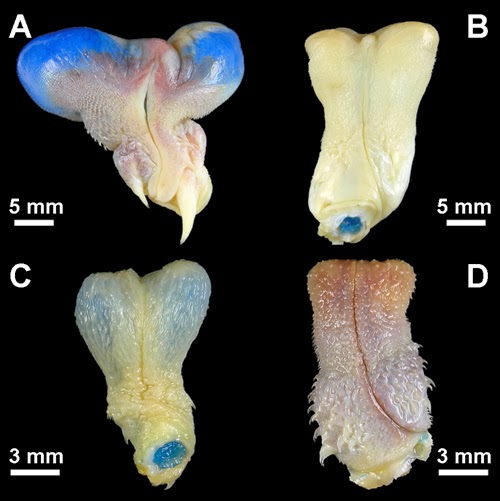
Some examples of snake hemipenes; photo by Robert Jadin
Hemipenes are one of the shared derived characters of squamates (snakes and lizards), distinguishing them from other reptiles (tuataras, turtles, crocodilians, and birds), all of which have either a single or no penis. In general, snake hemipenes are endowed with a groove, called the sulcus spermaticus, down which the sperm runs. Think of a canal rather than a pipe, although during mating the wall of the female's reproductive tract forms the other part of the tube that we mammals have. Hemipenes often have various spines, knobs, branches, and other projections, which typically correspond with the cloacal anatomy of female snakes of the same species, forming a sort of 'lock-and-key' mechanism that isolates species by discouraging mating among unrelated individuals. The amazingly variable structure of the hemipenes has often been used in snake taxonomy for this reason.

Hemipenes of:
top: Mountain Pit-viper
(Ovophis monticola)
middle: Spotted Slug-eater
(Pareas macularius)
bottom: Siamese Spitting Cobra
(Naja siamensis)
photos by Sjon Hauser
But why two? Wouldn't one penis do just as well, since male snakes only use one at a time anyway? Let's take a quick look at the timeline of snake reproduction. Boy snake meets girl snake. They spend some time together, intertwine their tails, and the male inserts one hemipenis so that his sperm find their way safely from cloaca to cloaca. But unlike in humans, female snakes have a lot of control over whether or not they get pregnant after mating. Because the best conditions for mating are not necessarily the best for ovulation and gestation, female snakes can store sperm for a long time, up to 5 years and possibly longer. They have specialized pockets in their reproductive tract where they do this. It can actually be rather difficult to distinguish between long-term sperm storage and facultative parthenogenesis (a form of asexual reproduction) without using molecular techniques to determine whether the offspring share all or just some of their genes with their mother. This is because in the former case, a female snake sometimes gets pregnant long after mating. If she has mated with multiple males, her clutch (in egg-laying species) or litter (in live-bearers) of offspring might be a mixture of offspring from multiple fathers. Amazingly, she can control which fathers' sperm she uses to fertilize her eggs, although exactly how she does this is still unclear. Because of this potential for delayed fertilization, sperm competition and cryptic female mate choice is thought to be more intense in reptiles than in species that usually follow insemination quickly with fertilization. Female snakes can mate with multiple males, and can then choose at their leisure among their sperm each time they reproduce over the next several years, so some male snakes might mate with many females but never produce offspring because their sperm are always judged to be inferior. This can also result in bizarre situations such as male snakes becoming fathers after they have died.

All this can complicate life for male snakes, because their paternity is even less certain than it is for other male vertebrates. As a result, a male snake's reproductive success is probably tied to the number of sperm he transfers to a female (although this is difficult to measure). This is probably a big part of why male snakes and lizards have two penises. Because each testis is dedicated to a single hemipenis, an alternating pattern of hemipenis use would allow a male a second chance to transfer a fresh batch of sperm if he has just mated recently. In humans and most other mammals, sperm from both testes is mixed together prior to ejaculation, so these species have just one chance to inseminate before they enter a refractory period (you know what I mean, guys). In fact, an alternating pattern is what we see when the kind of experiments every snake dreams of being a part of are conducted (in the spirit of full disclosure, most of these experiments were conducted with lizards, but the principle is similar). A male lizard mates with one female, which depletes sperm from that side of his reproductive tract, but he can then use his other hemipenis to inseminate a different female. He only alternates if the second mating opportunity comes during the refractory period, which lasts a few days. If mating opportunities are frequent and he is prevented from alternating (by placing a small piece of tape over one side of his cloaca), his sperm count is much lower on his second and third mating attempt.

Mating Western Diamondbacks, Crotalus atrox (from Clark et al. 2014)
It's advantageous for a female snake to mate with as many males as she can, so that she has a wide variety of sperm to choose from. Female adders with more mates have higher offspring survival, probably due to less inbreeding and more genetic diversity to choose from, especially in regions of the genome where diversity is important, such as the MHC, which codes for proteins involved in recognizing pathogens and initiating an immune response. Many species, including humans, select their mates at least partly on the basis of MHC dissimilarity (which they can judge by smell), and this may also be the case in snakes. However, many male and female snakes often have pretty limited time to get together, since they're only in the same place at the same time for short periods in spring and fall when they're entering and leaving hibernation sites, which might mean that they have to make rapid decisions about who to mate with. However, a recent paper by Rulon Clark and others showed that male Western Diamondback Rattlesnakes have distinct mating strategies depending on their body size. Larger males were more likely to guard their mates throughout the active season. Curiously, this behavior did not result in their fathering more offspring, possibly due to sperm the females had stored from previous years. In one of the most extreme examples of clustered mating, Common Gartersnakes in Canada emerge in huge numbers in spring and mate immediately upon emergence. Unlike in most snakes, there is conflict between males and females over how each sex best maximizes their reproductive success. There's also some evidence that male gartersnakes are "right-handed", preferring to use their right hemipenis unless they have just used it recently (it's connected to the larger right testis in this species). There are fewer studies of the mating systems of tropical snakes, which do not hibernate at all, but I suspect there is more diversity in parts of the world where it is always warm (we just don't know about it yet). One study found that larger male Slatey-grey Snakes (Stegonotus cucullatus) from tropical Australia fathered more offspring than smaller males, which is similar to the situation in many temperate snakes, but the exact evolutionary causes of this phenomenon are complex and have yet to be explained.

Hemipenes of:
top: Indo-chinese Ratsnake
(Ptyas korros)
middle: Banded Kukrisnake
(Oligodon fasciolatus)
bottom: Common Blackhead
(Sibynophis collaris)
All this raises some questions regarding the evolution of penises in vertebrates. I looked but could not find a single instance where a species of squamate had lost their hemipenes. The closest I came are snakes in the African subfamily Psammophiinae (which also includes the enigmatic scale-polishing snakes), which have small hemipenes and peculiar copulatory behavior, the causes and consequences of which are only two of the many things we don't know about psammophiines. The asymmetrical testes of male gartersnakes might be another example, but their left and right hemipenes are of equal size. Because penises don't fossilize well, we don't know very much about the anatomy of ancient snakes and lizards, but it's safe to assume that the common ancestor of all squamates had hemipenes. Although several other reptiles have lost their penises (and in some cases re-evolved some truly bizarre structures, such as the penises of ostriches, emus, ducks, alligators, turtles, and maybe even dinosaurs), there are some similarities between squamate hemipenes and the male reproductive organs of some of the most primitive mammals, the monotremes. Like snakes but unlike other mammals, echidnas have internal testes connected separately to a four-headed penis, similar to the hemipenes of snakes and lizards but joined at the base. Male echidnas only use one side (bearing two heads) at a time (video here), alternate sides just like snakes, and their sperm work cooperatively to reach the egg. The other monotremes, platypuses, have a forked penis, but only the left side is functional, because only the female's left ovary is functional. Many marsupials also have bifurcated penises, with scrotums that hang down in front of them. This suggests that a bifurcated penis might have appeared much earlier in amniote evolution than we think, although it could also be a case of convergent evolution caused by intense post-mating sexual selection on males. Detailed histological, embryological, and genetic studies would be required to answer this question, which would probably constitute the dissertation project you'd least want your family to know about. (update: I found out that Casey Gilman. a PhD student at UMass Amherst is working on this for his dissertation as we speak. You can donate to his crowd-funded project here).

ACKNOWLEDGMENTS

Thanks to Robert Jadin and Sjon Hauser for use of their photographs.

REFERENCES

Booth, W. and G. W. Schuett. 2011. Molecular genetic evidence for alternative reproductive strategies in North American pitvipers (Serpentes: Viperidae): long-term sperm storage and facultative parthenogenesis. Biological Journal of the Linnean Society 104:934–942 <link>

Clark, R. W., G. W. Schuett, R. A. Repp, M. Amarello, C. F. Smith, and H.-W. Herrmann. 2014. Mating Systems, Reproductive Success, and Sexual Selection in Secretive Species: A Case Study of the Western Diamond-Backed Rattlesnake, Crotalus atrox. PLoS ONE 9:e90616 <link>

Dubey, S., G. P. Brown, T. Madsen, and R. Shine. 2009. Sexual selection favours large body size in males of a tropical snake (Stegonotus cucullatus, Colubridae). Animal Behaviour 77:177-182 <link>

Greene, H. W. 1997. Snakes: The Evolution of Mystery in Nature. University of California Press, Berkeley <link>

S. D. Johnston, B. Smith, M. Pyne, D. Stenzel, and W. V. Holt. 2007. One‐Sided Ejaculation of Echidna Sperm Bundles. The American Naturalist 170:E162-E164 <link>

Laszlo, J. 1975. Probing as a practical method of sex recognition in snakes. International Zoo Yearbook 15:178-179.

Madsen, T., R. Shine, J. Loman, and T. Håkansson. 1992. Why do female adders copulate so frequently? Nature 355:440-441 <link>

Olsson, M. and T. Madsen. 2001. Promiscuity in Sand Lizards (Lacerta agilis) and Adder Snakes (Vipera berus): Causes and Consequences. Journal of Heredity 92:190-197 <link>

Sever, D. M. and W. C. Hamlett. 2002. Female sperm storage in reptiles. Journal of Experimental Zoology 292:187-199 <link>

Shine, R., M. M. Olsson, M. P. LeMaster, I. T. Moore, and R. T. Mason. 2000. Are snakes right-handed ? Asymmetry in hemipenis size and usage in gartersnakes (Thamnophis sirtalis). Behavioral Ecology 11:411-415 <link>

Tokarz, R. R. and J. B. Slowinski. 1990. Alternation of hemipenis use as a behavioural means of increasing sperm transfer in the lizard Anolis sagrei. Animal Behaviour 40:374-379 <link>

Tokarz, R. R. and S. J. Kirkpatrick. 1991. Copulation frequency and pattern of hemipenis use in males of the lizard Anolis sagrei in a semi-natural enclosure. Animal Behaviour 41:1039-1044 <link>

Zweifel, R. G. 1980. Aspects of the biology of a laboratory population of kingsnakes. Pages 141-152 in J. B. Murphy and J. T. Collins, editors. Reproductive biology and diseases of captive reptiles. Society for the Study of Amphibians and Reptiles, Lawrence, Kansas.

Creative Commons License

Life is Short, but Snakes are Long by Andrew M. Durso is licensed under a Creative Commons Attribution-NonCommercial-NoDerivs 3.0 Unported License.

Thursday, February 13, 2014

Snakes that Give Virgin Birth

In continuing association with the group that brought you the #SnakesAtYourService December blog carnival, this post is part of the new Reptile & Amphibian Blogging Network's first event, #HerpsAdapt. Starting on February 12th (in honor of Charles Darwin’s birthday), this event will showcase the remarkable evolutionary abilities of reptiles and amphibians.


One of several excellent new science mnemonics
from the popular webcomic xkcd
Virgin birth (a form of asexual reproduction) has fascinated humans for centuries. Recently, biologists have uncovered many of the mysteries associated with the ability of some animals to produce offspring without ever mating. This phenomenon is common in bacteria, most fungi, many plants, and some invertebrate animals, where it takes many forms. It is relatively uncommon in vertebrates, although a few species of fishes, amphibians, and reptiles reproduce using a form of asexual reproduction called parthenogenesis, which is when an embryo develops from an unfertilized egg cell. Parthenogenesis can be facultative or obligate. Species with facultative parthenogenesis can also reproduce sexually (and usually do), whereas species with obligate parthenogenesis cannot and are usually all-female. Both types of parthenogenesis are found in snakes, and several new examples have been documented in the past few years.

Brahminy Blindsnake (Ramphotyphlops braminus)
Only one species of snake is known to have obligate parthenogenesis. It is a member of the Scolecophidia, or blindsnakes, called the Brahminy Blindsnake or Flowerpot Snake (Ramphotyphlops braminus). This tiny egg-laying species is made up only of females and is extremely widespread, partially thanks to the ability of just a single individual to colonize new areas. Unlike mammals, most reptiles (and birds) have a ZW chromosomal sex determination system, so instead of the males being XY and the females XX (click here for a review), male snakes are ZZ and female snakes are ZW. However, in common with other obligate parthenogenetic species, Brahminy Blindsnakes are triploid, meaning that they have three sets of chromosomes rather than two. Examination of the karyotype (a picture of one complete set of chromosomes) of Brahminy Blindsnakes has revealed evidence of hybridization, which has also played a role in the origin of other polyploid obligate parthenogenetic vertebrates, including certain lizards, salamanders, and fishes.

Boa constrictor (Boa constrictor)
Facultative parthenogenesis has been documented in a number of species of snakes that normally reproduce sexually. Most of the time this takes place when someone has kept a female snake in captivity for a long period of time. Although it can be difficult to distinguish parthenogenesis from long-term sperm storage, which is possible in snakes over periods of up to at least 5 years, new molecular methods have allowed biologists to differentiate offspring that were produced parthenogenetically from those that were produced from sexual reproduction following prolonged sperm storage. Looking back at supposed cases of lengthy sperm storage may reveal facultative parthenogenesis in unexpected places.

In snakes, there are a wide variety of cellular mechanisms by which parthenogenesis can occur. Evidence for the exact type of facultative parthenogenesis can be gained by examining the sex and karyotype of the offspring, and appears to be correlated with the higher taxonomic group. Captive booid snakes such as rainbow boas (Epicrates maurus) and boa constrictors (Boa constrictor) have given birth to viable female offspring that have a WW sex chromosome pair, which is different from any other known chromosome combination. Why the parthenogenetically-produced offspring of these species are not a 50:50 mix of ZW and WW (the two combinations a female boa is capable of making via meiosis) is unknown.

Burmese Python (Python bivittatus)
Burmese python (Python bivittatus) females are capable of making exact ZW female clones of themselves, using a mechanism that is functionally similar to but distinct from that used by obligate parthenogenetic species like the Brahminy Blindsnake. The python offspring are all females and are mostly viable, having suffered no loss of genetic information. In both boas and pythons, the sex chromosomes are monomorphic, meaning that the Z and the W chromosome are approximately equal in size and indistinguishable from one another. It has been suggested that this method of reproduction might help species circumvent limitations on lifespan and establish new populations when individuals are isolated for long periods of time, although this claim will require more evidence to evaluate because parthenogenesis has not been observed in wild boas or pythons. However, new data from molecular ecologist Warren Booth has resulted in a reinterpretation of some of the conclusions of the original description of parthenogenesis in pythons [edit: specifically, Booth & colleagues suggested that the mode is in fact similar in boas and pythons, but that the female python who gave birth to exact clones was herself born via parthenogenesis - which is still exciting because it proves the reproductive competency of parthenogenetically-produced offspring].

Cottonmouth (Agkistrodon piscivorus)
In contrast, facultative parthenogenesis in caenophidians is fraught with difficulties. Most of the offspring produced this way are not viable because they have suffered a loss of some genetic information. Many are stillborn or have deformities or other abnormalities. All are males, and the litters are unusually small. Nevertheless, parthenogenesis has been documented in both captive and wild Cottonmouths (Agkistrodon picivorus) and Copeprheads (Agkistrodon contortrix), and in captive Eastern Diamondback (Crotalus adamanteus), Timber (C. horridus), and Aruba Island (C. unicolor) Rattlesnakes, four species of gartersnakes (Thamnophis couchii, T. elegans, T. marcianus, and T. atratus), and Arafura filesnakes (Acrochordus arafurae). Most of these species are commonly kept in captivity, and they span the gamut from the most basal caenophidians to the most derived, but the infrequent occurrence and low viability of facultative parthenogenesis in these species suggests that although all caenophidians may be capable of parthenogenesis, it is probably not very ecologically or evolutionarily significant. The reproductive potential of the few captive-born parthenogenetically-produced Copperheads that have survived is currently being assessed.

The next steps in this area of herpetology are to discover more about the different cellular and developmental mechanisms that control and influence parthenogenesis, document parthenogenesis in species and taxonomic groups where it is not so far known, and understand more about the hybrid origins of obligate parthenogenetic species. We still don't know what is required to induce parthenogenetic reproduction in either facultative or obligate species - some lizards require copulation with other females, and many salamanders require egg activation by the sperm of a male salamander of a different species. Who knows what bizarre adaptations parthenogenetic snakes await discovery?

Next month: the story of the most widespread snake in the world!

Update: In August 2014 a captive Green Anaconda joined the ranks of boid snakes known to be capable of facultative parthenogenesis, although as of November the observation was still awaiting confirmation via genetic methods. I also learned recently that parthenogenetic snakes play a starring role in a new curriculum for teaching mitosis and meiosis to introductory biology students.

ACKNOWLEDGMENTS

Thanks to xkcd, JD Willson, Todd Pierson, and Pierson Hill for their drawings and photographs.

REFERENCES

Booth, W., D. H. Johnson, S. Moore, C. Schal, and E. L. Vargo. 2011. Evidence for viable, non-clonal but fatherless Boa constrictors. Biology Letters 7:253-256 <link>

Booth, W., L. Million, R. G. Reynolds, G. M. Burghardt, E. L. Vargo, C. Schal, A. C. Tzika, and G. W. Schuett. 2011. Consecutive virgin births in the New World boid snake, the Colombian Rainbow Boa, Epicrates maurus. Journal of Heredity 102:759–763 <link>

Booth, W. and G. W. Schuett. 2011. Molecular genetic evidence for alternative reproductive strategies in North American pitvipers (Serpentes: Viperidae): long-term sperm storage and facultative parthenogenesis. Biological Journal of the Linnean Society 104:934–942 <link>

Booth, W., G. W. Schuett, A. Ridgway, D. W. Buxton, T. A. Castoe, G. Bastone, C. Bennett, and W. McMahan. 2014. New insights on facultative parthenogenesis in pythons. Biological Journal of the Linnean Society 10.1111/bij.12286 <link>

Booth, W., C. F. Smith, P. H. Eskridge, S. K. Hoss, J. R. Mendelson, and G. W. Schuett. 2012. Facultative parthenogenesis discovered in wild vertebrates. Biology Letters 8:983-985 <link>

Germano, D. J. and P. T. Smith. 2010. Molecular evidence for parthenogenesis in the Sierra garter snake, Thamnophis couchii (Colubridae). The Southwestern Naturalist 55:280-282 <link>

Groot, T., E. Bruins, and J. Breeuwer. 2003. Molecular genetic evidence for parthenogenesis in the Burmese python, Python molurus bivittatus. Heredity 90:130-135 <link>

Kearney, M., M. K. Fujita, and J. Ridenour. 2009. Lost sex in the reptiles: constraints and correlations. Pages 447-474 in I. Schön, K. Martens, and P. van Dijk, editors. Lost Sex: The Evolutionary Biology of Parthenogenesis. Springer, Dordrecht, Holland <link>

Reynolds, R. G., W. Booth, B. M. Fitzpatrick, G. W. Schuett, and G. M. Burghardt. 2012. Successive virgin births of viable male progeny in the checkered gartersnake, Thamnophis marcianus. Biological Journal of the Linnean Society 107:566–572 <link>

Schuett, G., P. Fernandez, W. Gergits, N. Casna, D. Chiszar, H. Smith, J. Mitton, S. Mackessy, R. Odum, and M. Demlong. 1997. Production of offspring in the absence of males: evidence for facultative parthenogenesis in bisexual snakes. Herpetological Natural History 5:1-10 <link>

Wright, R. 2014. Why Meiosis Matters: The case of the fatherless snake. CourceSource 1:1-6 <link>

Wynn, A. H., C. J. Cole, and A. L. Gardner. 1987. Apparent triploidy in the unisexual brahminy blind snake, Ramphotyphlops braminus. American Museum Novitates 2868:1-7 <link>

Creative Commons License

Life is Short, but Snakes are Long by Andrew M. Durso is licensed under a Creative Commons Attribution-NonCommercial-NoDerivs 3.0 Unported License.

Tuesday, January 28, 2014

The first invasive snake

Wolf Snakes (Lycodon aulicus) have become established
on Mauritius, where they threaten native skinks and geckos
Reptiles have been moving around the globe for a long time, often assisted by humans. Skinks and geckos had dispersed to the remotest Pacific islands by about 1600 BCE, at least partly thanks to the aid of the first human colonists of those regions. Brown Tree Snakes (Boiga irregularis) were brought from Australasia to Guam during World War II. In more recent decades, Burmese Pythons (Python molurus) have reached the Everglades, California Kingsnakes (Lampropeltis californiae) the Canary Islands, and Indian Wolf Snakes (Lycodon aulicus) the island of Mauritius in the Indian Ocean. In many cases, these introduced populations of snakes have become invasive, disrupting the native ecosystem in numerous ways, mostly by eating their way through populations of native prey. The indirect effects of these dramatic population declines are unpredictable and profound. For example, on Guam the loss of native forest birds as a result of snake predation led to an explosion of spider populations, with a 40-fold increase in the number of webs compared with nearby islands without invasive snakes that still harbored a native bird community. Although species have been colonizing new ecosystems for a long time, the rapid rate at which they are now being facilitated by global trade is a serious ecological concern. But how new is this problem, exactly?

Where was the first recorded population of introduced snakes? Incredibly, three species of snakes were introduced to the Balearic Islands in the western Mediterranean as far back as 2200 years ago. Having won the Second Punic War, the Roman Republic was expanding west into the Iberian peninsula, which they had taken from Carthage. As a result, transport and trade between the western and central Mediterranean were more regular than ever before, which may help explain the introduction of several species of amphibians and reptiles native to either the European or African mainland to the Balearics. The native people of the Balearics had served as mercenaries under both Rome and Carthage and were renowned for their skill with the sling, but Rome conquered their archipelago anyway shortly after the war and purposefully settled over 3,000 Spanish and Roman colonists there. It's likely that many of these people, understandably, missed their mainland homes, including the native plants and animals to which they were accustomed. They probably brought pet chameleons and tortoises with them, and surprisingly, keeping snakes as pets was also common, so they may have purposefully or accidentally introduced snakes from mainland Europe and Africa for this reason.

Ladder Snake, Rhinechis (Elaphe) scalaris
Their name reflects their dorsal pattern rather than their climbing prowess.
One species, the Ladder Snake (Rhinechis [Elaphe] scalaris), is endemic to the Iberian peninsula. It is a large, adaptable snake that eats mostly small mammals, similar to a North American ratsnake. Although it is easy to see how these snakes could have stowed away on ships, perhaps boarding to eat rats or mice that fed on grain or other goods, it has also been suggested that the Ladder Snake was introduced partly because it played a totemic purpose in mythology and religion. People encouraged non-venomous mammal-eating snakes to take up residence in and near their homes to keep populations of rats and mice under control, and having snakes around the home was thought to maintain the sexual potency of the home's male inhabitants. There is also some evidence that mammal-eating snakes were gathered up and released in areas where epidemics were rampant to help control rat or mouse vectors. This may have led to the association between the Roman god of healing, Aesculapius, whose staff is still a symbol of medicine today, and the Aesculapian Snake (Zamenis [Elaphe] longissimus), a relative of the Ladder Snake.

False Smooth Snake (Macroprotodon mauritanicus)
A smaller species, the False Smooth Snake (Macroprotodon mauritanicus [formerly cucullatus]), is native to northern Africa and southern Spain, where it preys upon small lizards. It might have been introduced to the Balearics accidentally, but no one is really sure how it got there. Apparently, False Smooth Snakes are at least partially responsible (introduced weasels, cats, and genets probably also contributed) for the extinction of an endemic species of lizard, Lilford's Wall Lizard (Podarcis lilfordi), a ground-dwelling, frugivorous species that once dispersed the seeds of a perennial shrub, Daphne rodriguezii. Since the wall lizards began to disappear from the large islands of the Balearics about 2000 years ago, the plants have suffered from a lack of seed disperal, a service formerly provided by the lizard, which would eat the fruit and crap out the seeds. On tiny offshore islets this relationship is still going strong, but on Menorca and Mallorca, where there are many snakes and no lizards, seedlings of D. rodriguezii sprout only underneath their parents, a losing strategy for a young plant.

Viperine Watersnake (Natrix maura)
Finally, the Viperine Watersnake (Natrix maura), a semi-aquatic natricine native to both southwestern Europe and northwest Africa, was introduced to both Menorca and Mallorca in ancient times. During naval battles, both the Phoenicians and the Carthaginians apparently used to throw open jars full of snakes into enemy warships to cause panic among the combatants (apparently even back then nobody could tell the difference between venomous and harmless snakes), which possibly led to or reinforced its populations on the islands. In the Balearics, these watersnakes eat endemic Mallorcan Midwife Toads (Alytes muletensis) (which they consume with impunity despite the frogs' toxins thanks to the snakes' immunity to a wide range of toxins), so a program of active eradication within the range of the frog has been enacted. The Viperine Watersnake could also have been responsible for the extinction of other endemic species of midwife toads never described but historically present.

Snakes may actually be some of the most problematic potential invasive species because they are difficult to detect and almost impossible to eradicate. Research has shown that if you're going to stop an invasive species, you had better stop it early or not at all, a tall order in the face of snakes' impressive crypsis and secretive behavior. Snakes' low energetic requirements allow them to persist through lengthy periods of resource scarcity, and their flexible metabolism allows them to quickly take advantage of resources when they are available, both adaptations to eating infrequent large meals. This scenario is ideal for an individual animal in transit or freshly introduced to a novel environment, who may need to have the ability to remain motionless without feeding or reproducing for long periods of time. Given snakes' long history with people, it's no wonder that Northern and Banded Watersnakes have become established in California, Aesculapian Snakes in Britain, Cornsnakes in the Cayman Islands, Catsnakes in Malta, Monocled Cobras and Habus in the Ryukyu Islands, and many other examples.

ACKNOWLEDGMENTS

Thanks to Rob, Javier Gállego, Aviad Bar, and Jose Zuñiga for the use of their photos.

REFERENCES

Austin, C. C. 1999. Lizards took express train to Polynesia. Nature 397:113-114 <link>

Bruna, E. M., R. N. Fisher, and T. J. Case. 1996. Morphological and genetic evolution appear decoupled in Pacific skinks (Squamata: Scincidae: Emoia). Proceedings of the Royal Society of London. Series B: Biological Sciences 263:681-688 <link>

Lazenby, F. D. 1947. Greek and Roman household pets. The Classical Journal 44:245-252 <link>

Fisher, R. N. 1997. Dispersal and evolution of the Pacific Basin gekkonid lizards Gehyra oceanica and Gehyra mutilata. Evolution 51:906-921 <link>

Pleguezuelos, J. 2002. Las especies introducidas de Anfibios y Reptiles. Pages 501-532 in J. Pleguezuelos, R. Márquez, and M. Lizana, editors. Atlas y Libro Rojo de los Anfibios y Reptiles de España. Dirección General de Conservación de la Naturaleza-Asociación Herpetológica Española, Madrid <link>

Rocha, I. R. S. 2012. Patterns of biological invasion in the herpetofauna of the Balearic Islands: Determining the origin and predicting the expansion as conservation tools. MS thesis. Universidade do Porto <link> <download>

Rogers, H., J. Hille Ris Lambers, R. Miller, and J. J. Tewksbury. 2012. ‘Natural experiment’ demonstrates top-down control of spiders by birds on a landscape level. PLoS ONE 7:e43446 <link>

Traveset, A. and N. Riera. 2005. Disruption of a plant‐lizard seed dispersal system and its ecological effects on a threatened endemic plant in the Balearic Islands. Conservation Biology 19:421-431 <link>

Creative Commons License

Life is Short, but Snakes are Long by Andrew M. Durso is licensed under a Creative Commons Attribution-NonCommercial-NoDerivs 3.0 Unported License.