If you need to identify a snake, try the Snake Identification Facebook group.
For professional, respectful, and non-lethal snake removal and consultation services in your town, try Wildlife Removal USA.
Showing posts with label Xenotyphlops. Show all posts

Sunday, April 30, 2017

The 21st century blindsnake revolution


Brongersma's Wormsnake (Amerotyphlops brongersmianus),
a widespread species from South America
Blindsnakes (Scolecophidia) don't get enough attention. They include the world's most widespread snake species, the world's smallest living snake species, and a diversity of jaw-raking feeding mechanisms unrivaled in bizarreness among land vertebrates. I recently noticed, much to my surprise, the the number of described species of blindsnakes has doubled in the last 13 years, from 305 in 2004 to 599 today; that's 16.5% of all snakes! June 2017 EDIT: This was a big mistake on my part. As of 2017 there are 442 species described instead of 599. I made this mistake because I was confused about the search terms being used on my go-to reference for reptile taxonomy, The Reptile Database. I was assuming that Leptotyphlopidae + Anomalepidae + Typhlopoidea = Scolecophidia, a search term that is no longer available in The Reptile Database, because of several phylogenies that show it to be paraphyletic. If you search for "Typhlopoidea" on The Reptile Database, you get a list of all 442 blindsnakes 442, including Leptotyphlopidae and Anomalepididae, and not only the three families of Typhlopoidea according to Vidal et al. 2010 (Typhlopidae, Xenotyphlopidae, Gerrhopilidae). I thought that Typhlopoidea only returned the latter three families and I added the 139 species of Leptotyphlopidae and 18 species of Anomalepididae to get an incorrect total of 599. Thanks to Claudia Koch of the Alexander Koenig Zoological Research Museum in Bonn for pointing this out to me. There are certainly many undiscovered species of blindsnakes, so it's likely that their numbers will continue to grow (as one recent study put it, "...even our most liberal estimates of species numbers will likely prove to be an underestimate of the true diversity...of secretive blind snakes").

Blindsnake evolutionary tree.
Extinction of the dinosaurs (K-T boundary) was
between the green and pink-shaded areas.
From Vidal et al. 2010
One of the biggest phylogenetic rearrangements within the Scolecophidia was the recognition of two new families in 2010. The new families Gerrhopilidae and Xenotyphlopidae were formerly part of Typhlopidae, but were discovered to be distantly related to other typhlopids and were separated, although these three families are grouped together in the superfamily Typhlopoidea to emphasize their closer relationship to one another than to the other two families of scolecophidians (Leptotyphlopidae and Anomalepididae). The original diversification of blindsnakes is thought to have been caused by the breakup of Gondwana, whereas the later diversification of Typhlopoidea is associated with the breakup of East Gondwana into Antarctica, Madagascar, India, and Australia (with subsequent colonization by typhlopids from West Gondwana [Africa/South America]). Subsequent diversification within the Typhlopidae coincides with the early Paleozoic Era, just after the extinction of the dinosaurs, and includes four major groups: a Eurasian-Australasian one, an African one, a Malagasy one, and a South American-West Indian one. Because sea levels were low at this time, dispersal among continents and islands was relatively easy, at least for a small vertebrate with low metabolism and most likely travelling along with their invertebrate prey. The relationships of blindsnakes track plate tectonics better than those of any other vertebrate group, perhaps because of their tendency to stay put.

Gerrhopilus mirus from Sri Lanka
The two "new" families probably originated on the ancient landmass "Indigascar" (modern India and Madagascar, which were physically connected long after their isolation from other continents and India's subsequent unification with Asia). One family, Gerrhopilidae ("Indo-Malayan blindsnakes"), were formerly known as the Typhlops ater species group. They differ from other blindsnakes in having gland-like structures ‘peppered’ over the head scales. Many species also have a divided preocular and/or ocular scale, and the second supralabialal scale overlaps the preocular in all species but one (G. tindalli). The family contains at least 16 species in the genus Gerrhopilus, and possibly others (the most-recently described species are from 1996 and 2005). This is where it starts to get really weird.
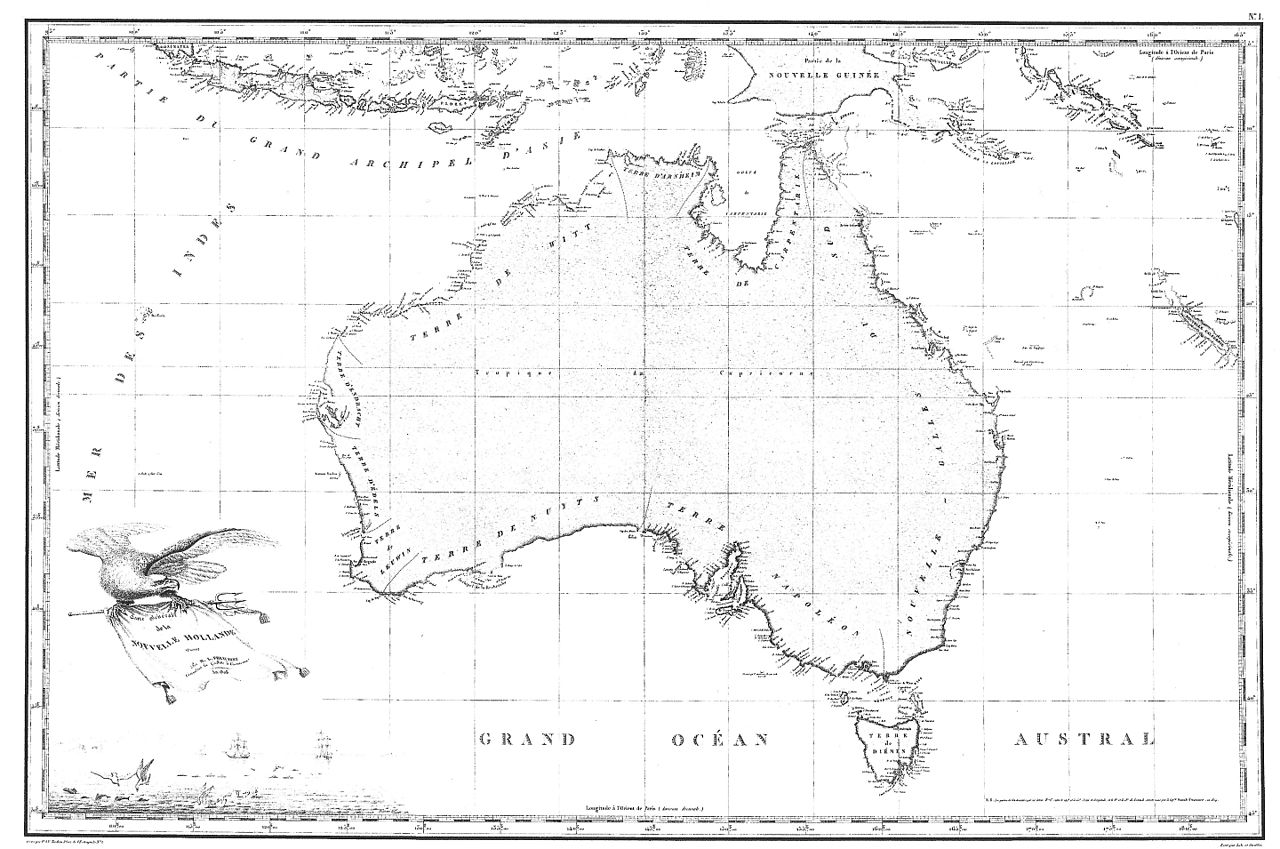
The 1811 Freycinet map of Australia, where
Cathetorhinus melanocephalus was not found
There is another candidate member of the family Gerrhopilidae. The genus Cathetorhinus contains a single species, known from only a single specimen (Natural History Museum, Paris RA-0.138, an adult male). It was collected by French zoologists François Péron and Charles-Alexandre Lesueur on a scientific expedition to Australia led by Nicolas Baudin between 1801 and 1803, and scientifically described (along with an unprecedented and unqeualed number of other new snake species) in the 1844 volume of Duméril & Bibron's opus Erpetologie Générale (the series is also the provenance of the mudsnake plate that I use as a logo for this blog). Cathetorhinus melanocephalus was the only blindsnake they collected, despite visiting the Canary Islands, Mauritius, Timor, and South Africa in addition to Australia (of which members of the expedition later produced the first complete map). Unfortunately, for reasons lost to history and despite their general habits as conscientious collectors1, the location where they found Cathetorhinus melanocephalus was not recorded (I'm speculating here, but it may have been because they were distracted by fearing for their lives—of a total of 24 scientists who went on the expedition, 5 died and 10 disembarked at Mauritius due to illness).

Cathetorhinus melanocephalus
From Wallach & Pauwels 2008
This wouldn't be such a problem (lots of type specimens have vague or missing type localities; Linnaeus correctly attributed fewer than half of his snakes to the right continent "Indiis") except that no other specimens have ever been found. It is taxonomically unique based on its morphology, descriptions of which have been rather inconsistent over the decades, partially because blindsnakes are really small and their scales are really hard to count, especially given the crummy optics of the 19th century. Except for the head glands, Cathetorhinus shares more anatomical characteristics with Gerrhopilus than with any other blindsnakes. A 2008 study reviewed the history of the Baudin expedition and concluded that “the provenance of this species remains unknown: it is certainly Old World, and may be from (in order of probability) Timor, Australia, Mauritius or Tenerife”. And so it would have remained, if not for some really excellent bibliographical sleuthing by biologist and scholar Anthony Cheke, an expert on Mascarene fauna. Cheke reviewed the unpublished original notes made by Lesueur on the voyage, and found a reference to "a very small [snake] species 4–5 inches maximum...the only one found during our stay [on Mauritius in 1803]...found amongst stones while clearing some land...about 8 inches be-low the soil surface". This tantalizing description suggests a blindsnake in size, habitat, and behavior, and although Cheke himself had assumed that it referred to the Brahminy Blindsnake (Indotyphlops braminus), he later realized that the first records of introduction of this widespread species were from 1869, 66 years later.2 Although this isn't concrete proof, it's highly suggestive that Lesueur's blindsnake was Cathetorhinus melanocephalus, since it was the only blindsnake collected on the entire journey.3 Fossils of an endemic Mauritian typhlopid were discovered around 1900 and described as Typhlops cariei, but direct comparison of the bones with those of Cathetorhinus has not been made. Could Cathetorhinus still survive in the wild? Many non-native blindsnake predators were already introduced to Mauritius when Lesueur and Péron visited, including rats, shrews, and tenrecs, and others have since become established, such as mongeese. Only time, and further field work on Mauritius, will tell.

Malayotyphlops luzonensis (L), M. denrorum (C), and M. andyi (R)
From Wynn et al. 2016
As if that wasn't strange enough, there is a third possible candidate member of Gerrhopilidae: the species known as either Typhlops manilae, Malayotyphlops manilae, or Gerrhopilus manilae. The taxonomic status of this species is currently unclear. It was described by American herpetologist and spy Edward H. Taylor in 1919, from a specimen that was "discovered in the Santo Tomas Museum" in Manila, although even then nobody knew when, where, or by whom it was collected. It appears to have been barely mentioned in the scientific literature until 2014, when its morphological distinctiveness from other members of the Typhlops ater species group/Gerrhopilidae was noted as part of a massive review of typhlopid snakes led by Pennsylvania State University blindsnake specialist and evolutionary biologist Blair Hedges. They suggested it belonged instead to another new genus, Malayotyphlops, also mostly from the Philippines, because it has 28 scale rows (vs. 18 in Gerrhopilus) and a short tail, and because a subocular scale is not unique to Gerrhopilus. Later the same year, a different study disagreed and moved the species back to Gerrhopilus based on the statement from the original description that it has a subocular. However, yet a third study took a close look at Taylor's original description, which contains no illustration, and noted several areas of potential confusion, concluding that without examination of the original specimen, which is still in Manila, "it is not possible to determine to which genus, or even family, T. manilae...belongs".

The three reptile species originally described by Mocquard
and re-discovered at Baie de Sakalava in northern Madagascar
after more than 100 years without records.
The blindsnake Xenotyphlops grandidieri (pink), and two
legless skink species: Paracontias minimus (brown with
longitudinal lines of dark spots) and P. rothschildi
(beige with black flanks). From Wegener et al. 2013
Before you get too discouraged, remember that snake biology is replete with tales of rediscovery. Case in point: the other "new" family, Xenotyphlopidae. This bizarre snake has completely lost any traces of visible eyes. It was known solely from the type specimens, described by French zoologist François Mocquard in 1905 and 1906, for more than 100 years. Their precise locality was unknown. However, Hanna Wegener and a term of German, Belgian, and American herpetologists rediscovered Xenotyphlops in 2013 on a coastal dune under a piece of wood in the sand in a littoral forest at Baie de Sakalava in northern Madagascar, along with two endemic legless skinks in the genus Paracontias also described by Mocquard. Because the new specimens of X. grandidieri overlapped the other species in this genus (X. mocquardi) in most morphological characteristics, the two have now been synonymized, making the family Xenotyphlopidae monotypic (for now). These blindsnakes are unique in having a greatly enlarged and nearly circular rostral scale and an enlarged anal shield, and in lacking a tracheal lung.

The number of less-phylogenetically-distinct but poorly-known blindsnakes is not small. These have received renewed attention due to their placement in new families, but the 21st century blindsnake revolution is just getting started.


1 Péron and Lesueur also collected the first and some of the only specimens of Bolyeria multicarinata from Mauritius, which is now thought to be extinct, although they mistakenly labeled it as being from Australia.


2 Today, only I. braminus and another introduced species, I. porrectus, are found on Mauritius; the latter may have also been introduced in the 1800s but was first conclusively documented only in 1993.


3 A few pieces of evidence against: a length of 4–5 French inches corresponds to 109–136 mm, which is just right for I. braminus but a tad small for the Cathetorhinus specimen, which measures 178 mm (6.6 French inches). Cheke thought that "Lesueur appeared to be writing from memory without the specimen actually before him, so, impressed by its small size, he may have exaggerated how tiny his snake actually was.", maybe the last time in history that somebody underestimated the size of a snake. The other point of confusion is over the exact locality: Lesueur and Péron were clearing land with an upland planter, Toussaint de Chazal, at whose estate in the area now known as Mondrain they were staying. Mondrain is on a plateau adjacent to the Tamarin Gorge, which is 9 km from Grand Bassin, where Lesueur stated that they found the snake.


ACKNOWLEDGMENTS

Thanks to Tim ColstonRuchira Somaweera and Sumaithangi Ganesh for the use of their photos.

REFERENCES

Cheke, A. 2010. Is the enigmatic blind snake Cathetorhinus melanocephalus (Serpentes: Typhlopidae) an extinct endemic species from Mauritius? Hamadryad 35:101-104 <full-text>

Duméril, C., G. Bibron, and A. Duméril. 1854. Erpetologie Générale on Histoire Naturelle Compléte des Reptiles. Librairie Encyclopédique de Roret, Paris <link to Cathetorhinus description>

Hedges, S., A. Marion, K. Lipp, J. Marin, and N. Vidal. 2014. A taxonomic framework for typhlopid snakes from the Caribbean and other regions (Reptilia, Squamata). Caribbean Herpetology 49:1-61 <full-text>

Kraus, F. 2005. New species of blindsnake from Rossel Island, Papua New Guinea. Journal of Herpetology 39:591-595 <abstract>

Pyron, R. and V. Wallach. 2014. Systematics of the blindsnakes (Serpentes: Scolecophidia: Typhlopoidea) based on molecular and morphological evidence. Zootaxa 3829:1-81 <full-text>

Taylor, E. H. 1919. New or rare Philippine reptiles. Philippine Journal of Science 14:105-125 <full-text>

Vidal, N., J. Marin, M. Morini, S. Donnellan, W. R. Branch, R. Thomas, M. Vences, A. Wynn, C. Cruaud, and S. B. Hedges. 2010. Blindsnake evolutionary tree reveals long history on Gondwana. Biology Letters 6:558-561 <full-text>

Wallach, V. 1996. Two new Blind snakes of the Typhlops ater species group from Papua new Guinea (Serpentes: Typhlopidae). Russian Journal of Herpetology 3:107-118 <full-text>

Wallach, V. and O. Pauwels. 2008. The systematic status of Cathetorhinus melanocephalus Duméril & Bibron, 1844 (Serpentes: Typhlopidae). Hamadryad 33:39-47 <full-text>

Wegener, J. E., S. Swoboda, O. Hawlitschek, M. Franzen, V. Wallach, M. Vences, Z. T. Nagy, S. B. Hedges, J. Köhler, and F. Glaw. 2013. Morphological variation and taxonomic reassessment of the endemic Malagasy blind snake family Xenotyphlopidae. Spixiana 36:269-282 <full-text>

Wynn, A. H., R. P. Reynolds, D. W. Buden, M. Falanruw, and B. Lynch. 2012. The unexpected discovery of blind snakes (Serpentes: Typhlopidae) in Micronesia: two new species of Ramphotyphlops from the Caroline Islands. Zootaxa 3172:39–54 <full-text>

Wynn, A. H., A. C. Diesmos, and R. M. Brown. 2016. Two new species of Malayotyphlops from the northern Philippines, with redescriptions of Malayotyphlops luzonensis (Taylor) and Malayotyphlops ruber (Boettger). Journal of Herpetology 50:157-168 <full-text>

Creative Commons License

Life is Short, but Snakes are Long by Andrew M. Durso is licensed under a Creative Commons Attribution-NonCommercial-NoDerivs 3.0 Unported License.


Tuesday, May 27, 2014

Snakes long-lost


Clarión Nightsnake (Hypsiglena unaocularis)
Photograph from Mulcahy et al. 2014
Just over one year ago, a team of scientists from the Smithsonian and the Red de Interacciones Multitróficas rediscovered a species of nightsnake (genus Hypsiglena) on remote Clarión Island in the eastern Pacific Ocean, over 400 miles southwest of Cabo San Lucas. Called the Clarión Nightsnake (Hypsiglena unaocularus), it was originally discovered by the renowned American naturalist William Beebe in 1936, during a nocturnal sea turtle nesting survey. Because Clarión Island is only accessible via military escort, biologists have not visited the island frequently since Beebe's time, and in 1955 herpetologist Bayard Brattstrom suggested that perhaps Beebe's locality information had been an error, since only a single specimen existed and several other Clarión Island expeditions had not turned up another. However, the type specimen collected by Beebe, resting in the herpetology collection of New York's American Museum of Natural History, was sufficiently distinct from any other Hypsiglena specimen that it prompted herp phylogeographer Dan Mulcahy to reexamine Beebe's book and field notes, which contained a pretty clear description of the circumstances under which Beebe found the snake:

“We walked on, flashing the light all around. Not far from the water on the black lava 
I saw a small dark brown snake. It seemed to be unlike the one I had found in daylight, 
having lines of black spots on the body, so I picked it up and cached it in my shirt.” 
(p. 282 of Zaca Venture)

Location of Clarión Is.
From Mulcahy et al. 2014
Click to enlarge
As their name implies, Nightsnakes mostly come out at night (although I found one in southern Utah at about 9:30 in the morning a few weeks ago), and even then they are normally only active under certain conditions - in particular, they prefer to be active when there is not much moonlight, such as on cloudy nights or when the moon is new. Even if one is specifically searching for Nightsnakes, they can be difficult to find. Combined with their generally secretive nature, this could explain the failure of several Clarión Island expeditions to find the Clarión Nightsnake - until Mulcahy's expedition in May of 2013, which found 11 individuals in 15 days. Using phylogenetics, they determined that the Clarión Nightsnake is most closely related to the Santa Catalina Nightsnake (H. catalinae), which is found on Santa Catalina Island in the Gulf of California (which is not the same as the well-known Santa Catalina Island off of the US state of California). Nightsnakes are found all around the shoreline of the Gulf of California, and they are obviously exceptional over-water dispersers, because they occur on many of the islands in that region as well.

This remarkable story of rediscovery is a testament to the kind of attention to detail that it takes to be a good natural historian, but it's not the only species of snake that has been rediscovered many years after its initial description. Here are a few others:

Angel’s Stream Snake (Paratapinophis praemaxillaris)
Photograph from Murphy et al. 2008
Angel’s Stream Snake (Paratapinophis praemaxillaris) was described from two newborn specimens from northern Laos in 1929. At that time it was placed into a new genus because of an unusual process on its nose, but a few years later it was moved into the cosmopolitan genus Opisthotropis. Two more specimens were collected in the 1980s, but it wasn't until 2008, when five adult specimens were collected from a pool at the base of a waterfall on the Nan River in northern Thailand, that it became clear that the nose structure was actually an egg tooth, a structure normally lost a few days after hatching. At that time, Paratapinophis was placed back into its own genus because of several other formerly-overlooked unique features, including sexually dimorphic color, pattern, and scale ornamentation. Like most other natricines, this species eats fishes.

Chersodromus rubriventris
Photograph from Ramírez-Bautista et al. 2013
Chersodromus rubriventris, the Redbelly Earth Runner, was discovered in a cloud forest in San Luis Potosí, Mexico, just after the end of World War II and described a few years later by American herpetologist and spy Edward H. Taylor, who also used his biology as a cover for work in the Philippines, Russia, and Sri Lanka during both world wars. Two other specimens, one from the late 1960s and the other from the early 1980s, were known, but in 2013, a team of herpetologists from the Universidad Autónoma del Estado de Hidalgo found three individuals in a cloud forest in nearby Hidalgo, doubling the number of specimens and photographing the snake alive for the first time. Stomach contents included beetle larvae and ants, both of which are unusual prey for a dipsadid snake.

Atractus wagleri
Photograph from Passos & Arredondo 2009
The genus Atractus, a group of burrowing snakes found from Panama to Argentina, is the most diverse alethinophidian snake genus, with over 130 species, most of which are only known from a few specimens. Recently Paulo Passos of the Brazilian National Museum matched up several previously mis- or unidentified Atractus specimens in South American museums with their species, constituting rediscoveries of sorts. For example, Wagler's Ground Snake (Atractus wagleri) was described in 1945 from a single specimen from western Colombia, and that specimen was lost in a fire in 1948. In 2009 Passos located three additional specimens of this poorly known snake in museums in Colombia. Another species, the Modest Ground Snake (Atractus modestus), was described in 1894 by the great Belgian zoologist George Boulenger, from a single specimen from western Ecuador. In 2007 Passos located more specimens in Ecuadorian museums, expanding the range of the species across most of the country. Although species of Atractus are seemingly quite rare, occurring at high elevations and having secretive fossorial habitats, a large number of Atractus specimens remain misidentified or unidentified in herpetological collections, so our knowledge of these snakes stands to improve dramatically as these are examined and described.

Argus Snail Sucker (Sibon argus)
The Lichen-coloured or Argus Snail Sucker (Sibon argus) is an extremely slender arboreal dipsadine snake with eye-like ("ocellate") spots. It was originally described from a single specimen from southeastern Costa Rica in 1876, by renowned paleontologist Edward Drinker Cope (who feuded with O.C. Marsh in the "Bone Wars" over who could discover more dinosaurs, the subject of an upcoming film starring Steve Carrell as Cope). The validity of the species was uncertain because of the subsequent description of other gracile snakes with ocellated patterns from the same region. In his classic revision of Neotropical snail- and slug-eating snakes, James Peters suggested that Cope's specimen might be aberrant, or perhaps that it represented one half of a species with strong sexual dimorphism (which is rare in snakes), because the only known S. argus specimen  was a male, and another species, Sibon longifrenis, was known at the time from just two specimens, both females. Males and females of the same species had been described as separate species before. Ultimately, Peters decided that the two species were probably different, and he was proven right in 1992, when tropical herpetologist Jay Savage was preparing his opus on Costa Rican herpetofauna. Savage discovered both male and female specimens that best matched Cope's 1876 S. argus in the collections of the University of Kansas and the Universidad de Costa Rica. The snakes had been collected in evergreen forests in Panama and Costa Rica, near the type locality of S. argus. With Roy McDiarmid, Savage redescribed the species, which has become much more well-known since. A recent study by Julie Ray and colleagues documented a more diverse diet for this species than previously expected, including other gooey prey such as oligochaete worms and frog eggs. Unfortunately for Sibon argus, both of these prey types are in decline in the neotropics, the worms due to overcollection of their bromeliad homes for horticulture, and the amphibians due to the devastating effects of the amphibian chytrid fungus Batrachochytrium dendrobatidis.

Brygophis coulangesi
Photograph from Andreone & Raxworthy 1998
Other examples of rediscovered snakes abound. The Uluguru Worm Snake (Letheobia uluguruensis) was described from four specimens collected in 1926 from the Uluguru Mountains of eastern Tanzania, a mountain range with dozens of endemic species, and was not seen again until 2004, when four were dug up by local people employed by a group of herpetologists from the London Natural History Museum and the University of Glasgow to search for caecilians. Another blindsnake, Typhlops tasymicris, was rediscovered on Union Island, St. Vincent and the Grenadines, in 2010. An entire genus of blindsnake, Xenotyphlops, was rediscovered in Madagascar, in 2007, 102 years after it's description. A rare sea snake, Hydrophis parviceps, was originally collected by the Danish research vessel Dana and described in 1935 and was seen again only once in 1960 until three turned up in fisheries bycatch off of Vietnam in 2001. Another species of rare sea snake, H. bituberculatus, was rediscovered off Sri Lanka in the late 1980s, over 100 years after the first one was collected (although the fishermen who collected the specimen were so secretive that they refused to divulge the location). One of the rarest snakes in Madagascar, a slow-moving reddish-orange species called Brygophis coulangesi, was first collected in 1968, when one fell from a tree and vomited up a chameleon, with a second specimen found on a cloudy, rainy night during a rain forest survey in 1998, over 300 miles to the north of the first. A second specimen of another Malagasy lamprophiidAlluaudina mocquardi, was discovered in a pitch-black cave in northern Madagascar in 1982, 50 years after the first was found in a different cave nearby. I don't think any more have been found since, so this one should be getting ready to be rediscovered again soon (edit: City University of New York snake biologist Frank Burbrink informed me that on his recent trip to Madagascar they turned up an Alluaudina mocquardi in tsingy rock at Ankarana - see photo here)!

March 2010 Herp. Review cover
featuring Crotalus lannomi
A high-profile rediscovery graced the cover of the March 2010 issue of the journal Herpetological Review, which featured a photograph of a long-sought-after species of rattlesnake, the Autlán Long-tailed Rattlesnake (Crotalus lannomi). Discovered in the summer of 1966 by Joseph Lannom, C. lannomi became sort of a “holy grail” of rattlesnakes in the decades that followed, as numerous herpetologists ventured into the mountains of western Jalisco in search of it. They were stymied by heavy fog and dangerous flooding, roads with treacherous curves and highway robberies, and drug-related violence. In 2008, five specimens of C. lannomi were found in the foothills of Colima, roughly 50 km from the type locality in Jalisco, in some of Mexico's most pristine forest habitat.

Although most of this was new to me, I've actually written about a different rediscovered viper before, the Spider-tailed Adder (Pseoducerastes urarachnoides) of Iran, which was discovered in 1968 and was at first thought to have either a tumor, a congenital defect, or a growth caused by a parasite, or maybe a spider clinging to its tail (turns out its tail is modified into a lure to attract spider-eating birds). Also, in one of my first articles, I wrote about the South Florida Rainbow Snake (Farancia erytrogramma seminola), described by Wilfred T. Neill in 1964 from Fisheating Creek in Glades County near Lake Okeechobee, Florida, and presumed extinct, never seen again since. To the best of my knowledge this subspecies has yet to be rediscovered, despite a $500 reward from the Center for Snake Conservation and Center for Biological Diversity. (Edit: a diligent reader reminded me that I also wrote about another snake that hasn't been seen since 1975 in one of my earliest articles, the Round Island Burrowing Boa, Bolyeria multocarinata).

Undoubtedly there are numerous snake species left to be discovered and rediscovered, and in many cases almost nobody's out there looking. The Reptile Database has predicted that the total number of described reptile species will surpass 10,000 in 2014, and that non-avian reptiles will perhaps eclipse birds in diversity soon after that. With snakes currently at 3,466, representing just over one third of reptiles, maybe you will be the next to rediscover a snake thought lost!

ACKNOWLEDGMENTS

Thanks to Dan Mulcahy and Don Filipiak for the use of their photographs.

REFERENCES

Andreone, F. and C. Raxworthy. 1998. The colubrid snake Brygophis coulangesi (Domergue 1988) rediscovered in north-eastern Madagascar. Tropical Zoology 11:249-257 <link>

Beebe, CW. 1938. Zaca Venture. Harcourt, Brace and Co. Inc., New York <link>


Cope, E. D. 1875. On the batrachia and reptilia of Costa Rica : With notes on the herpetology and ichthyology of Nicaragua and Peru. Journal of the Academy of Natural Sciences Philadelphia 2:93-157 <link>


Gower, D. J., S. P. Loader, and M. Wilkinson. 2004. Assessing the conservation status of soil‐dwelling vertebrates: Insights from the rediscovery of Typhlops uluguruensis (Reptilia: Serpentes: Typhlopidae). Systematics and Biodiversity 2:79-82 <link>


Lanza, B. 1990. Rediscovery of the Malagasy colubrid snake Alluaudina mocquardi Angel 1939. Tropical Zoology 3:219-223 <link>


Mulcahy, D. G., J. E. Martínez-Gómez, G. Aguirre-León, J. A. Cervantes-Pasqualli, and G. R. Zug. 2014. Rediscovery of an endemic vertebrate from the remote Islas Revillagigedo in the eastern Pacific Ocean: The Clarión Nightsnake lost and found. PLoS ONE 9:e97682 <link>


Mulcahy, D. G. and J. R. Macey. 2009. Vicariance and dispersal form a ring distribution in nightsnakes around the Gulf of California. Molecular Phylogenetics and Evolution 53:537-546 <link>


Murphy, J. C., T. Chan-Ard, S. Mekchai, M. Cota, and H. K. Voris. 2008. The rediscovery of Angel’s Stream Snake, Paratapinophis praemaxillaris Angel, 1929 (Reptilia: Serpentes: Natricidae). The Natural History Journal of Chulalongkorn University 8:169-183 <link>


Passos, P. and J. C. Arredondo. 2009. Rediscovery and redescription of the Andean earth-snake Atractus wagleri (Reptilia: Serpentes: Colubridae). Zootaxa 1969:59-68 <link>


Passos, P., D. F. Cisneros-Heredia, and D. Salazar-V. 2007. Rediscovery and redescription of the rare Andean snake Atractus modestus. The Herpetological Journal 17:1-6 <link>


Peters, J. A. 1960. The snakes of the subfamily Dipsadinae. Miscellaneous Publications of the Museum of Zoology, University of Michigan 114:1-228 <link>


Ramírez-Bautista, A., C. Berriozabal-Islas, R. Cruz-Elizalde, U. Hernández-Salinas, and L. Badillo-Saldaña. 2013. Rediscovery of the snake Chersodromus rubriventris (Squamata: Colubridae) in cloud forest of the Sierra Madre Oriental, México. Western North American Naturalist 73:392-398 <link>


Rasmussen, A. R. 1992. Rediscovery and redescription of Hydrophis bituberculatus Peters, 1872 (Serpentes: Hydrophidae). Herpetologica 48:85-97 <link>


Rasmussen, A. R., J. Elmberg, K. L. Sanders, and P. Gravlund. 2012. Rediscovery of the rare sea snake Hydrophis parviceps Smith 1935: identification and conservation status. Copeia 2012:276-282 <link>


Ray, J. M., C. E. Montgomery, H. K. Mahon, A. H. Savitzky, and K. R. Lips. 2012. Goo-eaters: Diets of the Neotropical snakes Dipsas and Sibon in central Panama. Copeia 2:197-202 <link>


Reyes-Velasco, J., C. I. Grünwald, J. M. Jones, and G. N. Weatherman. 2010. Rediscovery of the rare Autlán Long-tailed Rattlesnake, Crotalus lannomi. Herpetological Review 41:19-25 <link>


Rodríguez, M. J. R., E. J. Bentz, D. P. Scantlebury, R. R. John, D. P. Quinn, J. S. Parmerlee Jr, R. W. Henderson, and R. Powell. 2011. Rediscovery of the Grenada Bank endemic Typhlops tasymicris (Squamata: Typhlopidae). Journal of Herpetology 45:167-168 <link>


Savage, J. M. and R. W. McDiarmid. 1992. Rediscovery of the Central American colubrid snake, Sibon argus, with comments on related species from the region. Copeia 1992:421-432 <link>


Taylor, E. H. 1949. A preliminary account of the herpetology of the state of San Luis Potosí, Mexico. University of Kansas Science Bulletin 33:169-215 <link>


Wallach, V., V. Mercurio, and F. Andreone. 2007. Rediscovery of the enigmatic blind snake genus Xenotyphlops in northern Madagascar, with description of a new species (Serpentes: Typhlopidae). Zootaxa 1402:59-68 <link>


Weaver, R. E. 2010. Activity Patterns of the Desert Nightsnake (Hypsiglena chlorophaea). The Southwestern Naturalist 55:172-178 <link>


Creative Commons License

Life is Short, but Snakes are Long by Andrew M. Durso is licensed under a Creative Commons Attribution-NonCommercial-NoDerivs 3.0 Unported License.