If you need to identify a snake, try the Snake Identification Facebook group.
For professional, respectful, and non-lethal snake removal and consultation services in your town, try Wildlife Removal USA.
Showing posts with label Antaresia. Show all posts

Wednesday, August 17, 2016

Why snakes are long (and other recent updates)

This post will soon be available in Spanish 

A Western Hog-nosed Snake (Heterodon nasicus)
depredating a turtle nest in Nebraska
As I did in March and June, I wanted to highlight some recent and exciting updates to some of my earlier articles. There is so much recent snake news this month, which is lucky for me because I've been writing my dissertation, which I'll be defending next month, so I haven't had much time to write. anything else! I hope to return to longer-form content in October.

Also, although I rarely promote my own research on this blog, I'm very excited to have just published the second chapter of my masters thesis, documenting the diet of Western Hog-nosed Snakes (Heterodon nasicus) in Illinois using stable isotopes to quadruple our sample size. We showed that the diet of juveniles was composed mostly of Six-lined Racerunners (Aspidoscelis sexlineata) and their eggs, whereas adults mostly feed on aquatic turtle eggs! Surprisingly, we found very little evidence that these snakes were eating amphibians, which are considered to be staples of their diet elsewhere.

Snake Genomes, Lizards of Glass, and Why Snakes are Long

Variation in the length of different vertebrate bodies,
including a Rosy Boa (Lichanura)
From Head & Polly 2015
Researchers from the Gulbenkian Institute of Science in Portugal used data from the king cobra and Burmese python genomes as part of new research that's too meta for me not to write about. The developmental biology of snakes deserves a whole article (and, indeed, is the subject of an entire book chapter), but snake development is uniquely interesting from the perspective of understanding the evolution of both limblessness and body elongation. A very recent article in the journal Developmental Cell shed light on the genetic regulation of body length in vertebrates, which varies from a dozen or fewer in humans and most vertebrates to over 200 in many snakes and caecilians and exceeds 400 in some snake species.

For a long time, scientists thought that Hox genes, which control many aspects of body layout and development, probably controlled body length too. But, so far experiments modifying Hox genes have failed to produce differences in body length, and most snake Hox genes are not substantially different from those of other vertebrates. Instead, the new study showed that the "junk DNA" surrounding a different gene, called Oct4, apparently influences body length in developing vertebrate embryos. Although the Oct4 gene itself was already known to play a role in regulating stem cell flexibility, the surrounding DNA was formerly considered to be "junk DNA" because it was not translated into RNA and seemed to have no purpose. Measurements showed that Oct4 is active for longer in developing snake embryos than in mouse embryos, which is probably what causes their bodies to grow so long. And, just by copying snake "junk DNA" into mouse embryos, the researchers were able to artificially increase both the level of expression of Oct4 in mouse embryos as well as the length of their bodies. Comparing the genomes of snakes, lizards, and mammals showed that the Oct4 "junk DNA" of snakes differed from that of lizards and mammals. Interestingly, glass lizard (Ophisaurus) Oct4 "junk DNA" was similar to that of geckos and anoles, even though these limbless lizards share an elongated snake-like body form with snakes.

Conservation Successes with Indigo Snakes

Seasonal variation in the probability of moving of female (top)
& male (bottom) Eastern Indigo Snakes (Drymarchon couperi)
in Florida. From Bauder et al. 2016
Many snakes make seasonal movements to and from hibernacula, in search of food or mates, or for other reasons. Often, we think of these movements as driven by the changing of seasons, either the wet and dry seasons in the tropics or the four well-defined temperate seasons. But, we don't know much about the seasonal movements of snakes that live in tropical and sub-tropical zones. For a species with such a small range, Eastern Indigo Snakes have fairly different requirements in the northern part of their range, where frosty Georgia winter nights force them to rely on deep, warm Gopher Tortoise (Gopherus polyphemus) burrows, and in sub-tropical peninsular Florida, where they are less reliant on such particular shelters. A recent study by a group of Florida scientists, including Orianne Society staff, used radio-telemetry to document a seasonal pattern of movement in Florida Indigo Snakes that differs from their pattern in Georgia. In particular, male Florida Indigos are most likely to move in the late fall and early winter, when they are searching for mates, whereas both males and females stay put during the spring, for reasons yet unknown. In contrast, Indigos in the rest of their range maintain small winter home ranges on xeric sandhills but use much larger home ranges and a greater diversity of habitats during the rest of the year.

Malagasy Leaf-nosed Snakes

A female Langaha pseudoalluaudi
Photo from iNaturalist
Global all-taxa citizen science portal iNaturalist's observation of the week this week was a very rare snake indeed, a photograph of Langaha pseudoalluaudi. Less than two dozen other individuals of this species have ever been found by scientists. The first was collected in 1966 and described in 1988, and the second individual was photographed in 2003 by a Durrell Wildlife Conservation Trust biologist. Since that time, a handful of other records have trickled in from the field in Madagascar, including a few photos on Flickr and the only known photo of a male, published in a field guide in 2007. This individual was found by group of Operation Wallacea volunteers on a conservation research expedition, one of whom, Victoria Jackson, a student of Biological Sciences at the University of Exeter, posted it on iNaturalist. Of the three species of Langaha, none of which are particularly well-known, L. pseudoalluaudi is by far the rarest and most poorly-known. Perhaps the most fascinating aspect of Langaha biology is their obvious anatomical sexual dimorphism, a feature that is very rare among snakes. Females of all three Langaha species have a serrated snout that resembles a small flower that has not fully bloomed. Female L. pseudoalluaudi also have protruding horn-like scales above their eyes. Males have smooth, pointed snouts instead that resemble the seed pods of a Madagascan legume. We have very little idea why these snakes might be sexually dimorphic—the nose ornaments could be shaped by sexual selection, or they might function to make the snakes more cryptic to predators or prey, if the sexes forage or hide in different environments or on different foods.

Do Snakes Sleep?

Sleep in Bearded Dragons
From Shine-Idelson et al. 2016
There has only ever been one study of sleep in snakes. It was conducted in France in 1969 on an African Rock Python (Python sebae), which produced sleep-like brain waves almost 16 hours a day, increasing to over 20 hours following feeding. The data suggest that these brainwaves corresponded with slower breathing and heart rate, some muscle relaxation, and perhaps a lowered behavioral response threshold. There was no evidence for REM sleep in this snake. Evidence for REM sleep in other reptiles is mixed. The April 29th issue of Science contained new data from the Max Planck Institute for Brain Research documenting slow-wave and rapid eye movement (REM) sleep in Bearded Dragons (Pogona vitticeps). [Edit 4/19/2017: This research has since been criticized for failing to exclude the possibility that putative REM sleep was actually partial or full awakenings from sleep, which looks very similar.] This is pretty cool because Bearded Dragons and snakes might be pretty close relatives (if phylogenetic trees using molecular data are to be believed) and it suggests that not only do reptiles definitely sleep, they may also dream. Previously, scientists had hypothesized that slow-wave and REM sleep evolved independently in birds and mammals and, like parental care, could be linked to endothermy. The unequivocal [see above edit] evidence for these sleep phases in reptiles suggest that REM sleep evolved much earlier and probably only once. The senior author on the study, neuroscientist Gilles Laurent was quoted as saying "If you forced me to speculate and to use a loose definition of dreaming, I'd speculate that [Bearded Dragon] dreams are about recent notable events: insects, maybe a place where there are good insects, an aggressive male in the next terrarium, et cetera. If I were an Australian dragon living in Frankfurt, I'd be dreaming of a warm day in the sun."

The 9,999th Reptile

Geophis lorcana
From Canseco-Márquez et al. 2016
Snake species number over 3,600 this month, in part because of the description of a new species of Geophis from Mexico. The beautiful Geophis lorcana is the 50th species in the genus Geophis and the 8th new species in that genus since the turn of the century. It was discovered in the cloud forests of the Sierra Zongolica and Sierra de Quimixtlán mountains by biologist Miguel Ángel de la Torre Loranca, in whose honor the new species is named. Like other Geophis, this snake is fossorial and secretive, and has a small geographic range. Further exploration of this region combined with molecular and anatomical data is likely to yield additional new species, although the habitats in which they are likely to be found are vulnerable to a variety of threats. Other new snake species from the past year include 10 new blindsnakes in the genus Epictia from Central and South America, a new boa from the Bahamas that sheds light on the island biogeography of the Caribbean, and a new species of Neotropical watersnake (genus Helicops) whose specific epithet is taken from one of Tolkien's Elvish languages.

Identifying Snake Sheds

Antaresia stimsoni inside its shed skin
Video still from Alice Springs Reptile Centre
It's not peer-reviewed research, but a recent video from the Alice Springs Reptile Centre in Alice Springs, Australia showed an unusual occurrence—a shedding Stimson's Python (Antaresia stimsoni) that seemed to have gotten stuck inside of an endless loop of its own shed skin. The snake must have crawled into the mouth orifice of the shed skin before it finished shedding the skin from the posterior part of its body. According to a Facebook post, the Alice Springs Reptile Centre staff reported that they had not observed this phenomenon before and that the python was able to free itself after about three hours of crawling in a circle by making a small, tidy exit hole in the shed. The video was featured on the popular IFLS science fan site.

ACKNOWLEDGMENTS

Thanks to John Iverson for the use of his photo.

REFERENCES

Female Langaha pseudoalluaudi
From its original description
in Domergue 1988
Aires, R., Jurberg, Arnon D., Leal, F., Nóvoa, A., Cohn, Martin J. & Mallo, M. (2016) Oct4 is a key regulator of vertebrate trunk length diversity. Developmental Cell, 38, 262-274 <link>

Aulsebrook, A. E., T. M. Jones, N. C. Rattenborg, T. C. Roth, II, and J. A. Lesku. Sleep Ecophysiology: Integrating Neuroscience and Ecology. Trends in Ecology & Evolution 31:590-599 <link>

Bauder, J.M., Breininger, D.R., Bolt, M.R., Legare, M.L., Jenkins, C.L., Rothermel, B.B. & McGarigal, K. (2016) Seasonal variation in Eastern Indigo Snake (Drymarchon couperi) movement patterns and space use in peninsular Florida at multiple temporal scales. Herpetologica, 72, 214-226 <link>

Canseco-Márquez, L., C. J. Pavón-Vázquez, M. A. Lòpez-Luna, and A. Nieto-Montes de Oca. 2016. A new species of earth snake (Dipsadidae, Geophis) from Mexico. ZooKeys 610:131-145 <link>

Costa, H. C., D. J. Santana, F. Leal, R. Koroiva, and P. C. A. Garcia. 2016. A New Species of Helicops (Serpentes: Dipsadidae: Hydropsini) from Southeastern Brazil. Herpetologica 72:157-166 <link>

Domergue, C. A. 1988. Notes sur les serpents de la région malgache. VIII: Colubridae nouveaux. Bulletin du Muséum national d'histoire naturelle. Section A, Zoologie, biologie et écologie animales 10:135-146 <link>

Durso, A. M. and S. J. Mullin. 2016. Ontogenetic shifts in the diets of Plains Hog-nosed Snakes (Colubridae: Heterodon) revealed by stable isotope analysis. Zoology DOI:10.1016/j.zool.2016.07.004 <link>

Head, J. J. and P. D. Polly. 2015. Evolution of the snake body form reveals homoplasy in amniote Hox gene function. Nature 520:86-89 <link>

Held Jr., L. I. 2014. The snake. Pages 75-94 in L. I. Held Jr., editor. How the Snake Lost its Legs. Cambridge University Press, Cambridge <link>

Kuchling, G. (2003) New record, range extension, and colouration in life of Langaha pseudoalluaudi (Reptilia: Colubridae) in north-western Madagascar. Salamandra, 39, 235-240 <link>

Reynolds, R. G., A. R. Puente-Rolón, A. J. Geneva, K. J. Aviles-Rodriguez, and N. C. Herrmann. 2016. Discovery of a Remarkable New Boa from the Conception Island Bank, Bahamas. Breviora 549:1-19 <link>

Shein-Idelson, M., Ondracek, J.M., Liaw, H.-P., Reiter, S. & Laurent, G. (2016) Slow waves, sharp waves, ripples, and REM in sleeping dragons. Science, 352, 590-595 <link>

Wallach, V. 2016. Morphological review and taxonomic status of the Epictia phenops species group of Mesoamerica, with description of six new species and discussion of South American Epictia albifrons, E. goudotii, and E. tenella (Serpentes: Leptotyphlopidae: Epictinae). Mesoamerican Herpetology 3:216-374 <link>

Creative Commons License

Life is Short, but Snakes are Long by Andrew M. Durso is licensed under a Creative Commons Attribution-NonCommercial-NoDerivs 3.0 Unported License.

Monday, November 30, 2015

Snakes that are Good Parents

Almost all mammals and birds care for their young to some extent, but most amphibians and reptiles do not. We tend to think of snakes as particularly asocial, and in many cases this is probably true. But, a growing body of evidence contradicts the generalization, made as recently as 1978, that "all reptiles produce precocial offspring without postnatal parental care", and shows that some snakes, in particular, are more caring parents than we typically think.

Vipers

A female Timber Rattlesnake (Crotalus horridus)
with her newly-born young
Probably the group of snakes most well-known for parental care are now the vipers, which is somewhat ironic considering the fierce but undeserved reputation of these venomous snakes. Although it was documented as early as 1850, parental care by vipers was not widely known or accepted by the scientific community until the 1990s; like crocodilians, it was assumed that these animals were too vicious to exhibit such caring behavior. When Laurence Klauber, at the time the world's foremost authority on rattlesnakes, wrote in 1956 that "Their propinquity [to aggregate]...does not result from any maternal solicitude; rather it is only because the refuge sought by the mother is also used as a hiding place by the young.", he was uncharacteristically incorrect; in hindsight, his words now seem almost willfully ignorant. In the 1990s, credible reports of parental care in wild pitvipers began to accumulate, corroborating the many older stories listed by Klauber, and in 2002, a seminal review paper based around two studies using radio-telemetry and DNA proved once and for all that mother rattlesnakes do stay with and care for their young. Today, you can read a whole blog about parental care in rattlesnakes, and we think that parental care is widespread (but not ubiquitous) among the ~230 species of pitvipers (aka crotalines or New World vipers). This is particularly remarkable because many of them give birth to live young, which they guard until the young's first shed, even though they may not have eaten for 9-10 months beforehand. It appears that the completion of the first shed cycle is the cue for them to separate, an event which is mediated by the same hormone in snakes as it is in birds and mammals. Because snakes swallow their food whole, the mother can't really feed her offspring, and they forage for themselves after they disperse. Pitvipers are the only snakes known to care for their living young; other snakes with parental care limit themselves to care of their eggs.

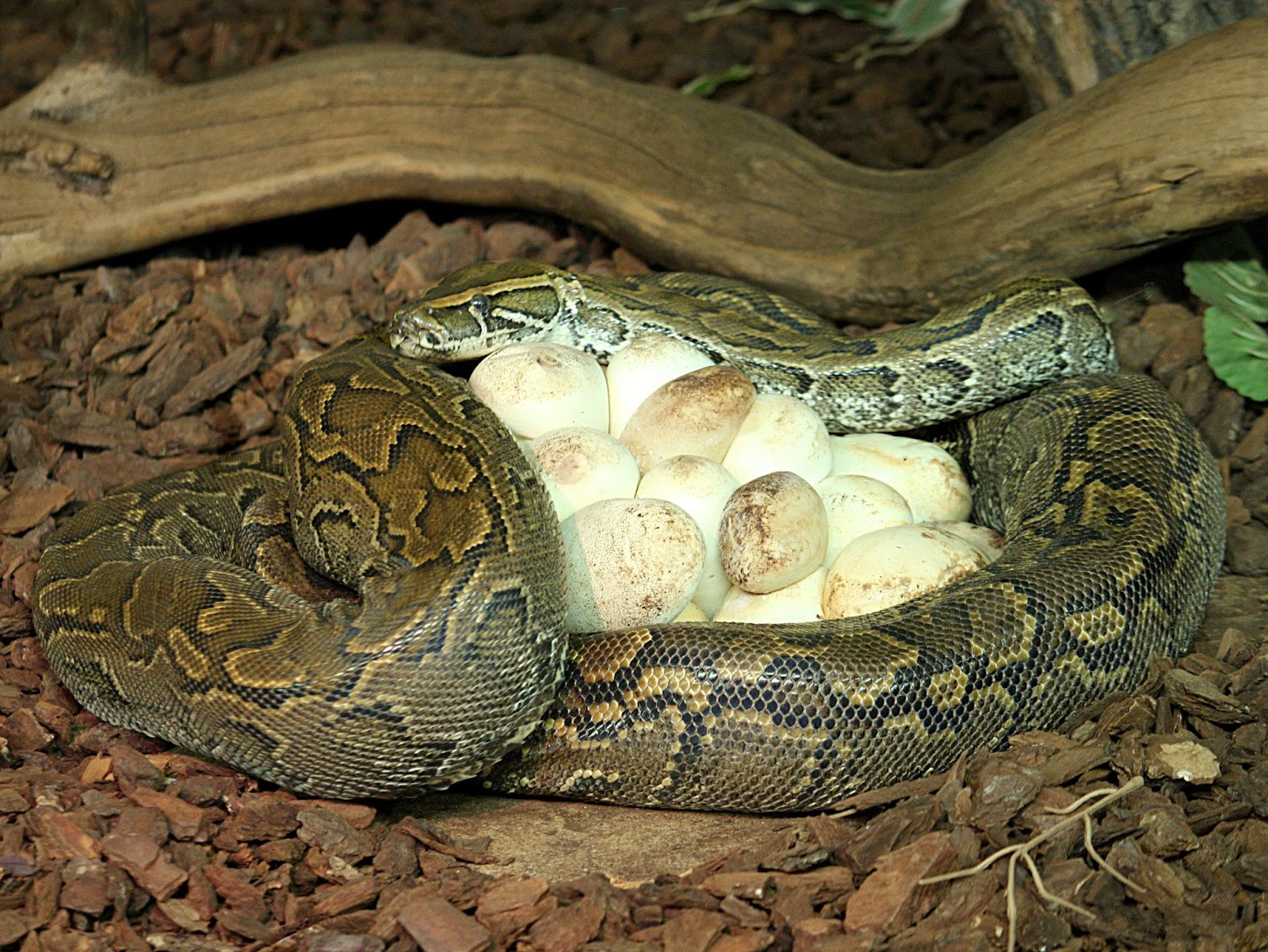
Pythons

A mother African Rock Python (Python sebae)
brooding her eggs
The next most well-known example of parental care in snakes is egg-brooding behavior in pythons, first documented in 1835. All 40 species of pythons lay eggs, and most of them coil tightly around them throughout incubation, forsaking food. As with vipers, early reports of this behavior were dismissed, but by the 1930s observations of pythons in zoos showed that they did indeed brood their eggs. Some species that live in cold climates, such as Indian Pythons (Python molurus) and Carpet Pythons (Morelia spilota), also generate heat using muscle contractions ("shivering"). Measurements taken of brooding Indian Pythons have shown that they can increase the temperature of their clutch by 7-10°F. Even though mother pythons may brood for up to 2 months, studies have found that, at normal temperatures, they rarely shiver and lose only about 6% of their body mass, suggesting that the costs of brooding are relatively small compared to the benefits, which also include reduced water loss by the eggs and hatchlings that develop faster and are larger and more active. The brooding instinct in mother pythons is very strong—lab experiments have shown that they will brood the eggs of other pythons just as readily as they will brood their own, and they will even brood rocks that are the same size as their eggs (a behavior reminiscent of the well-known fixed-action pattern of egg-retrieval behavior in graylag geese). Today, pythons are frequently used as models to study female reproductive behavior and life-history trade-offs.

King Cobras

Top: A female King Cobra guarding her nest
Bottom left: A diagram of a typical King Cobra nest
Bottom right: King Cobra eggs in an excavated nest chamber
From Hrima et al. 2014
That female King Cobras (Ophiophagus hannah) use their coils to build a nest of sticks and bamboo leaves and guard their eggs for two to three months has been known at least since 18921. Detailed observation of nest-building and attendance were made in captivity at the Bronx Zoo from 1953-1956, and wild King Cobra nests were surveyed and detailed observations made in 19692. King Cobra nests are the largest and most complex of any snake's, measuring up to four feet in diameter and rising to a similar height, with an internal chamber for the 20-50 eggs and sometimes a second one above for the snake, which abandons the nest just before the eggs hatch. The female must select her nesting material and bring it to the nest site, because the species of bamboo that are most commonly used in building the nest are not the most abundant species in the surrounding area. There are also some anecdotal reports that male King Cobras will guard the nest and/or the female. Some sources suggest that female King Cobras are more aggressive towards humans when they are guarding their nests, but most suggest that their behavior is no different than at any other time.

Other snakes

A female Mudsnake (Farancia abacura)
coils around her eggs in a subterranean nest
Maternal attendance or guarding of clutches of eggs is widespread in snakes, but observations in the wild are still fairly uncommon, mostly due to the difficulty of locating nesting sites. There are several excellent reviews of this topic, including those written by Rick Shine (1988), Carl Gans (1996), Louis Somma (2003), and Zach Stahlschmidt and Dale DeNardo (2011).

Other snakes that have been observed guarding their eggs in the wild include:
It's worth noting that, unlike the case with pythons, survival or physiological benefits to the eggs have not been documented in any of these cases. In addition, there are numerous anecdotal reports of egg attendance in other snakes, many of which are based on hearsay and are not backed up by data, photographs, or even descriptions. So, expect this list to grow, but keep in mind that parental care in snakes is still, and will probably always be, the exception rather than the rule.

Costs and benefits

Except for pythons and pitvipers, the costs and benefits of parental care in snakes have not been examined, and I've mentioned some of the evidence for both in pythons already. Why do rattlesnakes and other pitvipers care for their eggs or young? There are several non-mutually-exclusive theories, including:

A mother Pigmy Rattlesnake (Sistrurus miliarius) with
her brood. Because rattlesnake rattles are made of segments
that form each time the snake sheds its skin, newborn snakes
have only one segment and cannot yet make sound.
1. To protect them from predators. This might involve any or all of the following:

  • Physical concealment, especially of the eggs, which are less well-camouflaged than the adults.
  • Deterrence of predators, which may recognize an adult viper as a threat but not an egg or a juvenile.
  • Active defense from predators, using venom or the threat thereof. This may be especially important prior to the first shed of the young, since they would probably suffer their heaviest mortality during this stage because of their small size, inexperience, hampered eyesight and pit organ sensitivity, and, in rattlesnakes, their inability to use their rattle.
  • Socially-facilitated retreat from predators, in which the parent helps the young escape an attack by physically moving them, showing them what to do, or distracting the predator. These may seem like surprisingly sophisticated behaviors for snakes, but several observations of mother snakes and their young support this idea, and we are learning that many snakes have subtle but complex social lives and communication abilities that have long been underappreciated.

Antipredator benefits of parental care in snakes may vary geographically or in other ways, because some species of pitvipers do not seem to change their defensive behavior when they are guarding their young, but others are more defensive, and still others are less defensive but more distracting.
Young Tiger Snakes (Notechis scutatus) snuggling
and data showing that the more litter-mates
they snuggle with, the more slowly they cool off
From Aubret & Shine 2009
2. Litters or clutches of several species of young snakes, including some rattlesnakes, aggregate together, without their mothers, in order to conserve water or heat—which, if they were mammals, we would call snuggling. Experiments have shown that they prefer to snuggle—sorry, I mean aggregate—inside shelters that contain their own scent cues, and that snuggling kept them warm, which helped them slither to shelter faster. No one has tested whether young pitvipers that snuggle with their mothers have higher body temperatures or lower rates of evaporative water loss than those snuggling with one another, but physics suggests that they would, since larger animals have a lower surface-area-to-volume ratio and thus lose heat and water more slowly. The presence of the mother may also offset the increased visibility or olfactory conspicuousness to predators of a bunch of aggregated young snakes. If this is the primary benefit, it is easy to see how maternal attendance of eggs could evolve into maternal attendance of the young, because we think that live birth has evolved many times in snakes, and parental care may have evolved and been lost as many as six and ten times, respectively, in vipers. It's probable that we will continue to fill in the gaps in our knowledge. For example, perhaps we're overlooking the behavior in some poorly-studied vipers, as we did in North American pitvipers for over a century.

Viper family tree showing the evolution of parental care.
A few details have changed but the basic shape of the tree
is the same. Abbreviations: O=oviparous, V=viviparous;
Tr=tropical, Te=temperate. From Greene et al. 2002
3. The week or so of parental care may represent an imprinting period for the young snakes to learn the scent of their mother and of one another, similar to the time a young sea turtle spends imprinting on its natal beach or a young salmon on its natal stream. This would be especially important for snakes in cold climates because they use each others' scent trails to locate hibernation sites. Although there is no direct evidence for the third hypothesis, it is suggestive that, at least in the Americas, temperate pitvipers stay with their young, but live-bearing tropical pitvipers, which do not need to hibernate, do not3. Other explanations include that memories of their siblings' scents help young snakes avoid inbreeding later in life, or that they promote other social behaviors, such as communal basking. Some new data suggest that the adult behavior of pitvipers differs when they are deprived of a maternal attendance period. Tall tales about snakes abound, and initially social behavior ranked among them (there are still false tales about parental behavior in snakes, such as the idea that they swallow their young). Parental care in vipers may just be the tip of their social iceberg. Research over the last decade has shown that vipers make use of chemical information left behind by other vipers when they choose their foraging sites, like a dog sniffing a fire hydrant. This kind of cryptic sociality in snakes can lead to things like inheritance of birthing rookeries, nesting sites, and hibernation sites over many generations. Some research even suggests that pair-bonding might happen between male and female copperheads. Some lizards build multi-generational homes; might we one day discover snakes doing the same? If we do, my money is on vipers.


1 Rudyard Kipling's The Jungle Book, containing the story Rikki Tikki Tavi, which describes a King Cobra pair, nest, and parental behavior, was originally published in 1893-4, just a year later.↩


2 The Kenyan herpetologist J.H.E. Leakey collected eggs from these nests and acknowledged in his paper the support of "the management of the International Hotel, who never once raised any objections to our housing live King Cobras in our rooms."↩


3 Intriguingly, the only two Neotropical pitvipers known to have parental care are also the only two that lay eggs. One is the Colombian toad-headed pitviper (Bothrops colombianus), about which very little is known. The other, the Bushmaster (Lachesis muta), well-known by comparison, is nevertheless a secretive denizen of primary rain forests. In 1910, Inaugural Bronx Zoo herp curator Raymond Ditmars and his Trinidad correspondent, R. R. Mole, were the first to publish a photograph of a female Bushmaster guarding her eggs. They wrote of Bushmasters guarding their eggs in the wild, and numerous subsequent captive snakes have borne these observations out. Although Eyelash Pitvipers (Bothriechis schlegelii) have not been observed to guard their young, they may do so because their young shed several days after birth, like those of temperate pitvipers, rather than within 24 hours of birth, like most tropical live-bearing pitvipers. The pattern of parental care in Old World vipers, about which we have far less information, appears to be more complicated still.↩
ACKNOWLEDGMENTS

Thanks to my parents, for indulging my interest in snakes and encouraging me to pursue a career studying them, and to Jim Williams, Peter May, J. Lanki, and Matt Nordgren for the use of their photos.

REFERENCES

Aubret, F., X. Bonnet, R. Shine, and S. Maumelat. 2005. Energy expenditure for parental care may be trivial for brooding pythons, Python regius. Animal Behaviour 69:1043-1053 <link>

Aubret, F., X. Bonnet, R. Shine, and S. Maumelat. 2005. Why do female ball pythons (Python regius) coil so tightly around their eggs? Evolutionary Ecology Research 7:743-758 <link>

Aubret, F., and R. Shine. 2009. Causes and consequences of aggregation by neonatal tiger snakes (Notechis scutatus, Elapidae). Austral Ecology 34:210-217 <link>

Bates, M. F. 1985. Notes on egg clutches in Lamprophis inornatus and Psammophylax rhombeatus rhombeatus. The Journal of the Herpetological Association of Africa 31:21-22.

Benedict, F. G., E. L. Fox, and V. Coropatchinsky. 1932. The incubating python: a temperature study. Proceedings of the National Academy of Sciences 18:209-212 <link>

Brashears, J., and D. F. DeNardo. 2012. Do brooding pythons recognize their clutches? Investigating external cues for offspring recognition in the Children's Python, Antaresia childreni. Ethology 118:793-798 <link>

Brown, G. P., and R. Shine. 2007. Like mother, like daughter: inheritance of nest-site location in snakes. Biology Letters 3:131-133 <link>

Brown, W. S., and F. M. MacLean. 1983. Conspecific scent-trailing by newborn timber rattlesnakes, Crotalus horridus. Herpetologica 39:430-436 <link>

Butler, J.A., T.W. Hull, and R. Franz. 1995. Neonate aggregations and maternal attendance of young in the Eastern Diamondback Rattlesnake, Crotalus adamanteus. Copeia 1995:196–198 <link>

Campbell, J. A., and W. W. Lamar. 1992. The taxonomic status of miscellaneous Neotropical viperids, with the description of a new genus. Occasional Papers of the Museum, Texas Tech University 153:1-31 <link>

Case, T. J. 1978. Endothermy and parental care in the terrestrial vertebrates. American Naturalist 112:861-874 <link>

Clark, R. W. 2007. Public information for solitary foragers: timber rattlesnakes use conspecific chemical cues to select ambush sites. Behavioral Ecology 18:487-490 <link>

Clark, R. W., W. S. Brown, R. Stechert, and H. W. Greene. 2012. Cryptic sociality in rattlesnakes (Crotalus horridus) detected by kinship analysis. Biology Letters 8:523-525 <link>

Cunningham, G. R., S. M. Hickey, and C. M. Gowen. 1996. Crotalus viridis viridis (Prairie Rattlesnake). Behavior. Herpetological Review 27:24 <link>

DeNardo, D. F., O. Lourdais, and Z. R. Stahlschmidt. 2012. Are females maternal manipulators, selfish mothers, or both? Insight from pythons. Herpetologica 68:299-307 <link>

Gans, C. 1996. An overview of parental care among the Reptilia. Pages 145-157 in J. S. Rosenblatt and C. T. Snowdon, editors. Parental Care: Evolution, Mechanisms, and Adaptive Significance. Academic Press, San Diego, California, USA <link>

Graves, B. M. 1989. Defensive behavior of female prairie rattlesnakes (Crotalus viridis) changes after parturition. Copeia 1989:791-794 <link>

Greene, H.W., P.G. May, D.L. Hardy, J.M. Sciturro, and T.M. Farrell. 2002. Parental behavior by vipers. Pp. 179-206 In Biology of the Vipers. Schuett, G.W., M. Höggren, M.E. Douglas, and H.W. Greene (Eds.).  Eagle Mountain Publishers, Eagle Mountain, UT <link>

Hibbard, C. W. 1964. A brooding colony of the blind snake, Leptotyphlops dulcis dissecta. Copeia 1964:222 <link>

Hoss, S.K. and R.W. Clark. 2014. Mother Cottonmouths (Agkistrodon piscivorus) alter their antipredator behavior in the presence of neonates. Ethology 120:933-941 <link>

Hoss, S. K., D. H. Deutschman, W. Booth, and R. W. Clark. 2015. Post-birth separation affects the affiliative behaviour of kin in a pitviper with maternal attendance. Biological Journal of the Linnean Society 116:637-648 <link>

Hoss, S.K., M.J. Garcia, R.L. Earley, and R.W. Clark. 2014. Fine-scale hormonal patterns associated with birth and maternal care in the cottonmouth (Agkistrodon piscivorus), a North American pitviper snake. General and Comparative Endocrinology 208:85-93 <link>

Leakey, J. 1969. Observations made on king cobras in Thailand during May 1966. Journal of the National Research Council of Thailand 5:1-10 <link>

Mori, A., and T. M. Randriamboavonjy. 2010. Field observation of maternal attendance of eggs in a Madagascan snake, Leioheterodon madagascariensis. Current Herpetology 29:91-95 <link>

Oliver, J. A. 1956. Reproduction in the king cobra, Ophiophagus hannah Cantor. Zoologica 41:145-152.

Reiserer, R., G. Schuett, and R. Earley. 2008. Dynamic aggregations of newborn sibling rattlesnakes exhibit stable thermoregulatory properties. Journal of Zoology 274:277-283 <link>

Savary, W. 1999. Crotalus molossus molossus (northern blacktail rattlesnake). Brood defense. Herpetological Review 30:45 <link>

Schuett, G., R. Repp, M. Amarello, and C. Smith. 2013. Unlike most vipers, female rattlesnakes (Crotalus atrox) continue to hunt and feed throughout pregnancy. Journal of Zoology 289:101-110 <link>

Shine, R. 1988. Parental care in reptiles. Pp. 275-330 In Biology of the Reptilia. Gans, C. and R.B. Huey (Eds.).  Alan Liss, New York <link>

Smith, C. F., and G. W. Schuett. 2015. Putative pair-bonding in Agkistrodon contortrix (Copperhead). Northeastern Naturalist 22:N1-N5 <link>

Somma, L. A. 2003a. Parental Behavior in Lepidosaurian and Testudinian Reptiles: A Literature Survey. Krieger Publishing Company, Malabar, Florida, USA.

Somma, L. A. 2003b. Reptilian parental behaviour. The Linnean 19:42-44 <link>

Stahlschmidt, Z.R. and D.F. DeNardo. 2011. Parental care in snakes. Pp. 673-702 In Reproductive Biology and Phylogeny of Snakes. Aldridge, R.D. and D.M. Sever (Eds.).  Science Publishers, Enfield, New Hampshire <link>

van Mierop, L. H. S., and E. L. Bessette. 1981. Reproduction of the ball python, Python regius in captivity. Herpetological Review 12:20-22 <link>

Wall, F. 1924. The Hamadryad or King Cobra, Naja hannah (Cantor). Journal of the Bombay Natural History Society 30:189-195 <link>

Walters, A. C., and W. Card. 1996. Agkistrodon piscivorus conanti (Florida Cottonmouth). Brood defense. Herpetological Review 27:203 <link>

Wasey, G. K. 1892. A nest of King Cobra's eggs. Journal of the Bombay Natural History Society 7:257 <link>

Whitaker, N., P. G. Shankar, and R. Whitaker. 2013. Nesting ecology of the King Cobra (Ophiophagus hannah) in India. Hamadryad 36:101-107.


Creative Commons License

Life is Short, but Snakes are Long by Andrew M. Durso is licensed under a Creative Commons Attribution-NonCommercial-NoDerivs 3.0 Unported License.