
The world is full of obscure snakes. According to Darren Naish at Tetrapod Zoology, the more you know about them, the better a person you are. Writing this blog, and in my research, I am often confronted with the challenging task of finding out something—anything at all—about a species of snake that I've never heard of before. This post is a walk-through of the process that I usually use to track down even the most basic information about obscure snakes, although it could be used as an example of how to find trustworthy information about any species of plant or animal. I'll use as an example the species Liophidium mayottensis (Peters's Bright Snake) - a lamprophiid colubroid found on the island of Mayotte. If you're like me then you're filled with questions right away: Who was Peters? What is so bright about this snake? Where's Mayotte?
 |
| Wikipedia page for Liophidium mayottensis as of October 2014 |
When faced with a species about which I know almost nothing—in this case a species I had never even heard of before—there are a couple of resources that I generally go to first in order to figure out how I should proceed. The first is always The Reptile Database. This wealth of information is curated by Peter Uetz, Jakob Hallermann, and Jiri Hosek, three individuals to whom the whole of the herpetological world is indebted. Using the advanced search feature, you can look up any species of living reptile using its common or scientific name, including by an old scientific name (a "synonym") that is no longer used. This is important because scientific names change all the time, and sometimes the same species has gone by 10 or 20 different names over the course of its taxonomic lifetime. It is particularly important to know about these names because the species may have gone by them for a long time in older literature, which is sometimes the most important literature there is.
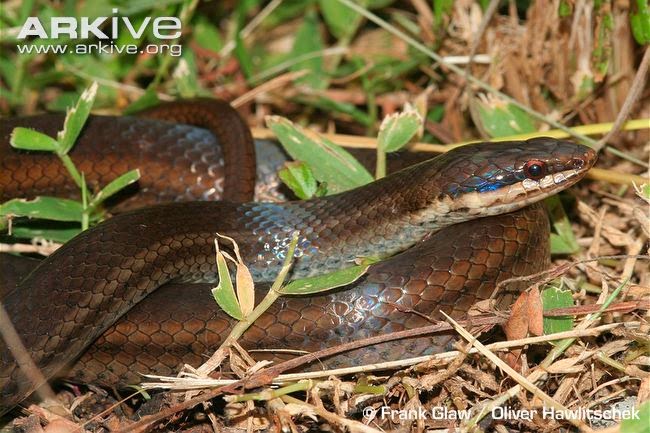 |
| Liophidium mayottensis |
Before searching TRD, I sometimes try to use the scientific name itself to figure out a little bit about what I'm looking for. It helps to know some Latin and Greek, and a handy reference that I use a lot is Borror's Dictionary of Word Roots and Combining Forms. In this case, the genus name Liophidium told me that this was a snake with smooth scales (the Greek prefix lio- meaning smooth + the Greek root ophid meaning snake + the Latin suffix -ium normally used to form abstract nouns). The specific epithet mayottensis means "from Mayotte" (the -ensis suffix is a common way to form an adjective indicating spatial or geographic origin in Latin, similar to the English suffix -ese, as in Maltese, Chinese, or Portuguese). Although the Latin and Greek origins of the scientific name can be helpful, they can also be misleading (for example, the North American Racer is called Coluber constrictor even though it is not a constrictor) or unhelpful (another familiar North American snake, Storeria dekayi, is named after two 19th century herpetologists, David H. Storer and James E. DeKay), so don't rely too much on these.
 |
| The Madagascan Biogeographic Realm Mayotte is the southeasternmost island in the Comoros chain, although politically it is part of France. Many interesting snakes inhabit this realm, including bolyeriids |
 |
| The BHL is also a great source of artwork in the form of old plates, like this mudsnake from Duméril's Erpétologie Générale, which adorns the logo of this blog |
 |
| Wilhlem C.H. Peters |
Another difference between the 1800s and now is that species descriptions today are generally much more complete. You might be surprised to learn that the International Commission on Zoological Nomenclature, which advises, arbitrates, and recommends rules for the zoological community on describing new species of animals, stipulates only that in order for a species description to count as official, it must include at a bare minimum just "a description or definition that states in words characters that are purported to differentiate the taxon", and even this 'strict' definition applies only to names published after 1930. Peters's description of Liophidium mayottensis (translated) reads:
17. Ablabes (Enicognathus) rhodogaster Schlegel var. mayottensis:
Two young specimens from Mayotte seem to me to belong to the above species, although they do not have red coloration on the belly. Frontal a little longer than high; 8 supralabials, of which the 4th and 5th touch the eye; temporals 1+2+2; infralabials 9, the first pair of which is in contact behind the tapered mental; two pairs of chin shields. Body scales smooth, without apical pits, in 19 longitudinal rows. Ventrals 190, divided anal, subcaudals 99 pairs. Above olive-brown, a little darker along the middle and fourth-to-last row of scales. From the snout through the eye and the frenal region there is a black band which is indistinct on the side of the neck and disappears in the penultimate row of scales on the side of the body. Under this there is a bright yellow band, which goes to the mouth. There are three black spots on the rostral and upper lip. The chin and infralabials are spotted or marbled with black and yellow. On the neck are fine yellowish transverse lines. Ventral scales with 4-6 black dots; posterior ventral scales and subcaudals yellowish-white.
 |
| Liophidium rhodogaster Gold-collared Snake |
It's likely that neither Peters nor Boulenger ever saw Liophidium mayottensis, or many of the other species they described, alive, so we can forgive them for not mentioning its habitat or patterns of activity (although they could have at least measured the specimen). Sometimes museum specimens yield information about diet (via stomach contents) or reproduction (via eggs or embryos in utero), but this does not seem to be the case for Peters's Bright Snake. To learn about these things, we'll have to sleuth out some other papers. The other two listed at TRD don't look too promising - one is a biography of Peters that's only available in print, and the other focuses on a different genus, Sibynophis, that's superficially similar to Liophidium but distantly related.
We can do a little better by checking some other common sources of information on the web. We already know that Wikipedia's useless (although the links at the bottom of some pages can be quite useful), but a general Google search for the scientific name typically turns up links to the pages for a species on several authoritative sites that aggregate biodiversity information online. In no particular order, I often check the University of Michigan Museum of Zoology's Animal Diversity Web. This is a great student-authored resource but it's still incomplete, and it doesn't even have a page for our genus yet (but check out their detailed pages on all three Acrochordus species). Other similar sites include the Encyclopedia of Life (species page incomplete for L. mayottensis, but check out Laticauda colubrina for a fairly good page), DiscoverLife (which is mostly links with little original content, and is unhelpful for our species, although they host a cool ID guide for North American snakes), and Map of Life (which has lots of cool mapping capabilities but not for our species). Citizen science projects can be a rich source of information on distribution, but such projects are in their infancy for herps. Two of the best are iNaturalist and HerpMapper, neither of which has any data on our species [Edit 11/4/2015: there is now a single iNaturalist record; a second record was entered on January 22, 2017]. Remember that none of these sources are peer-reviewed, so they may propagate misinformation (although I have found this to be rare).
ARKive is a film and image archive that generally has pictures of rare species when most other websites fail, and that is the case here, but as of 2014 it contained no additional information (contrast with their excellent accounts for snakes like Natrix natrix and Macroprotodon cucullatus). Flickr can be a good source of images too, in this case providing us with four additional images, all taken by the same person of the same individual snake. I have noticed that a culture of accurate species identification exists on Flickr that isn't found elsewhere on the Internet. For instance, don't ever trust Google Images when searching for rare species - in this case, only one of the hundreds of images returned is actually of our snake [Edit 11/4/2015: it's gotten a little better since I put up this post.]. Earlier I mentioned the Biodiversity Heritage Library, one of the most consistently useful resources on the web, and their search feature leads us to one new resource: a mention in a paper by John Cadle from 1999, focusing on morphological taxonomy of Malagasy snakes (which states that Liophidium are diurnal and led me to a paper describing the smooth, hinged, spatula-shaped teeth of Liophidium and other snakes, an adaptation for grasping and swallowing hard-bodied prey, such as skinks — their teeth fold backwards when forces are applied to their leading surface, but lock into an erect position if forces come from behind).
Two other online databases are more authoritative than those previously mentioned, in that they are reviewed by experts. One is GenBank, the NIH genetic sequence database. A GenBank search reveals that five genes have been sequenced from L. mayottensis, which is more than for most reptiles. These include four mitochondrial genes (ND4, CO1, and cyt-b, which are essential to the electron transport chain of cellular respiration, and 16S, part of the protein synthesis machinery of ribosomes) and one nuclear gene (c-mos, which plays a role in mitosis). These genes were chosen for their conserved functions and relatively slow rates of evolution, which makes them useful for phylogenetic purposes (except for CO1, which evolves at just the right rate for DNA barcoding, a technique which is used, among other things, to monitor trade of reptiles without specialized expert knowledge). A phylogenetic analysis was done to determine the relationship of Liophidium pattoni, a new species discovered in Madagascar in 2009, to the other species in the genus. The results placed L. pattoni as sister to L. rhodogaster, and L. mayottensis as sister to two other Malagasy species, L. torquatum and L. chabaudi. This may seem like a dry, mundane detail, but it actually tells us something very interesting about our species: it probably colonized Mayotte from Madagascar after the ancestors of Liophidium had already radiated there. It also says that Peters, who thought that L. mayottensis was a subspecies of L. rhodogaster, was way off - it's actually more closely related to almost any other member of the genus (although to be fair to Peters, none of those other members had been described yet when he named L. mayottensis — and morphology might lead you to believe that L. mayottensis was the most basal member of the group, since it has 19 dorsal scale rows whereas every other species has 17).
The other more authoritative online database is the IUCN Red List. The Red List assesses the conservation status of species and often includes a distribution map (although not in this case), some ecological information, and a short bibliography focused on ecology and conservation rather than on taxonomy. The IUCN page contains several useful nuggets, most of which come to us by way of expert knowledge and may or may not be published elsewhere. For instance, we learn that our species is classified as Endangered under the IUCN categories, which are based on quite rigorous and quantitative criteria. Peters's Bright Snake qualifies as Endangered despite very limited data because all known records are from a forested area of about 65 km2 in the center of Mayotte, which is subject to a continuing decline in quality (criterion B2b(iii)) and within which the actual occurrence records of the snake suggest that its populations are severely fragmented (criterion B2a). Even if the area of occupancy is underestimated, the entire terrestrial area of Mayotte is only 365 km2, which is still less than the minimum of 500 km2 that a species must exceed unless both it and its habitat are known to be contiguous and stable.
The IUCN record also lists several other pieces of information. It tells that the known records are all between 144 and 653 meters above sea level. It states that "this snake is diurnal, ground-dwelling and very secretive", "observed in natural forests and plantations", and is egg-laying. This last tidbit is pretty helpful, and it's no surprise that we haven't encountered it before—it's from a field guide written in French by Danny Meirte, covering the terrestrial fauna of the Comoros, published in 1999 and updated in 2004. As for conservation, it says that our species is not used by humans for any known purpose, but that an introduced civet may be a threat. All native reptile species on Mayotte are protected by law, and several nature reserves may benefit L. mayottensis, but no data is available on the snake's occurrence at these sites.
Finally, the IUCN record notes that "the extreme scarcity of observations may be attributed to the cryptic habits of this snake, but also suggests that L. mayottensis is not common". No shock there. The short bibliography includes both the old and new editions of the field guide and a paper by Oliver Hawlitschek in the journal ZooKeys that used field surveys and remotely sensed data to assess the conservation status of Comoran reptiles, upon which most of the conservation assessment is based. The profile also cites another work in preparation by Hawlitschek, who was also an expert reviewer for the species and took the Arkive photograph. I visited his website and was able to learn that he is a German PhD student studying herp conservation & phylogeography in the Comoros.
Now we're getting somewhere, although we're still looking for body size and clutch size, two of the most basic species attributes. Usually, after checking all off the above sources, I repeat the whole process on Google Scholar and track down any promising articles. Often, I'll add a search term for the particular attribute I'm looking for (e.g., "clutch size", "svl") to see if that helps. In this case, even Google Scholar didn't turn up much specific to our species. I was about to give up when I decided to contact Oliver Hawlitschek. When I went to look up his email address, I noticed that he recently published a paper in the journal PLoS ONE, which of all places is known for its free and open accessibility to all. The paper, titled "Island Evolution and Systematic Revision of Comoran Snakes: Why and When Subspecies Still Make Sense", includes supplementary material that finally gives us the answer to our seemingly simple question of "how long is Liophidium mayottensis"? The average adult total length is about 80 cm for both sexes, maximum 1 meter (3 feet), with the tail making up about 30% of the body. When I contacted Oliver he confirmed this, and he also told me that as far as he knew no information on clutch size was available (although he expected it would be small, like that of most other island snakes). From reading his paper, I also learned that this is by far the largest species of Liophidium (the next is L. therezieni at 72.6 cm) and the only one with 19 dorsal scale rows instead of 17. Oliver's paper suggested that Comoran Liophidium (and the snake Lycodryas and lizard Oplurus) are larger than their Malagasy congeners because they are released from competition with larger species that do not occur in the Comoros.
Oliver also put me in touch with Cynthia Wang, another graduate student who is using high-resolution X-ray computed tomography to make 3-D scans of the skulls of snakes. Turns out she recently scanned a L. mayottensis skull. You can see the spatula-shaped, hinged teeth characteristic of the genus, although the connective tissue is missing. He also told me that he will be returning to the Comoros this November, and that L. mayottensis will be his #1 target while he's there. All in all, a pretty satisfying conclusion.
We can do a little better by checking some other common sources of information on the web. We already know that Wikipedia's useless (although the links at the bottom of some pages can be quite useful), but a general Google search for the scientific name typically turns up links to the pages for a species on several authoritative sites that aggregate biodiversity information online. In no particular order, I often check the University of Michigan Museum of Zoology's Animal Diversity Web. This is a great student-authored resource but it's still incomplete, and it doesn't even have a page for our genus yet (but check out their detailed pages on all three Acrochordus species). Other similar sites include the Encyclopedia of Life (species page incomplete for L. mayottensis, but check out Laticauda colubrina for a fairly good page), DiscoverLife (which is mostly links with little original content, and is unhelpful for our species, although they host a cool ID guide for North American snakes), and Map of Life (which has lots of cool mapping capabilities but not for our species). Citizen science projects can be a rich source of information on distribution, but such projects are in their infancy for herps. Two of the best are iNaturalist and HerpMapper, neither of which has any data on our species [Edit 11/4/2015: there is now a single iNaturalist record; a second record was entered on January 22, 2017]. Remember that none of these sources are peer-reviewed, so they may propagate misinformation (although I have found this to be rare).
 |
| One of Pagale Bacha's Flickr photos of L. mayottensis |
 |
| Some L. mayottensis DNA. It looks just like the DNA of any other species, although there's a lot it can tell us. |
 |
| Liophidium pattoni and its relationship to some of its closest relatives, including L. mayottensis From Vieites et al. 2010 |
 |
| IUCN categories |
 |
| Hinged teeth of Liophidium rhodogaster From Savitzky 1981 |
Finally, the IUCN record notes that "the extreme scarcity of observations may be attributed to the cryptic habits of this snake, but also suggests that L. mayottensis is not common". No shock there. The short bibliography includes both the old and new editions of the field guide and a paper by Oliver Hawlitschek in the journal ZooKeys that used field surveys and remotely sensed data to assess the conservation status of Comoran reptiles, upon which most of the conservation assessment is based. The profile also cites another work in preparation by Hawlitschek, who was also an expert reviewer for the species and took the Arkive photograph. I visited his website and was able to learn that he is a German PhD student studying herp conservation & phylogeography in the Comoros.
 |
| Phylogenetic tree of Malagasy reptiles based on CO1 DNA barcodes Liophidium is near the top right From Nagy et al. 2012 |
 |
| Liophidium mayottensis skull (with tooth closeup, inset) Image by Cynthia Wang |
This was a long article; congratulations if you made it to the end! I justified the length partly in celebration of my birthday this month and partly in celebration of this blog reaching 250,000 views! I hesitated writing this article because I base a lot of my articles around obscure snakes and I was afraid that writing a how-to would amount to writing myself out of a lot of subject matter. On the other hand, I suppose I enjoy the chase, and I think this overly-long article's length goes to show just how much actually is out there, even for really obscure species, if you're willing to look (and there are certainly resources I've missed! Let me know about them in the comments). I also think that this process is easily generalizable to non-reptiles—there are some great resources out there for amphibians, birds, algae, echinoderms, insects, and much else. Whatever you're interested in, happy researching!
Update: In December 2014, Ludovic Montfort, Cynthia Wang, Oliver Hawlitschek, and Mark Scherz found a L. mayottensis atop Mt. Benara during their field work on Mayotte!
Update: In December 2014, Ludovic Montfort, Cynthia Wang, Oliver Hawlitschek, and Mark Scherz found a L. mayottensis atop Mt. Benara during their field work on Mayotte!
 |
| Cynthia Wang with L. mayottensis in December, 2014. Photo by Matthias Deuss |
ACKNOWLEDGMENTS
Thanks to Oliver Hawlitschek, Cynthia Wang, Matthias Deuss, Henry Cook, and Pagale Bacha for the use of their images.
REFERENCES
Bauer, A. M., R. Günther, and M. Klipfel. 1995. The Herpetological Contributions of Wilhem CH Peters (1815-1883). SSAR Facsimile Reprints in Herpetology:114.
Boulenger, G. A. 1893. Catalogue of the snakes in the British Museum (Natural History). Trustees of the British Museum, London <link>
Cadle, J. E. 1999. The Dentition, Systematics and Phylogeny of Pseudoxyrhopus and Related Genera from Madagascar (Serpentes: Colubridae) with Descriptions of a New Species and a New Genus. Bulletin of the Museum of Comparative Zoology at Harvard College 155:381-443 <link>
Hawlitschek, O., B. Brückmann, J. Berger, K. Green, and F. Glaw. 2011. Integrating field surveys and remote sensing data to study distribution, habitat use and conservation status of the herpetofauna of the Comoro Islands. ZooKeys 144:21–78 <link>
Hawlitschek, O., Nagy, Z., & Glaw, F. 2012. Island evolution and systematic revision of Comoran snakes: why and when subspecies still make sense. PLoS ONE 7:e42970 <link>
Hedges, S. B. 2013. Revision shock in taxonomy. Zootaxa 3681:297-298 <link>
Meirte, D. 2004. Reptiles. Pages 201-224 in M. Louette, D. Meirte, and R. Jocqué, editors. La faune terrestre de l'archipel des Comores. MRAC, Tervuren.
Nagy, Z. T., U. Joger, M. Wink, F. Glaw, and M. Vences. 2003. Multiple colonization of Madagascar and Socotra by colubrid snakes: evidence from nuclear and mitochondrial gene phylogenies. Proceedings of the Royal Society of London. Series B: Biological Sciences 270:2613-2621 <link>
Peters, W. C. H. 1873. Über eine von Hrn. F. Pollen und van Dam auf Madagascar und anderen ostafrikanischen Inseln gemachte Sammlung von Amphibien. Monatsberichte der Königlichen Preussische Akademie des Wissenschaften zu Berlin 1873:792-795 <link>
Savitzky, A. H. 1981. Hinged teeth in snakes: an adaptation for swallowing hard-bodied prey. Science 212:346-349 <link>
Uetz, P. 2010. The original descriptions of reptiles. Zootaxa 2334:59-68 <link>
Vieites, D. R., F. M. Ratsoavina, R.-D. Randrianiaina, Z. T. Nagy, F. Glaw, and M. Vences. 2010. A rhapsody of colours from Madagascar: discovery of a remarkable new snake of the genus Liophidium and its phylogenetic relationships. Salamandra 46:1-10 <link>
Zaher, H., F. G. Grazziotin, R. Graboski, R. G. Fuentes, P. Sánchez-Martinez, G. G. Montingelli, Y. P. Zhang, and R. W. Murphy. 2012. Phylogenetic relationships of the genus Sibynophis (Serpentes: Colubroidea). Papeis Avulsos de Zoologia (Sao Paulo) 52:141-149 <link>

Life is Short, but Snakes are Long by Andrew M. Durso is licensed under a Creative Commons Attribution-NonCommercial-NoDerivs 3.0 Unported License.


