If you need to identify a snake, try the Snake Identification Facebook group.
For professional, respectful, and non-lethal snake removal and consultation services in your town, try Wildlife Removal USA.

Friday, July 27, 2012

Snakes flying without planes


By now, all of us herpetologists have heard quite enough 'Snakes on a Plane' jokes, thank you very much (they're second only to jokes about how we probably study STDs - never heard that one before). Meanwhile, in reality, snakes have been flying - well, gliding, really - since long before Samuel L. Jackson had had it with them.

True flight, actively wing-powered and sustained for lengthy periods of time, has evolved only four times (in insects, pterosaurs, birds, and bats). In contrast, gliding flight (defined as falling at an angle more shallow than 45° from horizontal) is more energy efficient and has evolved many times, and many birds use both gliding flight and true flight depending on the circumstance. Among the vertebrates are found gliding lemurs, squirrels, fishes, frogs, lizards, ants, squids, and of course snakes. Of all the groups that have evolved gliding, snakes would seem to be the least likely candidates, because of their long, cylindrical body that seems ill-suited for flight. But evolve to glide they have. Many gliding groups live in the rainforests of Asia, especially on the island of Borneo, where the trees are very tall and widely spaced, and southeast Asia is where you will find the five species of gliding snake, genus Chrysopelea.

Chrysopelea paradisi
As with many species native to this region of the world, there are a lot of unknowns about gliding snakes. We don't know very much about how they spend their time in the wild, what they eat, or what eats them. Until recently, relatively few scientific papers had been published on Chrysopelea, including a note on their flight in 1906.1

Jake Socha, a comparative biomechanics researcher at Virginia Tech, studies the gliding flight of Chrysopelea. For his PhD at the University of Chicago, he characterized their mechanism of takeoff, the postures they adopt while gliding, and contributed substantially to our knowledge of their morphology. Socha and colleagues used multiple synchronized video cameras to film and digitally reconstruct the trajectory, speed, and body posture of gliding Chrysopelea, which they frightened off a three-story scaffolding built with a branch sticking out of the side, to simulate a tree. The videos showed that the snakes could descend at a very shallow angle of 13°, comparable to flying squirrels and other accomplished gliding vertebrates.

Next, Socha and colleagues looked for relationships between measures of the snakes' flight performance, such as glide angle and horizontal speed, and morphological characteristics of the snakes. They found that smaller snakes were better able to glide long distances than larger ones, and that the wave amplitude of the snake's body was a more important predictor of flight behavior than its wave frequency, the latter of which they hypothesize helps maintain stability during flight.

Undulating behavior of gliding Chrysopelea

In order to transform their bodies from fairly non-aerodynamic cylinders into a more aerodynamic wing-like shape that generates lift, Chrysopelea can flatten their body by extending their ribs, an observation first made by Robert Shelford (also the first person to document their gliding behavior, in 1906). The flattening process proceeds from anterior to posterior, does not include the tail, and takes only 100–350 milliseconds to complete. Although the exact mechanism of rib expansion has not been examined, it is presumably similar to that used by cobras to spread their hoods. Because the rib muscles are also involved in breathing, it is likely that Chrysopelea cannot breathe when gliding, which could physiologically limit the duration of their glides.

Figure from a 1906 paper describing the change in shape of the body of Chrysopelea.

Finally, Socha and colleagues have investigated Chrysopelea's take-off behavior in great detail, using the same synchronized camera set-up they used to film the snakes in flight. I won't go into excruciating detail (you can read the whole paper here), but you can get an idea of the movements involved by looking at the beautiful images produced below.


So far, the five species of Chrysopelea are the only known gliding snakes, although anecdotal reports suggest that their close relatives, the Bronzeback Snakes in the genus Dendrelaphis, are also capable of making gliding leaps. Although Chrysopelea have been known since the time of Linneaus (who described only their color, as "green, with a yellow line on both sides"), we are still learning about them today, and will probably never know all there is to know. In addition to having a fascinating natural history, these snakes are also incredibly graceful and beautiful. I think I would like to see one in the wild more than just about any other snake, which is always a bold statement to make. One day... 


1 The author, Robert Shelford, was brought dead specimens of Chrysopelea in the late 1890s by Dyak villagers in inland Borneo, who told him that they were of a flying species. Skeptical, he obtained some live specimens and tested them by dropping them from heights of 15-20'; "after one or two false starts the snake was felt to glide from the experimenter's hands".

ACKNOWLEDGMENTS

Thanks to photographers Angi Nelson and Jake Socha. If you have more questions about Chrysopelea, check out Jake Socha's Chrysopelea FAQ.

REFERENCES

Shelford R (1906) A note on "flying" snakes. Proceedings of the Zoological Society of London 76:227-230

Socha JJ (2002) Kinematics: Gliding flight in the paradise tree snake. Nature 418:603-604

Socha JJ (2006) Becoming airborne without legs: the kinematics of take-off in a flying snake, Chrysopelea paradisi. Journal of Experimental Biology 209:3358-3369 <link>

Socha JJ (2011) Gliding flight in Chrysopelea: Turning a snake into a wing. Integrative and Comparative Biology 51:969-982 <link>

Socha JJ, LaBarbera M (2005) Effects of size and behavior on aerial performance of two species of flying snakes (Chrysopelea). Journal of Experimental Biology 208:1835-1847 <link>

Socha JJ, O'Dempsey T, LaBarbera M (2005) A 3-D kinematic analysis of gliding in a flying snake, Chrysopelea paradisi. Journal of Experimental Biology 208:1817-1833 <link>


Creative Commons License

Life is Short, but Snakes are Long by Andrew M. Durso is licensed under a Creative Commons Attribution-NonCommercial-NoDerivs 3.0 Unported License.

Monday, July 16, 2012

Snake-eating snakes


I've mentioned before how snakes can eat nearly anything, due to amazing adaptations of their head and jaws that allow them to swallow objects bigger than their heads. But surely they must be limited to eating prey that are shorter than they are in overall length, right? What about items that are just a bit longer?

There are a wide variety of snakes that eat other elongate vertebrates, including other snakes, legless lizards, lizards with relatively small legs (like skinks), amphisbaenians, caecilians, and eels (today we'll focus on snakes, but look out for future articles on some of these other specialized diets). In many ways, this kind of diet is convenient for a snake, because they are already elongate, so they don't have to deform their stomachs, bodies, and mouths to the same extent as snakes that eat bulkier prey. Many are relatively primitive snakes that retain the robust skulls of their lizard-like ancestors, but quite a few derived snakes are snake-eaters as well, including the King Cobra, Ophiophagus hannah, the world's largest venomous snake.

The genus Ophiophagus means 'snake-eating'

Other familiar snake-eaters include the North American Kingsnakes (genus Lampropeltis), which have evolved resistance to the venom of many species of viper. Eastern Indigo Snakes (Drymarchon couperi) and their Central and South American relatives are also frequent snake eaters, and many other species of North American colubrids sometimes dine on each other, including Racers (Coluber constrictor), Coachwhips (genus Masticophis, now sometimes included in the racer genus Coluber), Garter and Ribbon Snakes (genus Thamnophis), and Coral Snakes (genus Micrurus). Among their prey are many of North America's venomous snakes, including the Copperhead (Agkistrodon contortrix), Cottonmouth (or water mocassin, Agkistrodon piscivorus), and many species of rattlesnake (genera Crotalus and Sistrurus), as well as many non-venomous species of snake. Because all snakes are predatory, the existence of snake-eating snakes implies that some snakes are feeding at a very high trophic level indeed, and indeed they may represent top predators in some ecosystems.

Just how does a snake accomplish eating another? It is an arduous process, especially when the prey snake is as long as or longer than the predator. It's true: some snakes are able to ingest other snakes that equal or exceed their own body length. That means that these snakes must fit an object longer than their entire body into just their stomach, which (perhaps it goes without saying) is not as long as their whole body. The prey must be fit into the stomach, and cannot extend into the intestine or the esophagus, because the lining of the stomach is the only part of the digestive system that secretes digestive enzymes.

Body width is not nearly as much as a problem - snakes have highly kinetic skulls and very strong and flexible trunk muscles, so they can both expand their body cavity and compress their prey in order to accommodate very wide meals. But there is a limit to the length of their gut - it cannot extend into their tail, which is solid with muscle, nor can the prey easily be left hanging out of the mouth, where it could impede the snake's movement, interfere with sensory processes, or begin to decompose.


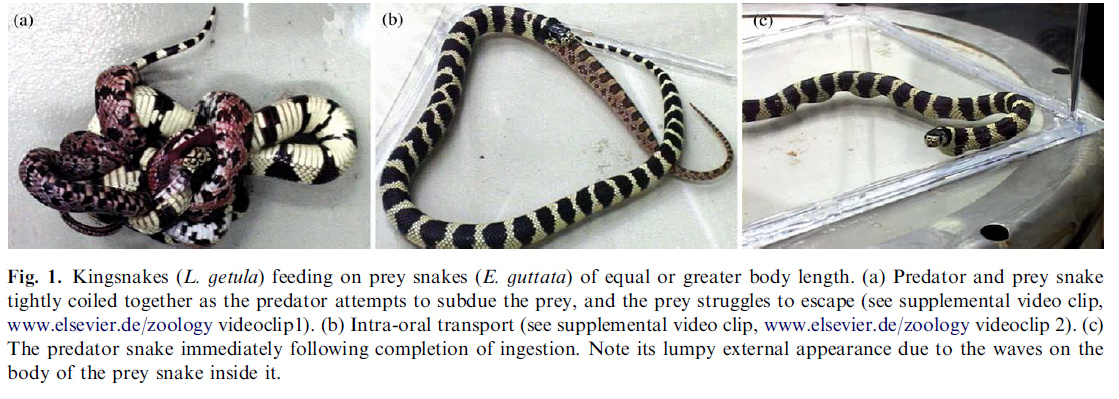
As determined in a paper by one of my favorite herpetologists, Kate Jackson, the author of the popular herpetological book Mean and Lowly Thingsthe solution hit upon by North American Kingsnakes seems to be to throw the prey into waves to decrease its length and pack it into the space available. They accomplish this by concertina-like motions of their own vertebral column, which causes the (dead) prey snake's body to conform in shape to that of its predator. The predator snake can then straighten out again while advancing its jaws, so that the standing waves were left in the body of the prey snake. As you can see from the below X-ray images, taken from Jackson's paper with  functional morphologists Nathan Kley and Elizabeth Brainerd, this allows the predator snake to pack pretty long snakes into its gut. It's the same principle as meandering your path increases the total distance you walk without affecting the straight-line distance from your starting point (in this case, the snake's mouth) to your finishing (here, the posterior end of the snake's stomach). Kingsnakes tested in Jackson et al.'s paper were able to ingest Cornsnakes (Pantherophis guttatus) up to 139% of their body length and up to 135% of their pre-feeding body mass, which would be like a 6'0", 175 lb. person eating an 8'4", 236 lb. meal - in one bite. Without using their hands.


As the prey snake is digested, a decrease in wavelength and increase in amplitude of the waves of the prey snake’s vertebral column takes place, because the prey snake's body becomes more compressible as its tissues are digested off. In Jackson's experiment, it took the Kingsnakes about 7-10 days to completely digest these huge meals (although a few of them regurgitated their prey after a couple days).


Once, I was lucky enough to observe a young racer that had just eaten a Ring-necked Snake (Diadophis punctatus) at a nature preserve in east-central Illinois:


As you can see, she was pretty much catatonic. The Ring-necked Snake she had eaten was 26.5 cm in length, and she herself measured only 28.9 cm, so her prey was >90% of her total length! You can really get an impression from this photo of the lumpy, kinked quality of the body of a snake that has recently eaten another, caused by the waves of the prey snake's body inside the gut of the predator.

An x-ray of a mudsnake (Farancia abacura) with a
three-toed amphiuma (Amphiuma tridactylum)
From Haertle et al. 2015
Edit: an observation published in 2015 showed that mudsnakes, which eat large, elongate prey such as sirens and amphiumas, also push their prey's vertebral columns into waves in order to fit them into their guts.

ACKNOWLEDGMENTS

Thanks to Belinda Wright for the photograph of the King Cobra.

REFERENCES

Durso, AM & NM Kiriazis. 2011. Coluber constrictor (North American Racer) Prey Size. Natural History Note. Herpetological Review. 42(2):285 <link>

Haertle, N. E., P. M. Hampton, P. N. Vogrinc, and J. D. Willson. 2015. Farancia abacura (Red-bellied Mudsnake). Feeding behavior. Herpetological Review 46:449-450 <link>

Jackson K, Kley NJ, Brainerd EL. 2004. How snakes eat snakes: the biomechanical challenges of ophiophagy for the California kingsnake, Lampropeltis getula californiae (Serpentes: Colubridae). Zoology 107(3):191-200. <link>


Creative Commons License

Life is Short, but Snakes are Long by Andrew M. Durso is licensed under a Creative Commons Attribution-NonCommercial-NoDerivs 3.0 Unported License.

Wednesday, July 4, 2012

This blog is supposed to be about snakes, but if you can't make exceptions for family, then you're a jerk


Sphaerodactylus elegans of Cuba
Geckos are some of the most diverse and widespread squamates on Earth. They range in size from the dwarf Sphaerodacylus of the Antilles (16-18 mm) to the (probably) extinct Kawekaweau or Delcourt's Giant Gecko, Hoplodactylus delcourti, of New Zealand (as long as a tuatara and as thick as a man's wrist). Except for a few species, none have eyelids, and most have adhesive pads on their toes that allow them to climb slick surfaces. Some are parthenogenic. A few owe their success partly to humans, and it is these that we consider here today.

Several species of gecko have been introduced to the United States by humans, most accidentally, as stowaways or through the pet and greenhouse trade. One of the most ubiquitous is the Mediterranean House Gecko, Hemidactylus turcicus. Described by Linnaeus in the first edition of his Systema Naturae, it is a yellow-tan, nocturnal, insectivorous gecko about six inches long. Whereas most of our non-native lizards are limited to a few small areas in Florida, H. turcicus can be found in 17 states, from California to Maryland. It isn't continuously distributed across the southern US, but rather locally common in urban sites, due to many separate introductions, the earliest of which occurred in Key West before 1915. One such population is in a middle school in Cary, North Carolina.

Hemidactylus turcicus
Legend has it that a science teacher during the early 1980s was keeping some H. turcicus in a terrarium. All was well until an absentminded student left the lid off one day. The lizards escaped, and a small population has been living in the walls of the school campus ever since. At least, that's what everyone thought. An ongoing summer of research conducted by a wildlife student at North Carolina State University, my brother Kevin Durso, in 2012, has revealed that the population is much larger than anyone thought.


Bags of geckos
On the first night, Kevin counted 82 geckos on the walls of the campus buildings. He came back with reinforcements - tall college students and volunteers armed with lizard nooses and water guns, for blasting geckos off ceilings and walls. On some nights, students at the middle school come out with their teachers and parents to see what the research is all about. Kevin & Co. are marking each gecko they capture with glow-in-the-dark elastomer, so they can be individually identified upon later capture. Once captures of new, unmarked geckos begin to decline, he can begin to estimate the total size of the population using a mathematical model. Whether this will happen sooner or later is still hard to know. Kevin is also keeping track of the exact location of each gecko sighting, so that a home range size estimate can be made. He works at night, when the geckos are most active. Perhaps this is why no one knew the true size of the gecko population until now - how often is anyone at school at night? Not if I can help it, Mom!

Super Soaking a gecko off a wall

Previous research on house geckos has revealed that they inhabit similar areas, both climatically and in terms of microhabitat, in their native and non-native range. A population on the Stephen F. Austin State University campus in Nacogdoches, Texas, ate mostly grasshoppers, moths, and isopods. Their great success in southern North America has been attributed to low predation pressure, little interspecific competition, and a life history which maximizes survival at all ages. House geckos in southern Louisiana are host to native North American parasitic worms, so there is some potential for parasites to regulate populations of these non-native lizards.

Injecting a gecko with glow-in-the-dark elastomer
What factors have allowed the Cary H. turcicus population to grow so large? What effects do these non-native geckos have on the local ecosystem, from the arthropods they eat to the birds and snakes they are eaten by? Have they been spreading around the Triangle area since the 1980s, brought home on schoolbuses in students' backpacks and coats? Only time, and further research, will tell.


ACKNOWLEDGMENTS

The College of Natural Resources and the Office of Undergraduate Research at NC State University provided support and funding for this project. Thanks to Konrad Mebert, Miguel Landastoy, Alex Morrison, Kevin Durso, and Sandy Durso for photographs.

REFERENCES

Davis WK (1974) The Mediterranean gecko, Hemidactylus turcicus in Texas. Journal of Herpetology 8:77-80

Rödder D, Lötters S (2009) Niche shift versus niche conservatism? Climatic characteristics of the native and invasive ranges of the Mediterranean house gecko (Hemidactylus turcicus). Global Ecology and Biogeography 18:674-687

Rose FL, Barbour CD (1968) Ecology and reproductive cycles of the introduced gecko, Hemidactylus turcicus, in the southern United States. American Midland Naturalist 79:159-168

Saenz D (1996) Dietary overview of Hemidactylus turcicus with possible implications of food partitioning. Journal of Herpetology 30:461-466

Selcer KW (1986) Life history of a successful colonizer: the Mediterranean gecko, Hemidactylus turcicus, in southern Texas. Copeia 1986:956-962


Creative Commons License

Life is Short, but Snakes are Long by Andrew M. Durso is licensed under a Creative Commons Attribution-NonCommercial-NoDerivs 3.0 Unported License.
Saturday, June 30, 2012

Egg-eating snakes


I think we can all agree that amniotic eggs are delicious. They also happen to be one of the best sources of energy out there, and this is at least partially why we, and many other animals, enjoy eating them so much. In addition, they rarely fight back, and they almost never have physical defenses, such as spines, or chemical ones, such as deadly toxins. In fact, on the inside they're pretty much all lipids (a group of molecules including fats and cholesterol), surrounded by either a leathery (in monotremes and most reptiles) or a hard, calcified (in birds) shell. I've already written about a species of burying beetle that specializes on snake eggs, apparently with great benefit to its fecundity relative to other burying beetles that use carrion. Turns out, snakes aren't above specialized oophagy themselves.

There are a few snakes that eat anamniotic eggs, such as the turtle-headed sea snakes (about which I've written before) and the South American goo-eaters. These have many amazing adaptations to eating shell-less eggs, but I'd like to focus on the amniotic egg-eating snakes for now. To review, an amniotic egg is one with a shell and several other embryonic membranes, called the amnion, chorion, and allantois. These structures physically protect the embryo and facilitate gas and waste exchange between the embryo and its surroundings, because the shell is too thick to allow the embryo to breathe and excrete by diffusion alone. These eggs are laid by birds, many reptiles, and monotremes (egg-laying mammals such as the platypus and echidna). In placental mammals (including humans), which are also amniotes, some of these structures are part of the umbilical cord, while others are vestigial. Amniotic eggs are adapted for being laid on land, and even the most aquatic of amniotes, such as sea turtles and pelagic birds, must come to land to lay their eggs.

Because of the resilience and self-contained nature of amniotic eggs, many organisms that lay them have done away with parental care. Choosing a nest site, usually under a rock, log, or pile of poop, or in a nest dug underground, is the extent of it. Beyond that, a female snake or turtle will most likely never see her kids hatch, let alone grow up, graduate, or become successful. This also means that their eggs are basically undefended from predators, except for being concealed and not smelling very much. Birds are slightly better parents, but they risk giving away the location of their nest to predators by flying back and forth to it many times a day. Experiments conducted by herpetologist Steve Mullin and ornithologist Bob Cooper have shown that gray ratsnakes locate bird nests over twice as quickly when parents are attending than when they aren't, a phenomenon so prevalent that it has its own name (Skutch's hypothesis) and is thought to influence the evolution of optimal clutch size in birds (because more offspring need to be fed more often, necessitating more trips to and from the nest and increasing the likelihood of detection by a predator).

Ok, enough - let's get to the pictures of snakes eating eggs!

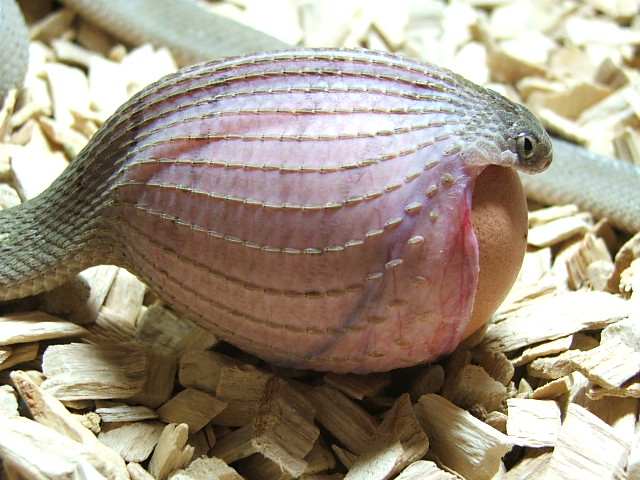
East African Egg-eating Snake, Dasypeltis medici
How do they do that!? That snake is going to choke itself! Got to be a faked, Photoshopped image, right? Think again:


Damn, that's impressive. If you watched the video above, you saw an African Egg-eating Snake, perhaps the most specialized oophagous snake there is, swallow a bird egg whole, crack it open, and regurgitate the  shell. How does it do it? The highly kinetic, flexible skull of this snake allows it to maneuver its jaws around an egg many times bigger than its head, despite the smooth, round surface and the snake's lack of hands. It'd be like a human trying to eat a whole watermelon. Egg-eating snakes lack teeth almost entirely, not needing them for gripping their prey. In addition, the snake's skin is stretchy enough to accommodate the egg's passage - the scale rows are clearly visible, widely separated by the skin in between. Most of the time, this skin can't be seen, because the skin is relaxed so that the rows of scales are in contact with one another.

Once the egg is in the snake's esophagus, how does it get cracked open? Snakes have strong digestive juices, but waiting for them to dissolve the shell of an egg would take too long. OK, are you ready? This is the coolest part:

Vertebral hypapophyses of  African egg-eating snakes, Dasypeltis
See those spines? Those are called hypapophyses, which is a fancy term for things that stick off the bottom (ventral side) of vertebrae. You've got them too - but in egg-eating snakes, they're modified to be much larger and sharper, the better to pierce eggshells with, my dear. At least, the ones on vertebrae 17-38 are, the vertebrae that sit right above the esophagus and thus above egg once it has been swallowed. The esophagus itself is modified as well - it has loose folds, like pockets, into which each of the hypapophyses fits, so that they don't puncture the esophagus itself. See how it works in the following video, from the BBC's Life in Cold Blood:


Starting at 2:45, you can see the moving x-ray of the egg-eating snake swallowing the egg. Continuing through the end of the video, the snake cracks the shell, allows the yolk inside to drain into its stomach, and regurgitates the eggshell. Most amazing, young Dasypeltis don't appear to have these hypapophyses - they grow as the snakes get older, which raises questions about what the juveniles eat. Even though eggs are nutritious, Dasypeltis must feed relatively often for a snake - one that my advisor kept in captivity ate several quail eggs a week.

Lateral view of the skull of Dasypeltis, from Gans 1952
The adaptations of the nine species of Dasypeltis allow them to eat eggs that are very large relative to their body size, and as far as we know they eat almost nothing else. Several generalist snakes also eat eggs; adult Eastern Kingsnakes (Lampropeltis getula), Western Hog-nosed Snakes (Heterodon nasicus), and Formosa Kukrisnakes (Oligodon formosanus) frequently consume reptile eggs, and many members of the rat snake genera Pantherophis and Elaphe opportunistically feed on both eggs and nestling birds. These snakes, however, have no special morphological or behavioral adaptations to assist them in the consumption of eggs. One species, the Japanese rat snake (Elaphe climacophora), can ingest relatively large eggs, and has several vertebral hypapophyses. However, E. climacophora ingests the entire egg, including the shell. Only Dasypeltis, and possibly a poorly-known species from India called Elachistodon westermanni, specialize in ingesting large eggs, then crushing the shell and retaining solely the contents.

Defensive display by Dasypeltis scabra
ACKNOWLEDGMENTS

Thanks to David Marti, Armata, Tony Phelps, and the BBC for images and videos.

REFERENCES

Coleman K, Rothfuss LA, Ota H, Kardong KV (1993) Kinematics of egg-eating by the specialized Taiwan snake Oligodon formosanus (Colubridae). Journal of Herpetology 27:320-327

Gans C (1952) The functional morphology of the egg-eating adaptations in the snake genus Dasypeltis. Zoologica 37:209-244

Gans C, Oshima M (1952) Adaptations for egg eating in the snake Elaphe climacophora (Boie). American Museum Novitates 1571:1-16

Gartner G, Greene H (2008) Adaptation in the African egg-eating snake: a comparative approach to a classic study in evolutionary functional morphology. Journal of Zoology 275:368-374

Mullin SJ (1996) Adaptations facilitating facultative oophagy in the gray rat snake, Elaphe obsoleta spiloides. Amphibia-Reptilia 17:387-394

Mullin SJ, Cooper RJ (1998) The foraging ecology of the Gray Rat Snake (Elaphe obsoleta spiloides)—visual stimuli facilitate location of arboreal prey. The American Midland Naturalist 140:397-401

Savitzky AH (1983) Coadapted character complexes among snakes: fossoriality, piscivory, and durophagy. American Zoologist 23:397-409


Creative Commons License

Life is Short, but Snakes are Long by Andrew M. Durso is licensed under a Creative Commons Attribution-NonCommercial-NoDerivs 3.0 Unported License.

Friday, June 22, 2012

Snakes that chew their food


I have to admit right up front that the title of this article is not really accurate. No snakes chew their food the way we do. Almost all snakes must swallow their food whole, which limits their (often considerable) gape to items they can jaw-walk their kinetic skulls over. Taken as a whole, there are few animals on Earth that snakes do not eat -- whales and dolphins, elephants, animals endemic to the polar regions, some very toxic millipedes. There are snakes that swallow leopards whole, snakes that eat porcupines without removing the quills, snakes that tolerate stabs from catfish spines, snakes that eat other snakes longer than they are. Here's a video of a Tantilla eating a giant centipede. As a group, they can eat nearly anything. They all swallow their prey whole. Almost.


Except for this one
Its genus name is Fordonia, which is probably meaningless, seeing as it was biologist J.E. Gray of the British Museum of Natural History,"well known for inventing many apparently meaningless scientific names", who came up with it (he also named the North American Farancia). Commonly known as the Crab-eating Water Snake or White-bellied Mangrove Snake (after the specific epithet), Fordonia leucobalia is native to the mangrove swamps and tidal mud flats of southeast Asia and northern Australia. It lives in mud lobster and fiddler crab burrows, and moves by jumping across the soft mud, into which it would sink if it tried to slither.

Part of a small but interesting group of live-bearing snakes known as homalopsids, Fordonia is southeast Asia's answer to the North American natricine Nerodia, for many the archetypical semi-aquatic snake. What sets Fordonia apart from other homalopsid snakes, which feed mostly on fishes, is that it eats crabs, an observation first made by Cantor in 1847. (This may be highly cathartic for the snakes, whose primary predators as juveniles include large crabs.)

Those are hard-shelled decapod crustaceans, for you biologists out there 
Like many other arthropods, crabs have an anti-predator adaptation called leg autotomy, similar to tail autotomy in lizards, salamanders, and some snakes. This means that their legs can break off when grabbed and will later regrow - better to lose a limb and escape than to be eaten whole. But Fordonia has evolved behaviors that exploit the crabs' ability to autotomize their legs - it pins the crab's body to the mud and pulls off its legs, eating them one at a time! Sometimes they also consume the crab's body, but often they just leave it behind. This makes Fordonia the only snake that breaks its prey apart prior to eating it, although we must admit that it is somewhat helped along by the crab's autotomy. This discovery was sufficiently exciting to be published in the prestigious journal Nature.


The five crab legs at the top, eaten by this snake, came from a crab about the size of the one on the bottom. The white circle represents the maximum-sized prey item the snake could have eaten whole. Figure from Jayne et al. 2002
The adaptations of Fordonia to cancrivory don't end there. As anyone who has eaten crab legs knows, a crab's exoskeleton is very tough - we humans must use tools to break into it. In order not to be internally lacerated by their prey, Fordonia have evolved extra tough, muscular stomach lining. Other crustacean-eating snakes, such as the North American crayfish snakes (genus Regina), as well as the arthropod-eating False Hook-nosed Snake (Pseudoficimia frontalis, a sonorine snake from western Mexican dry forests), also have thickened muscles surrounding their stomachs, to prevent internal damage from they prey's sharp exoskeletons.


Digestion in snakes is an intense process: their digestive enzymes are very strong, capable of breaking down  even bone. Still, a little mastication can help the digestive process along considerably. For most snakes this isn't an option, because their needle-like teeth and highly mobile skull bones are ill-suited to both cutting and generating bite forces. However, snake biologist Alan Savitzky reported that recently ingested crab legs extracted from Fordonia stomachs were crushed. How is this possible? In fact, Fordonia possess remarkably robust and compact teeth for a snake, almost like molars! Although this is an extreme morphological modification, Savitzky remarked that it is almost surprising that the teeth and skulls of Fordonia aren't more abnormal, considering their unusual diet. Finally, Fordonia has evolved a large salt gland to help maintain osmotic balance on a high-salt diet (crabs are isosmotic to their environment, meaning that they have the same salt content as sea water).

Left: Tooth of Cerberus rynchops; Right: Teeth of Fordonia leucobalia
While Fordonia does all this with hard-shelled crabs, another homalopsid species found in the same mangroves, the Cat-eyed Watersnake (Gerarda prevostiana), has been found to consume freshly-molted (and therefore soft-shelled) crabs in much the same way. This kind of specialization is also found among the four species of North American Crayfish Snakes (Regina) - two of which (R. rigida, R. alleni) have hinged teeth to help them consume hard-shelled crayfish, and two of which (R. grahamii, R. septemvittata) seek out freshly-molted crayfish by smelling their molting secretions. Incredibly, although Gerarda lacks the morphological adaptations for cancrivory of Fordonia, it was observed tearing apart the soft carapaces of crabs after eating their legs, which probably allows Gerarda to consume crabs that would otherwise be too large for them to swallow whole. The feeding mechanisms used by Fordonia and Gerarda differ in the modes of attack and prey restraint, the usual orientation for swallowing crabs, and how pieces were torn from prey, suggesting that they might have evolved their crab-eating habits independently and convergently, rather than inheriting them from a shared common ancestor (although they are evolutionary sisters, one another's closest relatives). Two other closely related genera of homalopsine, Myron and Cantoria, also consume some crustaceans, but are less well-known. How many snakes are out there with strange dietary adaptations that remain to be discovered? We may never know.

This snake only eats soft-shelled crabs - what a snob

ACKNOWLEDGMENTS

Thanks to A. Captain and Brendan Schembri for photographs.

REFERENCES

Alfaro ME, Karns DR, Voris HK, Brock CD, Stuart BL (2008) Phylogeny, evolutionary history, and biogeography of Oriental-Australian rear-fanged water snakes (Colubroidea: Homalopsidae) inferred from mitochondrial and nuclear DNA sequences. Molecular phylogenetics and evolution 46:576-593

Jayne BC, Voris HK, Ng PKL (2002) Snake circumvents constraints on prey size. Nature 418:143

Savitzky AH (1983) Coadapted character complexes among snakes: fossoriality, piscivory, and durophagy. American Zoologist 23:397-409

Shine R, Schwaner T (1985) Prey constriction by venomous snakes: a review, and new data on Australian species. Copeia 1985:1067-1071

Voris HK, Jeffries WB (1995) Predation on marine snakes: a case for decapods supported by new observations from Thailand. Journal of Tropical Ecology 11:569-576

Voris HK, Murphy JC (2002) The prey and predators of Homalopsine snakes. Journal of Natural History 36:1621-1632


Creative Commons License

Life is Short, but Snakes are Long by Andrew M. Durso is licensed under a Creative Commons Attribution-NonCommercial-NoDerivs 3.0 Unported License.

Monday, June 18, 2012

Snake-eating beetles


So little is known about the parasites of snakes that we tend to discount them all together, but the ecological  and evolutionary interactions between hosts and their parasites can be very strong. This is a story about how two enterprising snake biologists solved a mystery that had been puzzling entomologists for decades.

Burying beetles (genus Nicrophorus) conceal small vertebrate carcasses underground and prepare them for consumption by their young by excavating a crypt up to 60 cm deep, removing fur or feathers from the carcass, and covering it in anal secretions to prevent fungal growth. The two parents slowly eat the carcass, defending it from other carrion eaters, and feed regurgitated bits of it to their altricial larvae, which hatch from eggs they lay in the walls of the crypt and beg to be fed like baby birds. Although feeding your babies poop-coated vomit sounds like the plot of a gruesome horror movie, it has been a successful evolutionary strategy for the burying beetles. Their complex social behavior, including biparental care and communal breeding, is unusual among insects. The whole process takes about two weeks.

Nicrophorus pustulatus
Of the nearly 75 species of burying beetle, distributed throughout the Northern Hemisphere, one in particular stands out for its unusual natural history. Entomologists studying the group use dead mice to bait traps, but one species, Nicrophorus pustulatus, never seemed attracted to the carrion. In addition, they are able to produce very large broods (up to 190 vs. 30-45 for most other species of burying beetle) of large offspring on carcasses in the laboratory. Usually, a large brood size comes hand-in-hand with a decrease in individual offspring size, but not in this species apparently. Why not?

Theories ranged from that N. pustulatus used larger carcasses, such as rabbits, without burying them, to that  it was an interspecific brood parasite, like a brown-headed cowbird, laying its eggs in the nests of other burying beetles. But in 2000, a paper in the journal Ecoscience by two snake biologists, Gabriel Blouin-Demers and Patrick Weatherhead, then of Carleton University in Ontario, revealed a surprising discovery. They were studying the nesting ecology of black ratsnakes (Pantherophis obsoletus, formerly Elaphe obsoleta) in Canada by radio-tracking adult female ratsnakes to their oviposition sites. Their purpose was to document the use of communal nests by these snakes and to collect information on clutch size and juvenile survival. When they examined the ratsnake nests they found, they discovered that many of them contained adult and larval  N. pustulatus.

Ratsnake eggs parasitized by carrion beetles
Blouin-Demers and Weatherhead found evidence of beetles in six of the seven nests they looked at. In some nests, only old eggshells with small holes evidenced the beetles' presence, but in others 100% of the eggs were destroyed by the beetles and their larvae. Because black ratsnakes nest communally in this part of the world, up to 111 eggs can constitute a nest, even though the average clutch size is only 11-15 eggs per female. The ratsnakes use the same communal nesting sites year after year, which can be highly beneficial because of increased nest temperature and shorter development time. At such northern latitudes, female ratsnakes do not lay eggs until June or July, and the babies must hatch by late August in order to avoid being killed by an early frost. A mother ratsnake's only parental care is her nest site choice, and research has shown that eggs laid in communal nests hatch earlier, grow larger in their first year, and can even swim faster than those incubated with just their clutchmates. However, the probability of a beetle infection probably increases with increasing nest size, because it only takes one infected egg to spread the beetles to the whole nest. This is why N. pustulatus is so fecund compared to other carrion beetles - because it can raise enormous numbers of larvae on large snake nests, full of nutritious eggs and already hidden away in sites with ideal thermal and humidity.

Black Ratsnake (Pantherophis obsoletus)
Based on their findings, Blouin-Demers and Weatherhead characterized N. pustulatus as a parasitoid of snakes. A parasitoid is different from a parasite because they are parasitic only as larvae (although in this case, with a little help from their parents), and they always kill their host. However, they are also different from predators, because each parasitoid larva only kills a single host individual instead of many. Blouin-Demers and Weatherhead suggested that theirs was the first example of a vertebrate being host to an arthropod parasitoid, and so far they are correct.

The full mystery is far from solved, though. Did N. pustulatus evolve this behavior by first exploiting snake eggs that failed to hatch? How do the beetles find reptile eggs? Are communal nests easier for the beetles to find, or do they simply prefer them because of their higher concentration of resources? How has parasitism by this beetle influenced ratsnake evolution? Do any other species of Nircophorus also parasitize reptile eggs? Does N. pustulatus beetles also parasitize the eggs of other species of snake? Observations of fox snake (Pantherophis vulpinus) nests in Illinois have also yielded beetle larvae. The range of N. pustulatus extends farther north than that of any oviparous snake species (snakes at high latitudes tend to be viviparous, because the females can more precisely control the temperature of their developing offspring if they carry them around). What do they use for rearing their young up there? Could it be turtle eggs, or do they use small animal carcasses like their ancestors?

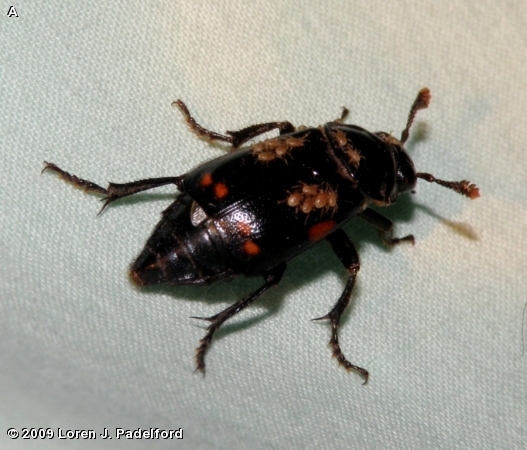
Nicrophorus pustulatus with phoretic mites
From the beetle's perspective, it has arrived at a very successful reproductive strategy by shifting hosts. By moving away from nesting in carcasses, for which they must compete with flies, ants, fungi, bacteria, and scavenging vertebrates such as skunks and raccoons, it has secured an apparently unique niche. As a defense against carcass competitors, some Nicrophorus species carry phoretic mites that eat fly eggs, but lab experiments have shown that the mites sometimes eat the beetles' eggs too, so the benefit is not without risk. Additionally, not having to move or bury snake eggs saves the parent beetles a lot of energy prior to laying their eggs. Experiments have shown that N. pustulatus females oviposit rapidly in house snake (Lamprophis) eggs, and that male beetles elevate their sex pheromone emission in response to snake eggs. Other beetles in the genus Nicrophorus did not show the same response. While N. pustulatus will use mouse carcasses to rear their young in the lab, no one has ever found them doing so in the field. The entomologists who performed these lab tests also found that N. pustulatus adjusted its fecundity to the available mass of snake eggs.

As a driver of evolution in oviparous snake nesting strategies, Nicrophorus pustulatus may play an important role. Could they potentially pose a threat to egg-laying snake species that are of conservation concern, such as the Eastern Indigo Snake (Drymarchon couperi)? What might happen if they were introduced to a continent whose snakes had not evolved with parasitic beetles eating their eggs? There is still so much we don't understand about snake behavior, reproduction, ecology, and evolution, especially in the wild. Thanks to the observations of a few scientists who thought they were studying something else entirely, we are one step closer.


ACKNOWLEDGMENTS

Thanks to Joyce Gross, Loren Padelford, and Gabriel Blouin-Demers for allowing me to use their photographs.

REFERENCES

Blouin-Demers G, Weatherhead PJ (2000) A novel association between a beetle and a snake: parasitism of Elaphe obsoleta by Nicrophorus pustulatus. Ecoscience 7:395-397 <link>

Blouin-Demers G, Weatherhead PJ, Row JR (2004) Phenotypic consequences of nest-site selection in black rat snakes (Elaphe obsoleta). Canadian Journal of Zoology 82:449-456 <link>

Ikeda H, Kubota K, Kagaya T, Abe T (2006) Niche differentiation of burying beetles (Coleoptera: Silphidae: Nicrophorinae) in carcass use in relation to body size: estimation from stable isotope analysis. Applied Entomology and Zoology 41:561-564 <link>

Robertson IC (1992) Relative abundance of Nicrophorus pustulatus (Coleoptera: Silphidae) in a burying beetle community, with notes on its reproductive behavior. Psyche 99:189-198 <link>

Scott MP (1998) The ecology and behavior of burying beetles. Annual Review of Entomology 43:595-618 <link>

Smith G, Trumbo S, Sikes D, Scott M, Smith R (2007) Host shift by the burying beetle, Nicrophorus pustulatus, a parasitoid of snake eggs. Journal of Evolutionary Biology 20:2389-2399 <link

Trumbo ST (2007) Defending young biparentally: female risk-taking with and without a male in the burying beetle, Nicrophorus pustulatus. Behavioral Ecology and Sociobiology 61:1717-1723 <link>

Creative Commons License

Life is Short, but Snakes are Long by Andrew M. Durso is licensed under a Creative Commons Attribution-NonCommercial-NoDerivs 3.0 Unported License.