If you need to identify a snake, try the Snake Identification Facebook group.
For professional, respectful, and non-lethal snake removal and consultation services in your town, try Wildlife Removal USA.
Showing posts with label ratsnakes. Show all posts

Tuesday, January 28, 2014

The first invasive snake

Wolf Snakes (Lycodon aulicus) have become established
on Mauritius, where they threaten native skinks and geckos
Reptiles have been moving around the globe for a long time, often assisted by humans. Skinks and geckos had dispersed to the remotest Pacific islands by about 1600 BCE, at least partly thanks to the aid of the first human colonists of those regions. Brown Tree Snakes (Boiga irregularis) were brought from Australasia to Guam during World War II. In more recent decades, Burmese Pythons (Python molurus) have reached the Everglades, California Kingsnakes (Lampropeltis californiae) the Canary Islands, and Indian Wolf Snakes (Lycodon aulicus) the island of Mauritius in the Indian Ocean. In many cases, these introduced populations of snakes have become invasive, disrupting the native ecosystem in numerous ways, mostly by eating their way through populations of native prey. The indirect effects of these dramatic population declines are unpredictable and profound. For example, on Guam the loss of native forest birds as a result of snake predation led to an explosion of spider populations, with a 40-fold increase in the number of webs compared with nearby islands without invasive snakes that still harbored a native bird community. Although species have been colonizing new ecosystems for a long time, the rapid rate at which they are now being facilitated by global trade is a serious ecological concern. But how new is this problem, exactly?

Where was the first recorded population of introduced snakes? Incredibly, three species of snakes were introduced to the Balearic Islands in the western Mediterranean as far back as 2200 years ago. Having won the Second Punic War, the Roman Republic was expanding west into the Iberian peninsula, which they had taken from Carthage. As a result, transport and trade between the western and central Mediterranean were more regular than ever before, which may help explain the introduction of several species of amphibians and reptiles native to either the European or African mainland to the Balearics. The native people of the Balearics had served as mercenaries under both Rome and Carthage and were renowned for their skill with the sling, but Rome conquered their archipelago anyway shortly after the war and purposefully settled over 3,000 Spanish and Roman colonists there. It's likely that many of these people, understandably, missed their mainland homes, including the native plants and animals to which they were accustomed. They probably brought pet chameleons and tortoises with them, and surprisingly, keeping snakes as pets was also common, so they may have purposefully or accidentally introduced snakes from mainland Europe and Africa for this reason.

Ladder Snake, Rhinechis (Elaphe) scalaris
Their name reflects their dorsal pattern rather than their climbing prowess.
One species, the Ladder Snake (Rhinechis [Elaphe] scalaris), is endemic to the Iberian peninsula. It is a large, adaptable snake that eats mostly small mammals, similar to a North American ratsnake. Although it is easy to see how these snakes could have stowed away on ships, perhaps boarding to eat rats or mice that fed on grain or other goods, it has also been suggested that the Ladder Snake was introduced partly because it played a totemic purpose in mythology and religion. People encouraged non-venomous mammal-eating snakes to take up residence in and near their homes to keep populations of rats and mice under control, and having snakes around the home was thought to maintain the sexual potency of the home's male inhabitants. There is also some evidence that mammal-eating snakes were gathered up and released in areas where epidemics were rampant to help control rat or mouse vectors. This may have led to the association between the Roman god of healing, Aesculapius, whose staff is still a symbol of medicine today, and the Aesculapian Snake (Zamenis [Elaphe] longissimus), a relative of the Ladder Snake.

False Smooth Snake (Macroprotodon mauritanicus)
A smaller species, the False Smooth Snake (Macroprotodon mauritanicus [formerly cucullatus]), is native to northern Africa and southern Spain, where it preys upon small lizards. It might have been introduced to the Balearics accidentally, but no one is really sure how it got there. Apparently, False Smooth Snakes are at least partially responsible (introduced weasels, cats, and genets probably also contributed) for the extinction of an endemic species of lizard, Lilford's Wall Lizard (Podarcis lilfordi), a ground-dwelling, frugivorous species that once dispersed the seeds of a perennial shrub, Daphne rodriguezii. Since the wall lizards began to disappear from the large islands of the Balearics about 2000 years ago, the plants have suffered from a lack of seed disperal, a service formerly provided by the lizard, which would eat the fruit and crap out the seeds. On tiny offshore islets this relationship is still going strong, but on Menorca and Mallorca, where there are many snakes and no lizards, seedlings of D. rodriguezii sprout only underneath their parents, a losing strategy for a young plant.

Viperine Watersnake (Natrix maura)
Finally, the Viperine Watersnake (Natrix maura), a semi-aquatic natricine native to both southwestern Europe and northwest Africa, was introduced to both Menorca and Mallorca in ancient times. During naval battles, both the Phoenicians and the Carthaginians apparently used to throw open jars full of snakes into enemy warships to cause panic among the combatants (apparently even back then nobody could tell the difference between venomous and harmless snakes), which possibly led to or reinforced its populations on the islands. In the Balearics, these watersnakes eat endemic Mallorcan Midwife Toads (Alytes muletensis) (which they consume with impunity despite the frogs' toxins thanks to the snakes' immunity to a wide range of toxins), so a program of active eradication within the range of the frog has been enacted. The Viperine Watersnake could also have been responsible for the extinction of other endemic species of midwife toads never described but historically present.

Snakes may actually be some of the most problematic potential invasive species because they are difficult to detect and almost impossible to eradicate. Research has shown that if you're going to stop an invasive species, you had better stop it early or not at all, a tall order in the face of snakes' impressive crypsis and secretive behavior. Snakes' low energetic requirements allow them to persist through lengthy periods of resource scarcity, and their flexible metabolism allows them to quickly take advantage of resources when they are available, both adaptations to eating infrequent large meals. This scenario is ideal for an individual animal in transit or freshly introduced to a novel environment, who may need to have the ability to remain motionless without feeding or reproducing for long periods of time. Given snakes' long history with people, it's no wonder that Northern and Banded Watersnakes have become established in California, Aesculapian Snakes in Britain, Cornsnakes in the Cayman Islands, Catsnakes in Malta, Monocled Cobras and Habus in the Ryukyu Islands, and many other examples.

ACKNOWLEDGMENTS

Thanks to Rob, Javier Gállego, Aviad Bar, and Jose Zuñiga for the use of their photos.

REFERENCES

Austin, C. C. 1999. Lizards took express train to Polynesia. Nature 397:113-114 <link>

Bruna, E. M., R. N. Fisher, and T. J. Case. 1996. Morphological and genetic evolution appear decoupled in Pacific skinks (Squamata: Scincidae: Emoia). Proceedings of the Royal Society of London. Series B: Biological Sciences 263:681-688 <link>

Lazenby, F. D. 1947. Greek and Roman household pets. The Classical Journal 44:245-252 <link>

Fisher, R. N. 1997. Dispersal and evolution of the Pacific Basin gekkonid lizards Gehyra oceanica and Gehyra mutilata. Evolution 51:906-921 <link>

Pleguezuelos, J. 2002. Las especies introducidas de Anfibios y Reptiles. Pages 501-532 in J. Pleguezuelos, R. Márquez, and M. Lizana, editors. Atlas y Libro Rojo de los Anfibios y Reptiles de España. Dirección General de Conservación de la Naturaleza-Asociación Herpetológica Española, Madrid <link>

Rocha, I. R. S. 2012. Patterns of biological invasion in the herpetofauna of the Balearic Islands: Determining the origin and predicting the expansion as conservation tools. MS thesis. Universidade do Porto <link> <download>

Rogers, H., J. Hille Ris Lambers, R. Miller, and J. J. Tewksbury. 2012. ‘Natural experiment’ demonstrates top-down control of spiders by birds on a landscape level. PLoS ONE 7:e43446 <link>

Traveset, A. and N. Riera. 2005. Disruption of a plant‐lizard seed dispersal system and its ecological effects on a threatened endemic plant in the Balearic Islands. Conservation Biology 19:421-431 <link>

Creative Commons License

Life is Short, but Snakes are Long by Andrew M. Durso is licensed under a Creative Commons Attribution-NonCommercial-NoDerivs 3.0 Unported License.

Monday, December 9, 2013

Blog Carnival: Ecology of Snake Sheds


Today I am participating in my first Blog Carnival (or blogeroclick here for the Spanish edition), which is called #SnakesAtYourService and is about the roles snakes play in ecosystems. Check out the links to the other posts below.

I've already written a series of posts about identifying snake sheds, which is definitely the most common question people ask about them (those three posts make up over a third of all the traffic on this site). People ask other questions about snake sheds much more rarely. In fact, I never stopped to ask some basic questions myself. What are snake sheds made of? What are they used for, and by whom? Where are they found? Do they make substantial contributions to ecology? You might think that because snake sheds are so insubstantial that they don't have much of an impact, but several facts about snakes lead us to believe otherwise.

Part I: Contributions to nutrient cycling

Oodles of Black Swampsnakes (Seminatrix pygaea)
from Ellenton Bay, South Carolina
Snakes can occur at high densities, although their population density can be difficult to measure because snakes are so hard to find. Some estimates provided by snake population ecologist JD Willson in his dissertation included 4-14 vipers per hectare in Scandinavia, 275 vipers per hectare on Shedao Island in China, and over 1000 ring-necked snakes per hectare in Kansas. Aquatic snakes in Ellenton Bay, South Carolina, where I did my undergraduate field research, can reach densities of  170 snakes/ha. I did a couple of back-of-the-envelope calculations using these estimates, plus those for snake shed frequency and shed energetic content, and found that all snakes shedding across the entire continental United States probably generate close to 1.6 billion pounds of shed skin each year, which contain about 3.6 trillion calories of energy. That's enough for everyone in Alabama to survive eating nothing but snake sheds every day all year long (ma, not this for dinner again!), if they could somehow collect all the snake sheds from the entire country. So it isn't an unimaginably immense amount of energy, but it's not insubstantial either. Given the results of this rather bizarre thought exercise, I think it's safe to say that shed snake skin contributes substantially to nutrient cycling in areas where snakes frequently shed.

A food web showing snakes as top predators
What exactly do I mean by nutrient cycling? Think of it as nature's ultimate recycling. It's one example of the services that ecosystems provide for free, and it's why you have regular access to clean water to drink, air to breathe, food to eat, and other essentials, without having to manufacture or engineer systems to produce these things. The cycles of carbon, nitrogen, sulfur, and other elements in and out of the water, air, soil, and the bodies of plants, animals, and microbes, are critical to maintaining a healthy ecosystem. Perturbations can lead to serious imbalances, like the changes to the global carbon cycle that result from the burning of fossils fuels. Few people have investigated the roles that amphibians and reptiles play specifically in nutrient cycling, but we are beginning to suspect that they are important components of many ecosystems. They may be small, but there are a lot of them. For instance, redback salamanders in forests in the northeastern US outnumber all other terrestrial vertebrates combined. On some tropical islands, lizards occur at densities of over 67,000 per hectare. Snakes can occur at really high densities as well, partly because they are so efficient at converting food into biomass as a result of being ectothermic (cold-blooded) and partly because feeding as infrequently as they do reduces the effects of competition with other snakes. By one estimate, snakes are 25 times more efficient at turning food into biomass than carnivorous mammals of equal size, and occur at population densities 20 – 1400 times greater, meaning that they probably contribute disproportionately to nutrient cycling. Explicit investigation of this phenomenon is underway in turtles, which have large bony shells that probably contribute to cycling of calcium and phosphorus, but to my knowledge no one has so far studied this in any snake, let alone for shed snakeskin.

A red-tailed green ratsnake (Gonyosoma oxycephalum)
sheds its skin
In the wild, shed snake skins disintegrate in about a week, although if you collect one and put it in a plastic bag, they can last decades. The chemical composition of snake sheds is poorly known, but they contain some keratin and some lipids, among other things. Some fungi feed on keratin, including those that cause athlete's foot and ringworm as well as the chytrid fungus that has caused amphibian declines worldwide (with disastrous consequences for the snakes that specialize on them), but these species mostly grow on living organisms. Although we don't know for sure, it seems likely that numerous fungi and microbes have probably evolved to take advantage of the abundant energy found in snake sheds. Of course, the dead bodies of the snakes themselves also eventually contribute to nutrient cycling, but depending on the source of mortality, many of those are probably eaten by predators, and fewer probably decompose compared with snake sheds.

Part II: Use by other animals

An Eastern Indigo Snake (Drymarchon couperi)
getting ready to shed
Snakes shed their skin in order to grow bigger. You do this too, just not all in one piece. Once a snake sheds its skin, it's typically done with it. However, both snakes and you might be surprised to learn that snake sheds are frequently used by other animals for a variety of purposes. As I mentioned previously in my article on conservation successes with Eastern Indigo Snakes, snake sheds are really smelly, and specially-trained dogs can sniff out even individual scales left over from a decomposing snake shed. This might be one reason that, although snakes usually spend several days inactive at their shedding site prior to shedding, they don't normally hang around for long afterwards - their predators might have an easier time finding their stinky sloughs than they would finding the snakes themselves. This could be especially true when those predators are other snakes. Some evidence suggests that dogs have an easier time sniffing out snake skins than actual snakes - the indigo-snake -sniffing dogs correctly identified a concealed snake 4 out of 5 times, but they got the sheds right every time. Dogs have also been used to help search cargo on Guam for hitchhiking Brown Tree Snakes, an invasive species which has spread around the Pacific. No word on whether the Brown Tree Snakes were shedding or how this affected the dogs' ability to smell them.

Most shedding sites are protected in some way, because snakes are vulnerable prior to shedding - they cannot see and other functions may be impeded as well. Shed sites used by Black Ratsnakes in Ontario include old barns, old mining machinery, cracks in building foundations, old hay piles, large hollow logs, rock crevices, and standing dead trees. Most of these things sound like something somebody might want to "clean up", but the fact is that they are important habitat features that many amphibians and reptiles use for shedding and also for hibernation. Many burrowing snakes come to the surface to shed, and shedding snakes may remain on the surface even during cold weather, when other snakes have retreated underground.

Sometimes other animals exploit the stink of snake sheds. Ground squirrels in California use them to scent themselves - first they chew up shed rattlesnake skins, then vigorously lick their own fur, which results in  a type of olfactory camouflage that reduces a rattlesnake's ability to correctly identify snake-scented ground squirrels as prey. Rattlesnakes and ground squirrels in California are partners in a coevolutionary relationship that goes back millions of years and has been well-studied by scientists from both the predator's and the prey's point-of-view.

A Great-crested Flycatcher nest with several
snake sheds
Birds use snake sheds in their nests, something people have noticed since at least as far back as the 1800s. Although birds cannot smell, ornithologists (who should study snakes more often) wondered whether the shed skins helped protect eggs or nestling birds by deterring would-be predators. Recently, two experiments have helped determine which predators might be frightened off and whether the strategy really works. Ecologists at Arkansas State University conducted a study to test whether snake skin is an effective deterrent to predators. They found that flying squirrels, a major nest predator, ate the eggs out of 20% of nests without sheds, but didn't depredate any nests with sheds. Because flying squirrels are themselves vulnerable to predation by snakes, this makes intuitive sense. Interestingly, they also noticed that the deterioration rate of the snake skins in their experimental nest boxes (which were not occupied by birds) was much faster than that in real nests, where birds were actively raising chicks. Many of the sheds were eaten by ants, which would probably have been eaten by birds maintaining active nests. Ornithologists in Slovakia found opposing results - nests of great reed warblers festooned with snake sheds were no more or less likely to be depredated by birds and small mammals. However, over a third of reed warblers incorporated grass snake (Natrix natrix) sheds into their nests. When given a choice, two thirds of female reed warblers elected to use sheds left near their nests, whereas only 10% used ribbons of a similar length and color. If they weren't deterring predators, what were they for? The researchers suggested that because snake skins were mainly incorporated by female birds early in the nest-building process, they may have functioned as a signal to male reed warblers that the nest-builder was good at finding rare nest materials, which might lead the male to invest more heavily in helping share the duties of parental care later on in the nesting season.

This holiday season, you can choose from a variety
of snake shed jewelry for that special someone
Humans use snake sheds too. Because of their many similarities with the outermost layer of human skin, shed snake skins are used as model membranes in membrane permeability research, which primarily includes studies of ways to better transport pharmaceuticals into target cells, including some drugs that are inspired by or derived from snake venom (another ecosystem service). Snake sheds are a good alternative to using human, mouse, or synthetic skin, because they are cheap, large, and lack hair. This work is just one of many examples of snakes being used as model organisms to study general concepts in biology. Snake sheds can also be very aesthetically pleasing - many people have taken to creating beautiful snake shed jewelry.

Finally, snakes are themselves very olfactory creatures. Skin lipid pheromones have been shown to play important roles in male combat and in mating behavior, which could mean that sexual selection could act on these chemicals, creating species-specific diversity and dimorphism between males and females, which is mostly lacking in other snakes (except for a few species, including Langaha from Madagascar, where snake play many important cultural and ecological roles). Because most of these pheromones are in the skin, what's the potential for snakes to use their shed skins to mark territories, communicate information about their reproductive stage, select ambush sites, or perform other functions? Really, no one knows. Although territoriality is not the norm in snakes, some species have been suggested to be territorial and others may exhibit other types of social behavior. I hope that by understanding more about the important roles snakes play in ecosystems, people attending this carnival will be more likely to see them as valuable and less likely to fear them. As I hope I've been able to communicate, the old axiom that 'the only good snake is a dead snake' is just not true.

ACKNOWLEDGMENTS

Thanks to JD Willson, Angie Luebben, and Volker Wurst for their photographs and to everyone who helped publicize this blog carnival. A special thanks to the other #SnakesAtYourService blog carnival participants. Be sure to check out their contributions:

Social Snakes: Good Neighbors Make a Greater Impact: How Viper Behavior Increases Their Effect on Prey Populations by Melissa Amarello, @socialsnakes

Living Alongside Wildlife: Kingsnakes Keep Copperheads in Check by David Steen, @AlongsideWild

Nature Afield: Pythons as Model Organisms by Heidi Smith, @HeidiKayDeidi

Ophidiophilia: Converting Ophidiophobes to Ophidiophiles, One Kid at a Time by Emily Taylor, @snakeymama

The Traveling Taxonomist: Snakes of Madagascar: Cultural and Ecological Roles by Mark Scherz, @MarkScherz

Strike, Rattle, & Roll: Snakes and the Ecology of Fear by Bree Putman, @breeput

Australian Museum: When the Frogs Go, the Snakes Follow by Jodi Rowley, @jodirowley

SnakeBytes: The Brown Tree Snake of Guam by Brian Barczyk (@SnakeBytesTV

REFERENCES

Blem, C. R. and M. P. Zimmerman. 1986. The energetics of shedding: energy content of snake skin. Comparative Biochemistry and Physiology Part A: Physiology 83:661-665 <link>

Blouin-Demers, G. and P. Weatherhead. 2001. Habitat use by black rat snakes (Elaphe obsoleta obsoleta) in fragmented forests. Ecology 82:2882-2896 <link>

Clark, R. W. 2007. Public information for solitary foragers: timber rattlesnakes use conspecific chemical cues to select ambush sites. Behavioral Ecology 18:487-490 <link>

Clucas, B., D. H. Owings, and M. P. Rowe. 2008. Donning your enemy's cloak: ground squirrels exploit rattlesnake scent to reduce predation risk. Proceedings of the Royal Society B: Biological Sciences 275:847-852 <link>

Engeman, R. M., D. V. Rodriquez, M. A. Linnell, and M. E. Pitzler. 1998. A review of the case histories of the brown tree snakes (Boiga irregularis) located by detector dogs on Guam. International Biodeterioration & Biodegradation 42:161-165 <link>

Itoh, T., J. Xia, R. Magavi, T. Nishihata, and J. H. Rytting. 1990. Use of shed snake skin as a model membrane for in vitro percutaneous penetration studies: comparison with human skin. Pharmaceutical Research 7:1042-1047 <link>

Medlin, E. C. and T. S. Risch. 2006. An experimental test of snake skin use to deter nest predation. The Condor 108:963-965 <link>

Stevenson, D. J., K. R. Ravenscroft, R. T. Zappalorti, M. D. Ravenscroft, S. W. Weigley, and C. L. Jenkins. 2010. Using a wildlife detector dog for locating Eastern Indigo Snakes (Drymarchon couperi). Herpetological Review 41:437-442.

Trnka, A. and P. Prokop. 2011. The use and function of snake skins in the nests of Great Reed Warblers Acrocephalus arundinaceus. Ibis 153:627-630 <link>

Willson, J. D. 2009. Integrative approaches to exploring functional roles of clandestine species: a case study of aquatic snakes within isolated wetland ecosystems. PhD dissertation, University of Georgia, Athens, GA <link>

Creative Commons License

Life is Short, but Snakes are Long by Andrew M. Durso is licensed under a Creative Commons Attribution-NonCommercial-NoDerivs 3.0 Unported License.

Monday, June 18, 2012

Snake-eating beetles


So little is known about the parasites of snakes that we tend to discount them all together, but the ecological  and evolutionary interactions between hosts and their parasites can be very strong. This is a story about how two enterprising snake biologists solved a mystery that had been puzzling entomologists for decades.

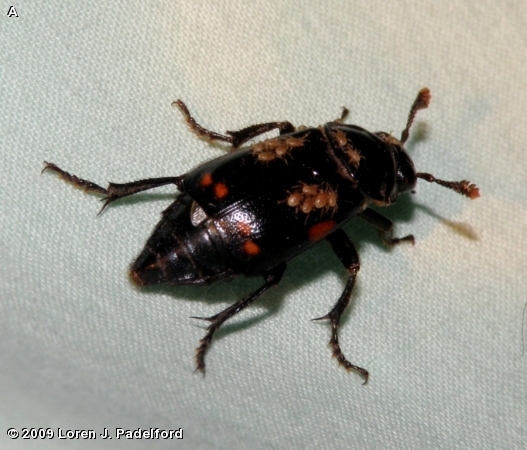
Burying beetles (genus Nicrophorus) conceal small vertebrate carcasses underground and prepare them for consumption by their young by excavating a crypt up to 60 cm deep, removing fur or feathers from the carcass, and covering it in anal secretions to prevent fungal growth. The two parents slowly eat the carcass, defending it from other carrion eaters, and feed regurgitated bits of it to their altricial larvae, which hatch from eggs they lay in the walls of the crypt and beg to be fed like baby birds. Although feeding your babies poop-coated vomit sounds like the plot of a gruesome horror movie, it has been a successful evolutionary strategy for the burying beetles. Their complex social behavior, including biparental care and communal breeding, is unusual among insects. The whole process takes about two weeks.

Nicrophorus pustulatus
Of the nearly 75 species of burying beetle, distributed throughout the Northern Hemisphere, one in particular stands out for its unusual natural history. Entomologists studying the group use dead mice to bait traps, but one species, Nicrophorus pustulatus, never seemed attracted to the carrion. In addition, they are able to produce very large broods (up to 190 vs. 30-45 for most other species of burying beetle) of large offspring on carcasses in the laboratory. Usually, a large brood size comes hand-in-hand with a decrease in individual offspring size, but not in this species apparently. Why not?

Theories ranged from that N. pustulatus used larger carcasses, such as rabbits, without burying them, to that  it was an interspecific brood parasite, like a brown-headed cowbird, laying its eggs in the nests of other burying beetles. But in 2000, a paper in the journal Ecoscience by two snake biologists, Gabriel Blouin-Demers and Patrick Weatherhead, then of Carleton University in Ontario, revealed a surprising discovery. They were studying the nesting ecology of black ratsnakes (Pantherophis obsoletus, formerly Elaphe obsoleta) in Canada by radio-tracking adult female ratsnakes to their oviposition sites. Their purpose was to document the use of communal nests by these snakes and to collect information on clutch size and juvenile survival. When they examined the ratsnake nests they found, they discovered that many of them contained adult and larval  N. pustulatus.

Ratsnake eggs parasitized by carrion beetles
Blouin-Demers and Weatherhead found evidence of beetles in six of the seven nests they looked at. In some nests, only old eggshells with small holes evidenced the beetles' presence, but in others 100% of the eggs were destroyed by the beetles and their larvae. Because black ratsnakes nest communally in this part of the world, up to 111 eggs can constitute a nest, even though the average clutch size is only 11-15 eggs per female. The ratsnakes use the same communal nesting sites year after year, which can be highly beneficial because of increased nest temperature and shorter development time. At such northern latitudes, female ratsnakes do not lay eggs until June or July, and the babies must hatch by late August in order to avoid being killed by an early frost. A mother ratsnake's only parental care is her nest site choice, and research has shown that eggs laid in communal nests hatch earlier, grow larger in their first year, and can even swim faster than those incubated with just their clutchmates. However, the probability of a beetle infection probably increases with increasing nest size, because it only takes one infected egg to spread the beetles to the whole nest. This is why N. pustulatus is so fecund compared to other carrion beetles - because it can raise enormous numbers of larvae on large snake nests, full of nutritious eggs and already hidden away in sites with ideal thermal and humidity.

Black Ratsnake (Pantherophis obsoletus)
Based on their findings, Blouin-Demers and Weatherhead characterized N. pustulatus as a parasitoid of snakes. A parasitoid is different from a parasite because they are parasitic only as larvae (although in this case, with a little help from their parents), and they always kill their host. However, they are also different from predators, because each parasitoid larva only kills a single host individual instead of many. Blouin-Demers and Weatherhead suggested that theirs was the first example of a vertebrate being host to an arthropod parasitoid, and so far they are correct.

The full mystery is far from solved, though. Did N. pustulatus evolve this behavior by first exploiting snake eggs that failed to hatch? How do the beetles find reptile eggs? Are communal nests easier for the beetles to find, or do they simply prefer them because of their higher concentration of resources? How has parasitism by this beetle influenced ratsnake evolution? Do any other species of Nircophorus also parasitize reptile eggs? Does N. pustulatus beetles also parasitize the eggs of other species of snake? Observations of fox snake (Pantherophis vulpinus) nests in Illinois have also yielded beetle larvae. The range of N. pustulatus extends farther north than that of any oviparous snake species (snakes at high latitudes tend to be viviparous, because the females can more precisely control the temperature of their developing offspring if they carry them around). What do they use for rearing their young up there? Could it be turtle eggs, or do they use small animal carcasses like their ancestors?

Nicrophorus pustulatus with phoretic mites
From the beetle's perspective, it has arrived at a very successful reproductive strategy by shifting hosts. By moving away from nesting in carcasses, for which they must compete with flies, ants, fungi, bacteria, and scavenging vertebrates such as skunks and raccoons, it has secured an apparently unique niche. As a defense against carcass competitors, some Nicrophorus species carry phoretic mites that eat fly eggs, but lab experiments have shown that the mites sometimes eat the beetles' eggs too, so the benefit is not without risk. Additionally, not having to move or bury snake eggs saves the parent beetles a lot of energy prior to laying their eggs. Experiments have shown that N. pustulatus females oviposit rapidly in house snake (Lamprophis) eggs, and that male beetles elevate their sex pheromone emission in response to snake eggs. Other beetles in the genus Nicrophorus did not show the same response. While N. pustulatus will use mouse carcasses to rear their young in the lab, no one has ever found them doing so in the field. The entomologists who performed these lab tests also found that N. pustulatus adjusted its fecundity to the available mass of snake eggs.

As a driver of evolution in oviparous snake nesting strategies, Nicrophorus pustulatus may play an important role. Could they potentially pose a threat to egg-laying snake species that are of conservation concern, such as the Eastern Indigo Snake (Drymarchon couperi)? What might happen if they were introduced to a continent whose snakes had not evolved with parasitic beetles eating their eggs? There is still so much we don't understand about snake behavior, reproduction, ecology, and evolution, especially in the wild. Thanks to the observations of a few scientists who thought they were studying something else entirely, we are one step closer.


ACKNOWLEDGMENTS

Thanks to Joyce Gross, Loren Padelford, and Gabriel Blouin-Demers for allowing me to use their photographs.

REFERENCES

Blouin-Demers G, Weatherhead PJ (2000) A novel association between a beetle and a snake: parasitism of Elaphe obsoleta by Nicrophorus pustulatus. Ecoscience 7:395-397 <link>

Blouin-Demers G, Weatherhead PJ, Row JR (2004) Phenotypic consequences of nest-site selection in black rat snakes (Elaphe obsoleta). Canadian Journal of Zoology 82:449-456 <link>

Ikeda H, Kubota K, Kagaya T, Abe T (2006) Niche differentiation of burying beetles (Coleoptera: Silphidae: Nicrophorinae) in carcass use in relation to body size: estimation from stable isotope analysis. Applied Entomology and Zoology 41:561-564 <link>

Robertson IC (1992) Relative abundance of Nicrophorus pustulatus (Coleoptera: Silphidae) in a burying beetle community, with notes on its reproductive behavior. Psyche 99:189-198 <link>

Scott MP (1998) The ecology and behavior of burying beetles. Annual Review of Entomology 43:595-618 <link>

Smith G, Trumbo S, Sikes D, Scott M, Smith R (2007) Host shift by the burying beetle, Nicrophorus pustulatus, a parasitoid of snake eggs. Journal of Evolutionary Biology 20:2389-2399 <link

Trumbo ST (2007) Defending young biparentally: female risk-taking with and without a male in the burying beetle, Nicrophorus pustulatus. Behavioral Ecology and Sociobiology 61:1717-1723 <link>

Creative Commons License

Life is Short, but Snakes are Long by Andrew M. Durso is licensed under a Creative Commons Attribution-NonCommercial-NoDerivs 3.0 Unported License.