If you need to identify a snake, try the Snake Identification Facebook group.
For professional, respectful, and non-lethal snake removal and consultation services in your town, try Wildlife Removal USA.
Showing posts with label Ophiophagus. Show all posts

Friday, March 31, 2017

Snakebite, antivenom research, and basic science

In the past few weeks, a peculiar congruence of several seemingly-unrelated events took place. (At least) two new scientific papers about snake biology were published, a new video series was announced, some scientists entered contests, and the U.S. executive branch announced a budget proposal with deep cuts to science funding. However, these events aren't as unrelated at they might seem at first glance, and they have something to tell us about where snake biology, and science in general, are going in the future.

The science: part I (puff adders)

A puff adder (Bitis arietans)
Puff Adders (Bitis arietans) are among Africa's most widespread vipers. They are heavy-bodied snakes that are found in savannas and open woodlands. Like most vipers, they eat mostly rodents as adults, which they ambush from carefully-selected sites, which they sometimes occupy for weeks at a time. Recently, Xavier Glaudas and Graham Alexander published a new study showing that, even though Puff Adder strikes last less than two seconds, they can choose to either hold onto or let go of the prey depending on its size. Specifically, they hold onto small mice, shrews, birds, toads, and lizards, but strike & release larger rodents and rabbits, because retaliatory rat bites are dangerous to them. After they let go of these larger prey, which usually run off a short distance before the venom kills them, they track them down again using stereotypic strike-induced chemosensory searching behavior to locate the scent of non-toxic components of their own venom. This is really similar to findings by Bree Putman and Rulon Clark that Southern Pacific Rattlesnakes (Crotalus oreganus) were more likely to hold onto smaller rodents than to larger ground squirrels. You can watch 26 awesome videos selected from an archive of thousands of hours of video taken in the wild over more than two years.1

This research matters because venomous snakes and their prey are in constant evolutionary arms races, leading to:
  1. a mosaic of new biochemical compounds that are often useful in treating disease
  2. a mosaic of new biochemical compounds that can make venomous snakebite really hard to treat
We'll come back to the second one in a minute. The obvious importance of human medicine and venomous snakebite treatment overshadow a third important reason to study snakes and what they eat. Although the beneficial role of snakes in rodent control is taken as gospel by many advocates of snake conservation, the amount of data that we actually have on what snakes eat in the wild is surprisingly small. For many species, we don't even have a general idea of what kinds of prey they like to eat. Given recent estimates that spiders eat about as much meat as people do worldwide, and the potential for snakes to reach very high population densities in certain habitats, it's likely that the top-down effects of snakes as predators are significant ecosystem services that most humans aren't aware of and thus undervalue. Indirect effects on other aspects of the ecology of snake prey species, such as predation release and disease transmission, link snake predation even more strongly to human health. This is particularly timely in light of recent predictions that 2017 will be a big year for white-footed mice and thus for Lyme disease in the northeastern USA, controversy over the reintroduction of Timber Rattlesnakes, one of the white-footed mouse's top predators, to Quabbin Island in Massachusetts2, and the continuation of both the infamous Sweetwater Rattlesnake Roundup3 and the reformed Claxton Wildlife Festival and Lone Star Rattlesnake Days earlier this month.

The science: part II (how cobras got their flesh-eating venoms)

A Mozambique spitting cobra (Naja mossambica) spitting its venom
Spitting cobras are even more well-known than puff adders because of their defensive venom spitting abilities, showcased on the BBC's Life in Cold Blood. They are found in Africa and Asia and are thought to have evolved two or three times from non-spitting cobras. A new paper from the lab of Bryan Fry at the University of Queensland sheds some light on when and why venom spitting evolved. Elapid snakes, including cobras, have venoms rich in neurotoxins, which are highly potent toxins that are very effective at paralyzing their prey. Cobras also have less potent cytotoxins that kill cells directly, which is a bit weird. What is the function of these toxins?

Toxicity of snake venom to human cells grown in culture.
Warm colors indicate higher toxicity.
From Panagides et al. 2017
The hypothesis put forth here is that the first step towards venom spitting was the evolution of hooding behavior and morphology, which happened twice in elapids: once in "regular" cobras and once in King Cobras, which are more closely related to mambas. Only once a conspicuous visual display was present was there selective pressure for cytotoxic venom components delivered to the eyes of potential predators via spitting. Although the venom of both groups is cytotoxic, Hemachatus (rinkhals) and Naja cobras use three-finger toxins, whereas King Cobras use L-amino acid oxidase enzymes, consistent with the undirected, opportunistic nature of our current model of venom evolution by gene duplication and mutation. The authors suggest that further elevations in cytotoxicity are linked to bright bands and other aposematic colors or hood markings, although their paper did not attempt to quantify these attributes of cobra displays, which can be quite diverse even within species. Further evidence in support of the hypothesis is that Naja naja and Naja oxiana seem, based on their nested position, to have lost spitting but to have retained cytotoxicity, and their close relatives Naja atra and Naja kaouthia might represent steps down this evolutionary path, being capable of spitting only in some populations and with less accuracy than the African and southeast Asian clades of true spitting cobras.

This is an extremely cool and popular topic. It was covered by IFLS, The Wire, Gizmodo, and the Washington Post. It goes to show that people worldwide are fascinated by venomous snakes, and the Fry lab has done a great job capitalizing on that interest (among other accolades, Fry's graduate student Jordan Debono recently won the Queensland Women in Science Peoples' Choice Award [a contest that was decided by an online popular vote; more on this later] for her research on global snakebite treatments). One reason for this fascination has to do with the question of who, exactly, these cobras are defending themselves from? The most reasonable hypothesis, given the timing and geography of the diversification of spitting cobras and the precision with which they can target forward-facing eyes and hominoid faces, is primates. Us, and our ancestors, who have eaten and been eaten by snakes for millions of years. Studying spitting cobras is a window into our own evolutionary past, a way for us to learn about ourselves. But, let us not be misled into thinking that interactions between humans and cobras are a thing of the past.

The upshot: the truth about snakebite

You can follow the ASV @Venimologie
If you haven't read the blog by medical toxinologist Leslie Boyer, you really should. Earlier this month she wrote about the vicious circle of antivenom shortage in sub-Saharan Africa, where millions of people are bitten by venomous snakes every year, many of which die or suffer awful injuries because they lack access to good antivenom. This crisis has prompted the creation of the African Society of Venimology and a new series of snakebite training videos in English, French, and Spanish. The politics and economics of antivenom are complicated and reflect larger issues in medicine, education, quality control, supply and demand, and how global economics and corporations have failed to respond to the needs of local communities and consumers. In a nutshell, the issue is that antivenom manufacturers don't make enough good antivenom, because not enough people buy it. People don't buy it because it's expensive, and it's expensive because not that much is made. This is despite a huge need for it—but not everybody with a snakebite goes to a hospital and gets antivenom in Africa, partially because it's not certain there will be any and partially because a lot of patients and doctors don't know about antivenom, because it's not in widespread use (which is mostly because of the reasons above). Other exacerbating problems include that it's often not certified, fake products can price the real antivenom out of the market, and the infrastructure for distributing antivenom and information in Africa is sub-optimal (but improving). Fixing any one or even most of these problems won't fix the whole system—if any one of them break down, supply and demand will be out of balance and people won't get the care they need.

A lot of the same issues used to be present in Mexico, but product improvements, government outreach, and massive education efforts in the 1980s and 1990s dramatically reduced mortality from venomous snakebite and led Mexico to become a major producer and consumer of high-quality, affordable antivenom, so much so that the USA now imports some of these drugs from Mexico. The Mexican government enabled the Mexican antivenom industry to be competitive and reach its market, which is much larger than the domestic market for American antivenom manufacturers—medically-serious venomous snakebites (and scorpion stings) in the USA are mostly confined to the southwest, and the per-capita risk of snakebite is the lowest in the world. This creates its own unique problems. You may have heard about the controversy surrounding the discontinued coralsnake antivenom made by Wyeth, and there are compelling arguments that the Mexican polyvalent antivenoms Anavip (made by Bioclon for humans) and ViperSTAT (made by Veteria Labs for cats and dogs) are more effective and much less expensive (although this is due almost exclusively to the idiosyncrasies of the US healthcare finance system) than the only FDA-approved viper antivenom, CroFab (although BTG, the maker of CroFab, filed a complaint asserting that these Mexican products infringe on its patent).

Finally, the global importance of the availability of high-quality, affordable antivenom for Latin American, African, and other exotic snakes is only going to increase as venomous snakes become more popular as pets and in zoos. This is particularly true in parts of the world completely lacking venomous snakes or with only very benign, non-life-threatening species, such as northern Europe, Scandinavia and northern North America, where doctors may be totally unprepared for a snakebite emergency and may not have appropriate antivenom on hand. This is exactly the kind of situation where government funding, in the form of orphan disease R&D grants, could play a role in making it affordable for researchers and doctors to save lives.

For a great introduction to and more in-depth coverage of these issues, you should watch The Venom Interviews or read their coverage of the recent video series.

The future: sequence the Temple Pitviper genome

Temple or Wagler's Pitvipers (Tropidolaemus wagleri)
at the famous Temple of the Azure Cloud in Penang, Malaysia
You can vote to sequence their genome here!
Genomics of snakes is taking off in a big way, and we stand to learn a lot more about the evolution and function of snake venoms and the treatment of their effects. But, funding for basic science isn't a priority for many people, and more and more scientists are turning to crowd-funding their research or relying on limited funding from private foundations, which often decide which projects to fund through a crowd-sourced voting process. This isn't necessarily a bad thing; in fact, I think it's a great thing in many cases. But, it's important to realize that government funding for science is different from private funding in two crucial ways: 1) there is a lot more of it (at least for now), and 2) it's not driven by specific, private interests. A great example is the Orianne Society, a non-profit reptile conservation organization whose founding purpose was preventing the extinction of Eastern Indigo Snakes (Drymarchon couperi). Thanks to generous donations from private funding sources, the Society succeeded in purchasing large areas of critical habitat for this endangered snake and protecting them in perpetuity, probably the most effective and laudable conservation goal in existence. Another good example is the work of the Durrell Wildlife Conservation Trust, who have essentially saved a globally-rare snake, Casarea dussumieri, from extinction in the wild. I wish the quality conservation work that these organizations have become well-known for were more common, but to date their donors are some of the only large private backers of reptile research and conservation in the world.

Snakes are part of human economics, albeit to a lesser extent than many insects, fishes, birds, and mammals—they are hunted for food (although there are many issues surrounding better management of unsustainable harvests), kept as pets, their skins made into leather, and their venom harvested to make antivenom and other drugs. But, in their current form, these industries place very little emphasis on finding out more about snake biology in the wild; it just isn't necessary for them to make a profit, even though the information is important for what they do. Antivenom manufacturers are accountable to their shareholders, but trying to block FDA approval of Mexican antivenom is certainly not going to result in better treatment for snakebite victims in the USA, and American companies aren't investing in any research to create new, better products themselves, since drug development is expensive and risky, and they already have a monopoly on antivenom in the USA.

It's no secret that snakes and snake research have a PR problem: even scientific journals are less likely to publish research articles about snakes than about mammals and birds (although the bias is likely subliminal). Many people prefer cute fuzzy animals that are similar to humans, but research into the biology of un-fuzzy animals is equally important. There's a parallel to the divide between funding for basic and applied science. Basic science isn't usually as sexy as the exciting, fun applications that come later, like saving lives, curing diseases, or discovering new complex biological phenomena. However, important applied science like antivenom creation cannot happen without basic science, in particular basic science on snakes. Private companies can't afford to invest in basic science the way they once did. Which leaves government funding and that from a limited number of interested, private backers.

We should support public funding for science and elect politicians who will do the same; better treatment for snakebite should be the least partisan and most universally-agreed-upon goal in the world. I think the path between basic (snake ecology, venomics, and genomics) and applied (antivenom manufacturing and public health) science is shorter and clearer in this context than in many, but the same principles apply—you cannot have medicine, conservation, and the other good parts of civilization without science.

You can vote now through April 5th 2017 for a project sequencing the entire genome of the Temple Pitviper (Tropidolaemus wagleri) co-led by Ryan McCleary.

Stay tuned for more about the role of snake venom proteins in treating human diseases, and the role of snakes as predators in ecosystems.


1 Naturally, I wanted to link to the full-text of the paper so that anyone interested in learning more could read it, but the publisher (Wiley) has a 12-month embargo on posting the PDF anywhere online. They actually expect you to pay between $6 and $38 to read the article. Now, I think it's great research, and it probably cost Glaudas, Alexander, and their university thousands of dollars and thousands of hours to do it. But, if you pay Wiley to read their paper, none of that money will go to them, nor to the scientists who peer-reviewed their work for free. It will go to Wiley, who Xav paid (maybe) to publish. They could have paid $3,000 to make it open access, but you can understand why they didn't. No wonder most most science is read by fewer than 10 people. It's an outdated model that can't go away fast enough. In contrast, the spitting cobra paper is open access, which cost its authors over $1,500. This is typical; academic authors almost always lose money on a publication.↩


2 Recent update here; you can write the governor of Massachusetts here.↩


3 Reports suggest that this year, like last year, a much larger number of live rattlesnakes were collected than markets could support, and at least one person died from a snakebite sustained while trying to capture a rattlesnake for a roundup.↩

ACKNOWLEDGMENTS

Thanks to Bryan Fry for alerting me in advance of his publication, and to Colin Donahue, Markus Oulehla, and Ian Glover for the use of their photos.

REFERENCES

Bonnet, X., R. Shine, and O. Lourdais. 2002. Taxonomic chauvinism. Trends in Ecology & Evolution 17:1-3 <link>

Boyer, L. V. 2016. On 1000-Fold Pharmaceutical Price Markups and Why Drugs Cost More in the United States than in Mexico. The American Journal of Medicine 128:1265-1267 <full-text>

Boyer, L. V. and A.-M. Ruha. 2016. Pitviper Envenomation Guidelines Should Address Choice Between FDA-approved Treatments for Cases at Risk of Late Coagulopathy. Wilderness and Environmental Medicine. 27:341–342 <full-text>

Boyer, L. V., P. B. Chase, J. A. Degan, G. Figge, A. Buelna-Romero, C. Luchetti, and A. Alagón. 2013. Subacute coagulopathy in a randomized, comparative trial of Fab and F (ab′) 2 antivenoms. Toxicon 74:101-108 <full-text>

Cao, N. V., N. T. Tao, A. Moore, A. Montoya, A. Rasmussen, K. Broad, H. Voris, and Z. Takacs. 2014. Sea snake harvest in the Gulf of Thailand. Conservation Biology 28:1677-1687 <full-text>

Chew, M., A. Guttormsen, C. Metzsch, and J. Jahr. 2003. Exotic snake bite: a challenge for the Scandinavian anesthesiologist? Acta Anaesthesiologica Scandinavica 47:226-229 <full-text>

Chippaux, J.-P. 2012. Epidemiology of snakebites in Europe: a systematic review of the literature. Toxicon 59:86-99 <full-text>

Glaudas, X., T. C. Kearney, and G. J. Alexander. 2017. To hold or not to hold? The effects of prey type and size on the predatory strategy of a venomous snake. Journal of Zoology 10.1111/jzo.12450 <abstract>

Glaudas, X. and G. Alexander. 2017. Food supplementation affects the foraging ecology of a low-energy, ambush-foraging snake. Behavioral Ecology and Sociobiology 71:5 <link>

Margres, M. J., J. J. McGivern, M. Seavy, K. P. Wray, J. Facente, and D. R. Rokyta. 2015. Contrasting modes and tempos of venom expression evolution in two snake species. Genetics 199:165-176 <full-text>

McCleary, R. J. and R. M. Kini. 2013. Non-enzymatic proteins from snake venoms: a gold mine of pharmacological tools and drug leads. Toxicon 62:56-74 <full-text>

Natusch, D. J. D., J. A. Lyons, Mumpuni, A. Riyanto, S. Khadiejah, N. Mustapha, Badiah, and S. Ratnaningsih. 2016. Sustainable Management of the Trade in Reticulated Python Skins in Indonesia and Malaysia. IUCN, Gland, Switzerland <full-text>

Nyffeler, M. and K. Birkhofer. 2017. An estimated 400–800 million tons of prey are annually killed by the global spider community. The Science of Nature 104:30 <full-text>

Panagides, N., Timothy N. Jackson, R. Pretzler, M. P. Ikonomopoulou, Kevin Arbuckle, D. C. Yang, S. A. Ali, I. Koludarov, J. Dobson, B. Sanker, A. Asselin, R. C. Santana, I. Hendrikx, Harold van der Ploeg, J. Tai-A-Pin, R. v. d. Bergh, H. M. I. Kerkkamp, F. J. Vonk, A. Naude, M. Strydom, L. Jacobsz, N. Dunstan, M. Jaeger, W. C. Hodgson, J. Miles, and Bryan G. Fry. 2017. How the cobra got its flesh-eating venom: cytotoxicity as a defensive innovation and its co-evolution with hooding and spitting. Toxins 9 <full-text>

Putman, B. J., M. A. Barbour, and R. W. Clark. 2016. The foraging behavior of free-ranging Rattlesnakes (Crotalus oreganus) in California Ground Squirrel (Otospermophilus beecheyi) colonies. Herpetologica 72:55-63 <full-text>

Stock, R. P., A. Massougbodji, A. Alagon, and J.-P. Chippaux. 2007. Bringing antivenoms to Sub-Saharan Africa. Nature Biotechnology 25:173-177 <full-text>

Wade, L. 2014. For Mexican antivenom maker, US market is a snake pit. Science 343:16-17 <full-text>

Willson, J. D. 2016. Indirect effects of invasive Burmese pythons on ecosystems in southern Florida. Journal of Applied Ecology 10.1111/1365-2664.12844 <full-text>

Willson, J. D. and C. T. Winne. 2016. Evaluating the functional importance of secretive species: A case study of aquatic snake predators in isolated wetlands. Journal of Zoology 298:266-273 <full-text>

Creative Commons License

Life is Short, but Snakes are Long by Andrew M. Durso is licensed under a Creative Commons Attribution-NonCommercial-NoDerivs 3.0 Unported License.


Monday, November 30, 2015

Snakes that are Good Parents

Almost all mammals and birds care for their young to some extent, but most amphibians and reptiles do not. We tend to think of snakes as particularly asocial, and in many cases this is probably true. But, a growing body of evidence contradicts the generalization, made as recently as 1978, that "all reptiles produce precocial offspring without postnatal parental care", and shows that some snakes, in particular, are more caring parents than we typically think.

Vipers

A female Timber Rattlesnake (Crotalus horridus)
with her newly-born young
Probably the group of snakes most well-known for parental care are now the vipers, which is somewhat ironic considering the fierce but undeserved reputation of these venomous snakes. Although it was documented as early as 1850, parental care by vipers was not widely known or accepted by the scientific community until the 1990s; like crocodilians, it was assumed that these animals were too vicious to exhibit such caring behavior. When Laurence Klauber, at the time the world's foremost authority on rattlesnakes, wrote in 1956 that "Their propinquity [to aggregate]...does not result from any maternal solicitude; rather it is only because the refuge sought by the mother is also used as a hiding place by the young.", he was uncharacteristically incorrect; in hindsight, his words now seem almost willfully ignorant. In the 1990s, credible reports of parental care in wild pitvipers began to accumulate, corroborating the many older stories listed by Klauber, and in 2002, a seminal review paper based around two studies using radio-telemetry and DNA proved once and for all that mother rattlesnakes do stay with and care for their young. Today, you can read a whole blog about parental care in rattlesnakes, and we think that parental care is widespread (but not ubiquitous) among the ~230 species of pitvipers (aka crotalines or New World vipers). This is particularly remarkable because many of them give birth to live young, which they guard until the young's first shed, even though they may not have eaten for 9-10 months beforehand. It appears that the completion of the first shed cycle is the cue for them to separate, an event which is mediated by the same hormone in snakes as it is in birds and mammals. Because snakes swallow their food whole, the mother can't really feed her offspring, and they forage for themselves after they disperse. Pitvipers are the only snakes known to care for their living young; other snakes with parental care limit themselves to care of their eggs.

Pythons

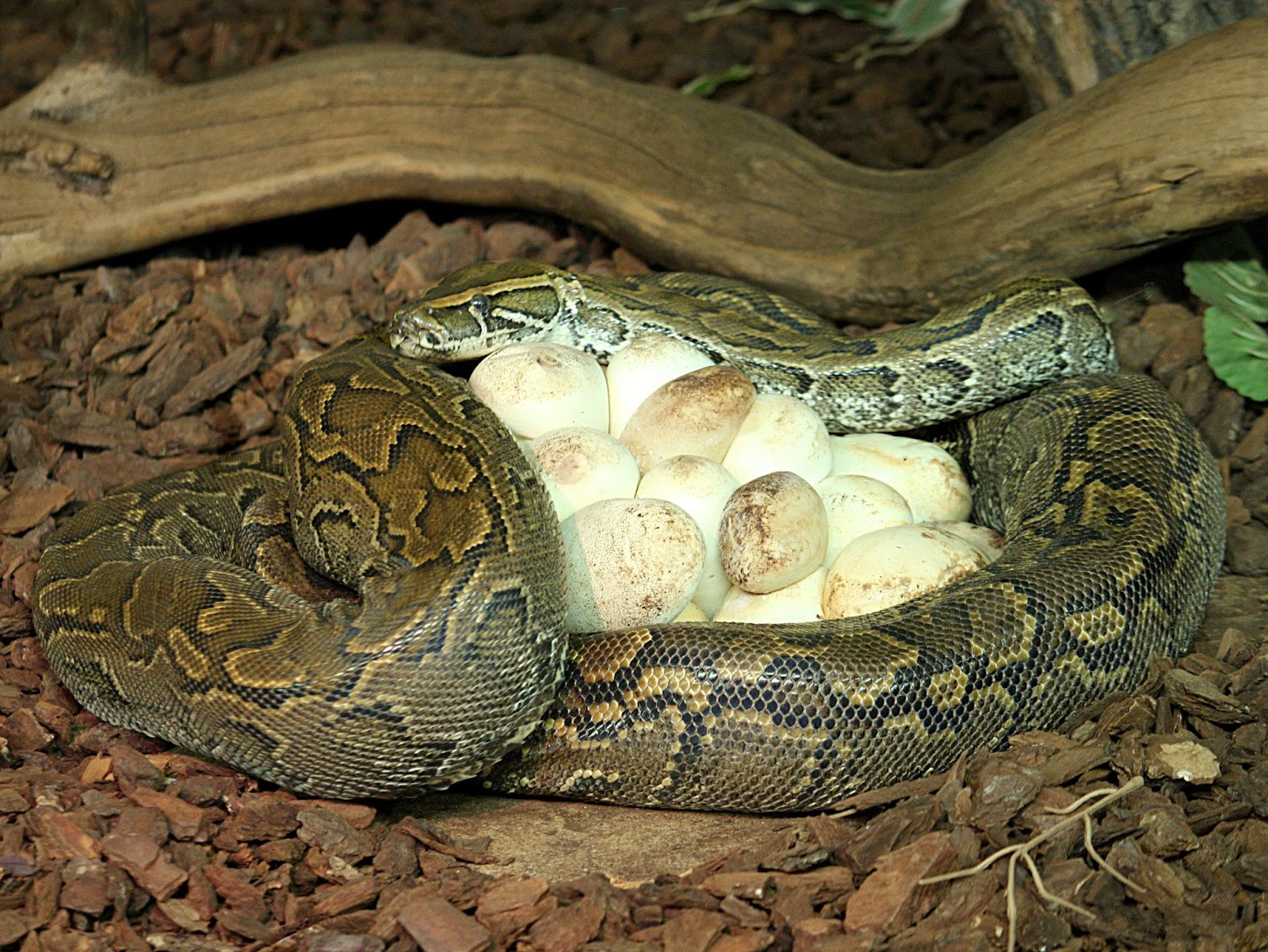
A mother African Rock Python (Python sebae)
brooding her eggs
The next most well-known example of parental care in snakes is egg-brooding behavior in pythons, first documented in 1835. All 40 species of pythons lay eggs, and most of them coil tightly around them throughout incubation, forsaking food. As with vipers, early reports of this behavior were dismissed, but by the 1930s observations of pythons in zoos showed that they did indeed brood their eggs. Some species that live in cold climates, such as Indian Pythons (Python molurus) and Carpet Pythons (Morelia spilota), also generate heat using muscle contractions ("shivering"). Measurements taken of brooding Indian Pythons have shown that they can increase the temperature of their clutch by 7-10°F. Even though mother pythons may brood for up to 2 months, studies have found that, at normal temperatures, they rarely shiver and lose only about 6% of their body mass, suggesting that the costs of brooding are relatively small compared to the benefits, which also include reduced water loss by the eggs and hatchlings that develop faster and are larger and more active. The brooding instinct in mother pythons is very strong—lab experiments have shown that they will brood the eggs of other pythons just as readily as they will brood their own, and they will even brood rocks that are the same size as their eggs (a behavior reminiscent of the well-known fixed-action pattern of egg-retrieval behavior in graylag geese). Today, pythons are frequently used as models to study female reproductive behavior and life-history trade-offs.

King Cobras

Top: A female King Cobra guarding her nest
Bottom left: A diagram of a typical King Cobra nest
Bottom right: King Cobra eggs in an excavated nest chamber
From Hrima et al. 2014
That female King Cobras (Ophiophagus hannah) use their coils to build a nest of sticks and bamboo leaves and guard their eggs for two to three months has been known at least since 18921. Detailed observation of nest-building and attendance were made in captivity at the Bronx Zoo from 1953-1956, and wild King Cobra nests were surveyed and detailed observations made in 19692. King Cobra nests are the largest and most complex of any snake's, measuring up to four feet in diameter and rising to a similar height, with an internal chamber for the 20-50 eggs and sometimes a second one above for the snake, which abandons the nest just before the eggs hatch. The female must select her nesting material and bring it to the nest site, because the species of bamboo that are most commonly used in building the nest are not the most abundant species in the surrounding area. There are also some anecdotal reports that male King Cobras will guard the nest and/or the female. Some sources suggest that female King Cobras are more aggressive towards humans when they are guarding their nests, but most suggest that their behavior is no different than at any other time.

Other snakes

A female Mudsnake (Farancia abacura)
coils around her eggs in a subterranean nest
Maternal attendance or guarding of clutches of eggs is widespread in snakes, but observations in the wild are still fairly uncommon, mostly due to the difficulty of locating nesting sites. There are several excellent reviews of this topic, including those written by Rick Shine (1988), Carl Gans (1996), Louis Somma (2003), and Zach Stahlschmidt and Dale DeNardo (2011).

Other snakes that have been observed guarding their eggs in the wild include:
It's worth noting that, unlike the case with pythons, survival or physiological benefits to the eggs have not been documented in any of these cases. In addition, there are numerous anecdotal reports of egg attendance in other snakes, many of which are based on hearsay and are not backed up by data, photographs, or even descriptions. So, expect this list to grow, but keep in mind that parental care in snakes is still, and will probably always be, the exception rather than the rule.

Costs and benefits

Except for pythons and pitvipers, the costs and benefits of parental care in snakes have not been examined, and I've mentioned some of the evidence for both in pythons already. Why do rattlesnakes and other pitvipers care for their eggs or young? There are several non-mutually-exclusive theories, including:

A mother Pigmy Rattlesnake (Sistrurus miliarius) with
her brood. Because rattlesnake rattles are made of segments
that form each time the snake sheds its skin, newborn snakes
have only one segment and cannot yet make sound.
1. To protect them from predators. This might involve any or all of the following:

  • Physical concealment, especially of the eggs, which are less well-camouflaged than the adults.
  • Deterrence of predators, which may recognize an adult viper as a threat but not an egg or a juvenile.
  • Active defense from predators, using venom or the threat thereof. This may be especially important prior to the first shed of the young, since they would probably suffer their heaviest mortality during this stage because of their small size, inexperience, hampered eyesight and pit organ sensitivity, and, in rattlesnakes, their inability to use their rattle.
  • Socially-facilitated retreat from predators, in which the parent helps the young escape an attack by physically moving them, showing them what to do, or distracting the predator. These may seem like surprisingly sophisticated behaviors for snakes, but several observations of mother snakes and their young support this idea, and we are learning that many snakes have subtle but complex social lives and communication abilities that have long been underappreciated.

Antipredator benefits of parental care in snakes may vary geographically or in other ways, because some species of pitvipers do not seem to change their defensive behavior when they are guarding their young, but others are more defensive, and still others are less defensive but more distracting.
Young Tiger Snakes (Notechis scutatus) snuggling
and data showing that the more litter-mates
they snuggle with, the more slowly they cool off
From Aubret & Shine 2009
2. Litters or clutches of several species of young snakes, including some rattlesnakes, aggregate together, without their mothers, in order to conserve water or heat—which, if they were mammals, we would call snuggling. Experiments have shown that they prefer to snuggle—sorry, I mean aggregate—inside shelters that contain their own scent cues, and that snuggling kept them warm, which helped them slither to shelter faster. No one has tested whether young pitvipers that snuggle with their mothers have higher body temperatures or lower rates of evaporative water loss than those snuggling with one another, but physics suggests that they would, since larger animals have a lower surface-area-to-volume ratio and thus lose heat and water more slowly. The presence of the mother may also offset the increased visibility or olfactory conspicuousness to predators of a bunch of aggregated young snakes. If this is the primary benefit, it is easy to see how maternal attendance of eggs could evolve into maternal attendance of the young, because we think that live birth has evolved many times in snakes, and parental care may have evolved and been lost as many as six and ten times, respectively, in vipers. It's probable that we will continue to fill in the gaps in our knowledge. For example, perhaps we're overlooking the behavior in some poorly-studied vipers, as we did in North American pitvipers for over a century.

Viper family tree showing the evolution of parental care.
A few details have changed but the basic shape of the tree
is the same. Abbreviations: O=oviparous, V=viviparous;
Tr=tropical, Te=temperate. From Greene et al. 2002
3. The week or so of parental care may represent an imprinting period for the young snakes to learn the scent of their mother and of one another, similar to the time a young sea turtle spends imprinting on its natal beach or a young salmon on its natal stream. This would be especially important for snakes in cold climates because they use each others' scent trails to locate hibernation sites. Although there is no direct evidence for the third hypothesis, it is suggestive that, at least in the Americas, temperate pitvipers stay with their young, but live-bearing tropical pitvipers, which do not need to hibernate, do not3. Other explanations include that memories of their siblings' scents help young snakes avoid inbreeding later in life, or that they promote other social behaviors, such as communal basking. Some new data suggest that the adult behavior of pitvipers differs when they are deprived of a maternal attendance period. Tall tales about snakes abound, and initially social behavior ranked among them (there are still false tales about parental behavior in snakes, such as the idea that they swallow their young). Parental care in vipers may just be the tip of their social iceberg. Research over the last decade has shown that vipers make use of chemical information left behind by other vipers when they choose their foraging sites, like a dog sniffing a fire hydrant. This kind of cryptic sociality in snakes can lead to things like inheritance of birthing rookeries, nesting sites, and hibernation sites over many generations. Some research even suggests that pair-bonding might happen between male and female copperheads. Some lizards build multi-generational homes; might we one day discover snakes doing the same? If we do, my money is on vipers.


1 Rudyard Kipling's The Jungle Book, containing the story Rikki Tikki Tavi, which describes a King Cobra pair, nest, and parental behavior, was originally published in 1893-4, just a year later.↩


2 The Kenyan herpetologist J.H.E. Leakey collected eggs from these nests and acknowledged in his paper the support of "the management of the International Hotel, who never once raised any objections to our housing live King Cobras in our rooms."↩


3 Intriguingly, the only two Neotropical pitvipers known to have parental care are also the only two that lay eggs. One is the Colombian toad-headed pitviper (Bothrops colombianus), about which very little is known. The other, the Bushmaster (Lachesis muta), well-known by comparison, is nevertheless a secretive denizen of primary rain forests. In 1910, Inaugural Bronx Zoo herp curator Raymond Ditmars and his Trinidad correspondent, R. R. Mole, were the first to publish a photograph of a female Bushmaster guarding her eggs. They wrote of Bushmasters guarding their eggs in the wild, and numerous subsequent captive snakes have borne these observations out. Although Eyelash Pitvipers (Bothriechis schlegelii) have not been observed to guard their young, they may do so because their young shed several days after birth, like those of temperate pitvipers, rather than within 24 hours of birth, like most tropical live-bearing pitvipers. The pattern of parental care in Old World vipers, about which we have far less information, appears to be more complicated still.↩
ACKNOWLEDGMENTS

Thanks to my parents, for indulging my interest in snakes and encouraging me to pursue a career studying them, and to Jim Williams, Peter May, J. Lanki, and Matt Nordgren for the use of their photos.

REFERENCES

Aubret, F., X. Bonnet, R. Shine, and S. Maumelat. 2005. Energy expenditure for parental care may be trivial for brooding pythons, Python regius. Animal Behaviour 69:1043-1053 <link>

Aubret, F., X. Bonnet, R. Shine, and S. Maumelat. 2005. Why do female ball pythons (Python regius) coil so tightly around their eggs? Evolutionary Ecology Research 7:743-758 <link>

Aubret, F., and R. Shine. 2009. Causes and consequences of aggregation by neonatal tiger snakes (Notechis scutatus, Elapidae). Austral Ecology 34:210-217 <link>

Bates, M. F. 1985. Notes on egg clutches in Lamprophis inornatus and Psammophylax rhombeatus rhombeatus. The Journal of the Herpetological Association of Africa 31:21-22.

Benedict, F. G., E. L. Fox, and V. Coropatchinsky. 1932. The incubating python: a temperature study. Proceedings of the National Academy of Sciences 18:209-212 <link>

Brashears, J., and D. F. DeNardo. 2012. Do brooding pythons recognize their clutches? Investigating external cues for offspring recognition in the Children's Python, Antaresia childreni. Ethology 118:793-798 <link>

Brown, G. P., and R. Shine. 2007. Like mother, like daughter: inheritance of nest-site location in snakes. Biology Letters 3:131-133 <link>

Brown, W. S., and F. M. MacLean. 1983. Conspecific scent-trailing by newborn timber rattlesnakes, Crotalus horridus. Herpetologica 39:430-436 <link>

Butler, J.A., T.W. Hull, and R. Franz. 1995. Neonate aggregations and maternal attendance of young in the Eastern Diamondback Rattlesnake, Crotalus adamanteus. Copeia 1995:196–198 <link>

Campbell, J. A., and W. W. Lamar. 1992. The taxonomic status of miscellaneous Neotropical viperids, with the description of a new genus. Occasional Papers of the Museum, Texas Tech University 153:1-31 <link>

Case, T. J. 1978. Endothermy and parental care in the terrestrial vertebrates. American Naturalist 112:861-874 <link>

Clark, R. W. 2007. Public information for solitary foragers: timber rattlesnakes use conspecific chemical cues to select ambush sites. Behavioral Ecology 18:487-490 <link>

Clark, R. W., W. S. Brown, R. Stechert, and H. W. Greene. 2012. Cryptic sociality in rattlesnakes (Crotalus horridus) detected by kinship analysis. Biology Letters 8:523-525 <link>

Cunningham, G. R., S. M. Hickey, and C. M. Gowen. 1996. Crotalus viridis viridis (Prairie Rattlesnake). Behavior. Herpetological Review 27:24 <link>

DeNardo, D. F., O. Lourdais, and Z. R. Stahlschmidt. 2012. Are females maternal manipulators, selfish mothers, or both? Insight from pythons. Herpetologica 68:299-307 <link>

Gans, C. 1996. An overview of parental care among the Reptilia. Pages 145-157 in J. S. Rosenblatt and C. T. Snowdon, editors. Parental Care: Evolution, Mechanisms, and Adaptive Significance. Academic Press, San Diego, California, USA <link>

Graves, B. M. 1989. Defensive behavior of female prairie rattlesnakes (Crotalus viridis) changes after parturition. Copeia 1989:791-794 <link>

Greene, H.W., P.G. May, D.L. Hardy, J.M. Sciturro, and T.M. Farrell. 2002. Parental behavior by vipers. Pp. 179-206 In Biology of the Vipers. Schuett, G.W., M. Höggren, M.E. Douglas, and H.W. Greene (Eds.).  Eagle Mountain Publishers, Eagle Mountain, UT <link>

Hibbard, C. W. 1964. A brooding colony of the blind snake, Leptotyphlops dulcis dissecta. Copeia 1964:222 <link>

Hoss, S.K. and R.W. Clark. 2014. Mother Cottonmouths (Agkistrodon piscivorus) alter their antipredator behavior in the presence of neonates. Ethology 120:933-941 <link>

Hoss, S. K., D. H. Deutschman, W. Booth, and R. W. Clark. 2015. Post-birth separation affects the affiliative behaviour of kin in a pitviper with maternal attendance. Biological Journal of the Linnean Society 116:637-648 <link>

Hoss, S.K., M.J. Garcia, R.L. Earley, and R.W. Clark. 2014. Fine-scale hormonal patterns associated with birth and maternal care in the cottonmouth (Agkistrodon piscivorus), a North American pitviper snake. General and Comparative Endocrinology 208:85-93 <link>

Leakey, J. 1969. Observations made on king cobras in Thailand during May 1966. Journal of the National Research Council of Thailand 5:1-10 <link>

Mori, A., and T. M. Randriamboavonjy. 2010. Field observation of maternal attendance of eggs in a Madagascan snake, Leioheterodon madagascariensis. Current Herpetology 29:91-95 <link>

Oliver, J. A. 1956. Reproduction in the king cobra, Ophiophagus hannah Cantor. Zoologica 41:145-152.

Reiserer, R., G. Schuett, and R. Earley. 2008. Dynamic aggregations of newborn sibling rattlesnakes exhibit stable thermoregulatory properties. Journal of Zoology 274:277-283 <link>

Savary, W. 1999. Crotalus molossus molossus (northern blacktail rattlesnake). Brood defense. Herpetological Review 30:45 <link>

Schuett, G., R. Repp, M. Amarello, and C. Smith. 2013. Unlike most vipers, female rattlesnakes (Crotalus atrox) continue to hunt and feed throughout pregnancy. Journal of Zoology 289:101-110 <link>

Shine, R. 1988. Parental care in reptiles. Pp. 275-330 In Biology of the Reptilia. Gans, C. and R.B. Huey (Eds.).  Alan Liss, New York <link>

Smith, C. F., and G. W. Schuett. 2015. Putative pair-bonding in Agkistrodon contortrix (Copperhead). Northeastern Naturalist 22:N1-N5 <link>

Somma, L. A. 2003a. Parental Behavior in Lepidosaurian and Testudinian Reptiles: A Literature Survey. Krieger Publishing Company, Malabar, Florida, USA.

Somma, L. A. 2003b. Reptilian parental behaviour. The Linnean 19:42-44 <link>

Stahlschmidt, Z.R. and D.F. DeNardo. 2011. Parental care in snakes. Pp. 673-702 In Reproductive Biology and Phylogeny of Snakes. Aldridge, R.D. and D.M. Sever (Eds.).  Science Publishers, Enfield, New Hampshire <link>

van Mierop, L. H. S., and E. L. Bessette. 1981. Reproduction of the ball python, Python regius in captivity. Herpetological Review 12:20-22 <link>

Wall, F. 1924. The Hamadryad or King Cobra, Naja hannah (Cantor). Journal of the Bombay Natural History Society 30:189-195 <link>

Walters, A. C., and W. Card. 1996. Agkistrodon piscivorus conanti (Florida Cottonmouth). Brood defense. Herpetological Review 27:203 <link>

Wasey, G. K. 1892. A nest of King Cobra's eggs. Journal of the Bombay Natural History Society 7:257 <link>

Whitaker, N., P. G. Shankar, and R. Whitaker. 2013. Nesting ecology of the King Cobra (Ophiophagus hannah) in India. Hamadryad 36:101-107.


Creative Commons License

Life is Short, but Snakes are Long by Andrew M. Durso is licensed under a Creative Commons Attribution-NonCommercial-NoDerivs 3.0 Unported License.

Tuesday, September 29, 2015

Can snakes hear?


Last month I wrote about whether snakes sleep, a topic that is far more interesting than the minuscule amount of research devoted to it. Another common question is whether snakes can hear, since they don't have external ear openings. The short answer is yes, snakes can hear, but the long answer is (as usual) more complicated. Happily, there is a good deal of research on this question, including a recent review. In general, many popular sources and some scientific ones have incorrectly claimed snakes to be deaf, whereas a plethora of behavioral, neurological, and physiological experiments, particularly those performed by the eminent Princeton hearing researcher Ernest Glen Wever in the 1960s and 70s, by UC-San Diego neurologist Peter Hartline in the 1970s, and by herpetologist and anatomist Bruce Young from the 1990s to the present, have conclusively shown that snakes can detect and respond to sounds.

Anatomy of the human ear
Most tetrapods have a three-part ear (outer, middle, and inner) that is useful for detecting airborne sounds. The boundary between the outer and middle ear is called the tympanic membrane or "ear drum", and its function is to convert airborne sounds from the outer ear into fluid-borne ones in the inner ear1, by way of one or more middle ear bones. Sounds are ultimately converted by auditory hair cells called stereocilia into nerve impulses, which travel to and are interpreted by the brain. At many stages along the way, the sounds are amplified by the vibrations they produce in the different parts of the ear, including the middle ear bones (more on these in a minute). It's been suggested that this three-part system evolved (possibly multiple times) around the beginning of the Triassic Period, in concert with the evolution of sound production in insects, the probable prey of many early amniotes. Many modern animals, such as songbirds, bats, dolphins, humans, frogs, and crocodilians, have very sensitive hearing that can detect extremely quiet airborne signals in spite of the presence of other competing noises.

Micro-CT scan of a ball python's skull and ear.
Red: mandible; dark blue: quadrate;
green: columella; purple/light blue: inner ear chambers

From Christensen et al. 2012
Click here for an interactive 3-D model.
You're probably familiar with the three bones of the middle ear in mammals, the malleus, incus, and stapes (also known as the hammer, anvil, and stirrup). Snakes and other reptiles have only a single middle ear bone, which is usually called the columella, although it is homologous with the mammalian stapes. The malleus and the incus evolved from the articular and quadrate bones in the lower jaw of early mammal-like reptiles, leaving modern mammals with a single lower jaw bone, the dentary. Modern reptiles still have three bones in their lower jaws, where they play a role in detecting vibrations, particularly those propagating through the ground. Most modern lizard ears are essentially like those of modern mammals, with a small external ear leading to a large ear drum close to the body's surface, which passes sound from the air (or the jawbones) to the columella and thence to the inner ear. In contrast, snakes lack all traces of an outer ear as well as an ear drum. Instead, a snake's columella is in direct contact with, and picks up vibrations from, its quadrate bone (the dark blue bone in the diagram above). You might suspect that this arrangement would only be useful for detecting ground-borne vibrations, and you'd be partially right: snakes are exquisitely sensitive to ground-borne vibrations. But, they can also detect airborne sounds.2

Diagram of the ear of a watersnake (Nerodia)
Modified from Wever 1978
Both older and several more recent experiments suggest that snakes can hear the vibrations produced by airborne sounds. Physiological data suggest that they are able to detect certain airborne frequencies directly using the inner ear, although the specific bioacoustic mechanisms remain poorly known. Instead, most airborne sounds are probably detected in using "somatic hearing". This happens when airborne sound waves strike a snake's body  and some of their energy is transferred to its bones, tissues, and organs, particularly the head and lung. The snake's vibration-sensitive hearing system can then pick up on and translate the vibrations from the rest of its body into fluid-borne vibrations and, ultimately, nerve impulses. So a snake probably can't hear, say, most music3 or human speech directly, but it can hear the sound of its own body vibrating in response to those sounds. So, instead of being deaf, snakes essentially have two auditory systems that are at least peripherally distinct. Whether signals from these two systems are integrated into a single neural pathway, as is the case for the eye and the pit organ, or whether they serve different functions, remains to be studied and determined.

The length and arrangement of the auditory hairs in the inner ears of snakes appears to be fairly uniform across species, at least relative to the variation seen in lizards, which can have very different auditory hair anatomy among families and often even among closely-related species. Snakes mostly have simple, tuatara-like papillae, which suggests that they have secondarily lost a more complex type of auditory organ. This might be due to the aquatic or burrowing lifestyle of their ancestors and/or to specializations of their lower jaws in response to their unusual eating habits. There is some variation in inner ear anatomy (and presumably in hearing capacity) among snakes: burrowing snakes have the longest papillae, arboreal snakes the shortest, and terrestrial snakes have papillae of intermediate length. Many mammals have over 10,000 auditory hair cells, whereas most snakes have only about 250 (although acrochordids have nearly 1,500). Supporting cells of unclear function are relatively more numerous in snakes and these cells have ultrastructural features that suggest that they are more specialized than those of other reptiles.

Hearing range of various animals, not including snakes
The louder and lower frequency airborne sounds are, the more easily a snake can detect them. This isn't entirely unlike our own hearing—although we do hear high-pitched airborne sounds directly more easily than snakes do, we also rely on amplification provided by our ear drums, inner ear hairs, and other parts of our bodies. Studies have shown that snakes can hear sounds in the 80-600 Hz range optimally, with some species hearing sounds up to 1000 Hz (for comparison, the range of human hearing is from 20-20,000 Hz). This means that a snake could hear middle C on a piano, as well as about one octave above and two below, but neither the lowest key (which is 27.5 Hz) nor the highest (which is 4186 Hz). The average human voice is around 250 Hz, which means that snakes can hear us talking as well. Of course, there is likely a lot of variation among snake species, and the hearing of most species has not been examined, so these are generalizations.

Use the player above to hear how the airborne parts of Led Zeppelin's classic "Good Times, Bad Times" would sound to a snake. Parts of the song below 80 Hz (some bass & drums) or above 600 Hz (almost all guitar, vocals, and cymbals) have been muted. This doesn't include their sensitivity to the groundborne vibration parts of the song, which you could simulate by turning the bass on your speakers all the way up.


Audibility curves for living reptiles, including birds (left). The lower
the curve, the quieter a sound can be detected at a given frequency.
You can see that snakes cannot hear very quiet sounds, but
otherwise are not that much worse than other reptiles
(although their hearing sucks compared to, say, owls).
Note the different y-axes. From Dooling et al. 2000.
What do snakes do with their hearing? Unlike frogs, birds, and insects, snakes don't seem to use sound for communication with each other. Although many snakes hiss and some use tail rattling, growling, scale rubbing, or cloacal popping to send messages to their would-be predators, these sounds are mostly above 2,500 Hz, so the snakes themselves cannot hear them. Some species are capable of producing sounds whose frequency overlaps with their hearing range, such as the loud, robust hisses of pinesnakes and gophersnakes (Pituophis), the bizarre and intimidating growling sounds of king cobras (Ophiophagus), and the famous rattles of some large rattlesnakes (Crotalus). Some people have suggested that rattlesnakes find their hibernacula by following the rattling sounds of other rattlesnakes, but this idea has been disproven because the power output of rattling is insufficient to serve as a long-distance signal, and playback experiments have not yielded a behavioral response to rattling.

Snakes might eavesdrop on the alarm calls of other, more vocal animals, as some lizards do with bird alarm calls, but probably not since most of these calls are between 2,500 and 10,000 Hz, well above their optimal frequency range. Most likely, snakes use their hearing to monitor their environment for sounds produced by approaching predators or prey, many of which are ground-borne vibrations. Snakes can hear in stereo and can use their hearing to determine the directionality and thereby the sources of sounds. One genus of snakes that probably relies quite heavily on vibration to hunt are Saharan sand vipers (Cerastes). These snakes ambush lizards and rodents from a position partially or completely buried in sand. Experiments have shown that their reliance on chemosensing and thermal cues was minimal and that, although snakes with their eyes obscured had altered strike kinematics, they were still able to capture prey.


1 This is necessary because "hearing" evolved under water. Many fishes and fully aquatic amphibians (such as amphiumas) have a network of hair-like cells all over their body, which is called a lateral line system. The lateral line allows them to sense water-borne vibrations using their entire body like one big eardrum. When early amniotes emerged onto land, the inner ear was still adapted to detecting fluid-borne vibrations, and the eardrum and outer ear evolved to facilitate collection of airborne sounds and translation of them into fluid-borne ones. These adaptations were further refined as amniotes began to hold their bodies off the ground (lizards, mammals) or fly (birds), minimizing their ability to pick up ground-borne vibrations with their ears. Snakes probably have a better capacity to pick up ground-borne vibrations than most amniotes, since at least some part of their body is in contact with the ground (or a tree) most of the time. To date, no one has examined hearing in fully aquatic snakes.↩


2 Many burrowing and aquatic amniotes have lost their external ear opening, because their need to detect airborne sounds is minimal, they can rely mostly on ground-borne vibrations, and their middle/inner ear could be damaged during burrowing or swimming if it was exposed. 
Amphisbaeneans and other lizards lacking external ears hear mostly ground-borne vibrations, which makes sense considering that many of them are fossorial and spend most of their lives with most of their bodies in contact with the ground. Amphisbaeneans have lost more of their airborne sound detection capacity than most burrowing lizards, in that, like snakes, they have also lost their tympanum and have their columella connected directly to their lower jaw (some naked mole rats have a similar jaw-middle ear connection and rely heavily on vibrational communication). One leading hypothesis suggests that snakes evolved from burrowing ancestors, and another suggests that they evolved from aquatic ancestors, so perhaps snakes lost and then regained an ability to hear airborne sounds. Other limbless squamates, such as pygopod geckos, specialize in making high-frequency vocalizations and have sensitive hearing to match.↩


3 At least two studies have investigated whether cobras can hear the music played by snake charmers, and concluded that cobras are responding to tactile and visual stimuli, not auditory.↩


REFERENCES

Christensen, C. B., J. Christensen-Dalsgaard, C. Brandt, and P. T. Madsen. 2012. Hearing with an atympanic ear: good vibration and poor sound-pressure detection in the royal python, Python regius. The Journal of Experimental Biology 215:331-342 <link>

Clack. J.A. 1997. The evolution of tetrapod ears and the fossil record. Brain, Behavior, and Evolution 50:198-212 <link>

Dooling, R.J., R.R. Fay, and A.N. Popper. 2000. Comparative Hearing in Birds and Reptiles. Springer, New York, NY, USA <link>

Dooling, R. J., Lohr, B., & Dent, M. L. 2000. Hearing in birds and reptiles. Pp. 308-359 in Comparative Hearing in Birds and Reptiles. Ed. by Robert J. Dooling, Richard R. Fay, and Arthur N. Popper. Springer New York <link>

Friedel, P., B. A. Young, and J. L. van Hemmen. 2008. Auditory localization of ground-borne vibrations in snakes. Physical Review Letters 100:48701 <link>

Fuong, H., Keeley, K. N., Bulut, Y., & Blumstein, D. T. 2014. Heterospecific alarm call eavesdropping in nonvocal, white-bellied copper-striped skinks, Emoia cyanura. Animal Behaviour, 95:129-135 <link>

Hartline, PH. 1971. Physiological basis for detection of sound and vibration in snakes. Journal of Experimental Biology 54:349-371 <link>

Ito, R., & Mori, A. 2010. Vigilance against predators induced by eavesdropping on heterospecific alarm calls in a non-vocal lizard Oplurus cuvieri cuvieri (Reptilia: Iguania). Proceedings of the Royal Society of London B: Biological Sciences, 277:1275-1280 <link>

Köppl, C., Manley, G. A., Popper, A. N., & Fay, R. R. 2014. Insights from Comparative Hearing Research. Springer New York <link>

Manley, G. A. 2012. Peripheral hearing mechanisms in reptiles and birds (Vol. 26). Springer Science & Business Media <link>

Manley, G. A., & Fay, R. R. (Eds.). 2013. Evolution of the Vertebrate Auditory System. Springer Science & Business Media <link>

Wever, E. G. 1978. The Reptile Ear: Its Structure and Function. Princeton: Princeton University Press <not available online>

Wever, EG and JA Vernon. 1960. The problem of hearing in snakes. Journal of Auditory Research 1:77-83 <not available online>

Young, B. A. 1997. A review of sound production and hearing in snakes, with a discussion of intraspecific acoustic communication in snakes. Journal of the Pennsylvania Academy of Science 71:39–46 <not available online>

Young, B. A. 2003. Snake bioacoustics: toward a richer understanding of the behavioral ecology of snakes. The Quarterly Review of Biology 78:303-325 <link>

Young, B. A., & Aguiar, A. 2002. Response of western diamondback rattlesnakes Crotalus atrox to airborne sounds. Journal of Experimental Biology 205:3087-3092 <link>

Young, B. A., & Morain, M. 2002. The use of ground-borne vibrations for prey localization in the Saharan sand vipers (Cerastes). Journal of Experimental Biology 205:661-665 <link>

Young, B. A., N. Mathevon, and Y. Tang. 2014. Reptile auditory neuroethology: What do reptiles do with their hearing? Pages 323-346 in C. Köppl, G. A. Manley, A. N. Popper, and R. R. Fay, editors. Insights from Comparative Hearing Research. Springer, New York <link>

Creative Commons License

Life is Short, but Snakes are Long by Andrew M. Durso is licensed under a Creative Commons Attribution-NonCommercial-NoDerivs 3.0 Unported License.