If you need to identify a snake, try the Snake Identification Facebook group.
For professional, respectful, and non-lethal snake removal and consultation services in your town, try Wildlife Removal USA.
Showing posts with label Dasypeltis. Show all posts

Tuesday, September 29, 2015

Can snakes hear?


Last month I wrote about whether snakes sleep, a topic that is far more interesting than the minuscule amount of research devoted to it. Another common question is whether snakes can hear, since they don't have external ear openings. The short answer is yes, snakes can hear, but the long answer is (as usual) more complicated. Happily, there is a good deal of research on this question, including a recent review. In general, many popular sources and some scientific ones have incorrectly claimed snakes to be deaf, whereas a plethora of behavioral, neurological, and physiological experiments, particularly those performed by the eminent Princeton hearing researcher Ernest Glen Wever in the 1960s and 70s, by UC-San Diego neurologist Peter Hartline in the 1970s, and by herpetologist and anatomist Bruce Young from the 1990s to the present, have conclusively shown that snakes can detect and respond to sounds.

Anatomy of the human ear
Most tetrapods have a three-part ear (outer, middle, and inner) that is useful for detecting airborne sounds. The boundary between the outer and middle ear is called the tympanic membrane or "ear drum", and its function is to convert airborne sounds from the outer ear into fluid-borne ones in the inner ear1, by way of one or more middle ear bones. Sounds are ultimately converted by auditory hair cells called stereocilia into nerve impulses, which travel to and are interpreted by the brain. At many stages along the way, the sounds are amplified by the vibrations they produce in the different parts of the ear, including the middle ear bones (more on these in a minute). It's been suggested that this three-part system evolved (possibly multiple times) around the beginning of the Triassic Period, in concert with the evolution of sound production in insects, the probable prey of many early amniotes. Many modern animals, such as songbirds, bats, dolphins, humans, frogs, and crocodilians, have very sensitive hearing that can detect extremely quiet airborne signals in spite of the presence of other competing noises.

Micro-CT scan of a ball python's skull and ear.
Red: mandible; dark blue: quadrate;
green: columella; purple/light blue: inner ear chambers

From Christensen et al. 2012
Click here for an interactive 3-D model.
You're probably familiar with the three bones of the middle ear in mammals, the malleus, incus, and stapes (also known as the hammer, anvil, and stirrup). Snakes and other reptiles have only a single middle ear bone, which is usually called the columella, although it is homologous with the mammalian stapes. The malleus and the incus evolved from the articular and quadrate bones in the lower jaw of early mammal-like reptiles, leaving modern mammals with a single lower jaw bone, the dentary. Modern reptiles still have three bones in their lower jaws, where they play a role in detecting vibrations, particularly those propagating through the ground. Most modern lizard ears are essentially like those of modern mammals, with a small external ear leading to a large ear drum close to the body's surface, which passes sound from the air (or the jawbones) to the columella and thence to the inner ear. In contrast, snakes lack all traces of an outer ear as well as an ear drum. Instead, a snake's columella is in direct contact with, and picks up vibrations from, its quadrate bone (the dark blue bone in the diagram above). You might suspect that this arrangement would only be useful for detecting ground-borne vibrations, and you'd be partially right: snakes are exquisitely sensitive to ground-borne vibrations. But, they can also detect airborne sounds.2

Diagram of the ear of a watersnake (Nerodia)
Modified from Wever 1978
Both older and several more recent experiments suggest that snakes can hear the vibrations produced by airborne sounds. Physiological data suggest that they are able to detect certain airborne frequencies directly using the inner ear, although the specific bioacoustic mechanisms remain poorly known. Instead, most airborne sounds are probably detected in using "somatic hearing". This happens when airborne sound waves strike a snake's body  and some of their energy is transferred to its bones, tissues, and organs, particularly the head and lung. The snake's vibration-sensitive hearing system can then pick up on and translate the vibrations from the rest of its body into fluid-borne vibrations and, ultimately, nerve impulses. So a snake probably can't hear, say, most music3 or human speech directly, but it can hear the sound of its own body vibrating in response to those sounds. So, instead of being deaf, snakes essentially have two auditory systems that are at least peripherally distinct. Whether signals from these two systems are integrated into a single neural pathway, as is the case for the eye and the pit organ, or whether they serve different functions, remains to be studied and determined.

The length and arrangement of the auditory hairs in the inner ears of snakes appears to be fairly uniform across species, at least relative to the variation seen in lizards, which can have very different auditory hair anatomy among families and often even among closely-related species. Snakes mostly have simple, tuatara-like papillae, which suggests that they have secondarily lost a more complex type of auditory organ. This might be due to the aquatic or burrowing lifestyle of their ancestors and/or to specializations of their lower jaws in response to their unusual eating habits. There is some variation in inner ear anatomy (and presumably in hearing capacity) among snakes: burrowing snakes have the longest papillae, arboreal snakes the shortest, and terrestrial snakes have papillae of intermediate length. Many mammals have over 10,000 auditory hair cells, whereas most snakes have only about 250 (although acrochordids have nearly 1,500). Supporting cells of unclear function are relatively more numerous in snakes and these cells have ultrastructural features that suggest that they are more specialized than those of other reptiles.

Hearing range of various animals, not including snakes
The louder and lower frequency airborne sounds are, the more easily a snake can detect them. This isn't entirely unlike our own hearing—although we do hear high-pitched airborne sounds directly more easily than snakes do, we also rely on amplification provided by our ear drums, inner ear hairs, and other parts of our bodies. Studies have shown that snakes can hear sounds in the 80-600 Hz range optimally, with some species hearing sounds up to 1000 Hz (for comparison, the range of human hearing is from 20-20,000 Hz). This means that a snake could hear middle C on a piano, as well as about one octave above and two below, but neither the lowest key (which is 27.5 Hz) nor the highest (which is 4186 Hz). The average human voice is around 250 Hz, which means that snakes can hear us talking as well. Of course, there is likely a lot of variation among snake species, and the hearing of most species has not been examined, so these are generalizations.

Use the player above to hear how the airborne parts of Led Zeppelin's classic "Good Times, Bad Times" would sound to a snake. Parts of the song below 80 Hz (some bass & drums) or above 600 Hz (almost all guitar, vocals, and cymbals) have been muted. This doesn't include their sensitivity to the groundborne vibration parts of the song, which you could simulate by turning the bass on your speakers all the way up.


Audibility curves for living reptiles, including birds (left). The lower
the curve, the quieter a sound can be detected at a given frequency.
You can see that snakes cannot hear very quiet sounds, but
otherwise are not that much worse than other reptiles
(although their hearing sucks compared to, say, owls).
Note the different y-axes. From Dooling et al. 2000.
What do snakes do with their hearing? Unlike frogs, birds, and insects, snakes don't seem to use sound for communication with each other. Although many snakes hiss and some use tail rattling, growling, scale rubbing, or cloacal popping to send messages to their would-be predators, these sounds are mostly above 2,500 Hz, so the snakes themselves cannot hear them. Some species are capable of producing sounds whose frequency overlaps with their hearing range, such as the loud, robust hisses of pinesnakes and gophersnakes (Pituophis), the bizarre and intimidating growling sounds of king cobras (Ophiophagus), and the famous rattles of some large rattlesnakes (Crotalus). Some people have suggested that rattlesnakes find their hibernacula by following the rattling sounds of other rattlesnakes, but this idea has been disproven because the power output of rattling is insufficient to serve as a long-distance signal, and playback experiments have not yielded a behavioral response to rattling.

Snakes might eavesdrop on the alarm calls of other, more vocal animals, as some lizards do with bird alarm calls, but probably not since most of these calls are between 2,500 and 10,000 Hz, well above their optimal frequency range. Most likely, snakes use their hearing to monitor their environment for sounds produced by approaching predators or prey, many of which are ground-borne vibrations. Snakes can hear in stereo and can use their hearing to determine the directionality and thereby the sources of sounds. One genus of snakes that probably relies quite heavily on vibration to hunt are Saharan sand vipers (Cerastes). These snakes ambush lizards and rodents from a position partially or completely buried in sand. Experiments have shown that their reliance on chemosensing and thermal cues was minimal and that, although snakes with their eyes obscured had altered strike kinematics, they were still able to capture prey.


1 This is necessary because "hearing" evolved under water. Many fishes and fully aquatic amphibians (such as amphiumas) have a network of hair-like cells all over their body, which is called a lateral line system. The lateral line allows them to sense water-borne vibrations using their entire body like one big eardrum. When early amniotes emerged onto land, the inner ear was still adapted to detecting fluid-borne vibrations, and the eardrum and outer ear evolved to facilitate collection of airborne sounds and translation of them into fluid-borne ones. These adaptations were further refined as amniotes began to hold their bodies off the ground (lizards, mammals) or fly (birds), minimizing their ability to pick up ground-borne vibrations with their ears. Snakes probably have a better capacity to pick up ground-borne vibrations than most amniotes, since at least some part of their body is in contact with the ground (or a tree) most of the time. To date, no one has examined hearing in fully aquatic snakes.↩


2 Many burrowing and aquatic amniotes have lost their external ear opening, because their need to detect airborne sounds is minimal, they can rely mostly on ground-borne vibrations, and their middle/inner ear could be damaged during burrowing or swimming if it was exposed. 
Amphisbaeneans and other lizards lacking external ears hear mostly ground-borne vibrations, which makes sense considering that many of them are fossorial and spend most of their lives with most of their bodies in contact with the ground. Amphisbaeneans have lost more of their airborne sound detection capacity than most burrowing lizards, in that, like snakes, they have also lost their tympanum and have their columella connected directly to their lower jaw (some naked mole rats have a similar jaw-middle ear connection and rely heavily on vibrational communication). One leading hypothesis suggests that snakes evolved from burrowing ancestors, and another suggests that they evolved from aquatic ancestors, so perhaps snakes lost and then regained an ability to hear airborne sounds. Other limbless squamates, such as pygopod geckos, specialize in making high-frequency vocalizations and have sensitive hearing to match.↩


3 At least two studies have investigated whether cobras can hear the music played by snake charmers, and concluded that cobras are responding to tactile and visual stimuli, not auditory.↩


REFERENCES

Christensen, C. B., J. Christensen-Dalsgaard, C. Brandt, and P. T. Madsen. 2012. Hearing with an atympanic ear: good vibration and poor sound-pressure detection in the royal python, Python regius. The Journal of Experimental Biology 215:331-342 <link>

Clack. J.A. 1997. The evolution of tetrapod ears and the fossil record. Brain, Behavior, and Evolution 50:198-212 <link>

Dooling, R.J., R.R. Fay, and A.N. Popper. 2000. Comparative Hearing in Birds and Reptiles. Springer, New York, NY, USA <link>

Dooling, R. J., Lohr, B., & Dent, M. L. 2000. Hearing in birds and reptiles. Pp. 308-359 in Comparative Hearing in Birds and Reptiles. Ed. by Robert J. Dooling, Richard R. Fay, and Arthur N. Popper. Springer New York <link>

Friedel, P., B. A. Young, and J. L. van Hemmen. 2008. Auditory localization of ground-borne vibrations in snakes. Physical Review Letters 100:48701 <link>

Fuong, H., Keeley, K. N., Bulut, Y., & Blumstein, D. T. 2014. Heterospecific alarm call eavesdropping in nonvocal, white-bellied copper-striped skinks, Emoia cyanura. Animal Behaviour, 95:129-135 <link>

Hartline, PH. 1971. Physiological basis for detection of sound and vibration in snakes. Journal of Experimental Biology 54:349-371 <link>

Ito, R., & Mori, A. 2010. Vigilance against predators induced by eavesdropping on heterospecific alarm calls in a non-vocal lizard Oplurus cuvieri cuvieri (Reptilia: Iguania). Proceedings of the Royal Society of London B: Biological Sciences, 277:1275-1280 <link>

Köppl, C., Manley, G. A., Popper, A. N., & Fay, R. R. 2014. Insights from Comparative Hearing Research. Springer New York <link>

Manley, G. A. 2012. Peripheral hearing mechanisms in reptiles and birds (Vol. 26). Springer Science & Business Media <link>

Manley, G. A., & Fay, R. R. (Eds.). 2013. Evolution of the Vertebrate Auditory System. Springer Science & Business Media <link>

Wever, E. G. 1978. The Reptile Ear: Its Structure and Function. Princeton: Princeton University Press <not available online>

Wever, EG and JA Vernon. 1960. The problem of hearing in snakes. Journal of Auditory Research 1:77-83 <not available online>

Young, B. A. 1997. A review of sound production and hearing in snakes, with a discussion of intraspecific acoustic communication in snakes. Journal of the Pennsylvania Academy of Science 71:39–46 <not available online>

Young, B. A. 2003. Snake bioacoustics: toward a richer understanding of the behavioral ecology of snakes. The Quarterly Review of Biology 78:303-325 <link>

Young, B. A., & Aguiar, A. 2002. Response of western diamondback rattlesnakes Crotalus atrox to airborne sounds. Journal of Experimental Biology 205:3087-3092 <link>

Young, B. A., & Morain, M. 2002. The use of ground-borne vibrations for prey localization in the Saharan sand vipers (Cerastes). Journal of Experimental Biology 205:661-665 <link>

Young, B. A., N. Mathevon, and Y. Tang. 2014. Reptile auditory neuroethology: What do reptiles do with their hearing? Pages 323-346 in C. Köppl, G. A. Manley, A. N. Popper, and R. R. Fay, editors. Insights from Comparative Hearing Research. Springer, New York <link>

Creative Commons License

Life is Short, but Snakes are Long by Andrew M. Durso is licensed under a Creative Commons Attribution-NonCommercial-NoDerivs 3.0 Unported License.

Saturday, June 30, 2012

Egg-eating snakes


I think we can all agree that amniotic eggs are delicious. They also happen to be one of the best sources of energy out there, and this is at least partially why we, and many other animals, enjoy eating them so much. In addition, they rarely fight back, and they almost never have physical defenses, such as spines, or chemical ones, such as deadly toxins. In fact, on the inside they're pretty much all lipids (a group of molecules including fats and cholesterol), surrounded by either a leathery (in monotremes and most reptiles) or a hard, calcified (in birds) shell. I've already written about a species of burying beetle that specializes on snake eggs, apparently with great benefit to its fecundity relative to other burying beetles that use carrion. Turns out, snakes aren't above specialized oophagy themselves.

There are a few snakes that eat anamniotic eggs, such as the turtle-headed sea snakes (about which I've written before) and the South American goo-eaters. These have many amazing adaptations to eating shell-less eggs, but I'd like to focus on the amniotic egg-eating snakes for now. To review, an amniotic egg is one with a shell and several other embryonic membranes, called the amnion, chorion, and allantois. These structures physically protect the embryo and facilitate gas and waste exchange between the embryo and its surroundings, because the shell is too thick to allow the embryo to breathe and excrete by diffusion alone. These eggs are laid by birds, many reptiles, and monotremes (egg-laying mammals such as the platypus and echidna). In placental mammals (including humans), which are also amniotes, some of these structures are part of the umbilical cord, while others are vestigial. Amniotic eggs are adapted for being laid on land, and even the most aquatic of amniotes, such as sea turtles and pelagic birds, must come to land to lay their eggs.

Because of the resilience and self-contained nature of amniotic eggs, many organisms that lay them have done away with parental care. Choosing a nest site, usually under a rock, log, or pile of poop, or in a nest dug underground, is the extent of it. Beyond that, a female snake or turtle will most likely never see her kids hatch, let alone grow up, graduate, or become successful. This also means that their eggs are basically undefended from predators, except for being concealed and not smelling very much. Birds are slightly better parents, but they risk giving away the location of their nest to predators by flying back and forth to it many times a day. Experiments conducted by herpetologist Steve Mullin and ornithologist Bob Cooper have shown that gray ratsnakes locate bird nests over twice as quickly when parents are attending than when they aren't, a phenomenon so prevalent that it has its own name (Skutch's hypothesis) and is thought to influence the evolution of optimal clutch size in birds (because more offspring need to be fed more often, necessitating more trips to and from the nest and increasing the likelihood of detection by a predator).

Ok, enough - let's get to the pictures of snakes eating eggs!

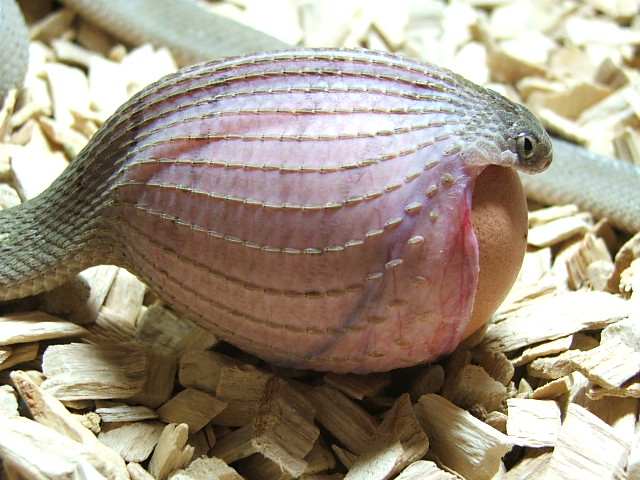
East African Egg-eating Snake, Dasypeltis medici
How do they do that!? That snake is going to choke itself! Got to be a faked, Photoshopped image, right? Think again:


Damn, that's impressive. If you watched the video above, you saw an African Egg-eating Snake, perhaps the most specialized oophagous snake there is, swallow a bird egg whole, crack it open, and regurgitate the  shell. How does it do it? The highly kinetic, flexible skull of this snake allows it to maneuver its jaws around an egg many times bigger than its head, despite the smooth, round surface and the snake's lack of hands. It'd be like a human trying to eat a whole watermelon. Egg-eating snakes lack teeth almost entirely, not needing them for gripping their prey. In addition, the snake's skin is stretchy enough to accommodate the egg's passage - the scale rows are clearly visible, widely separated by the skin in between. Most of the time, this skin can't be seen, because the skin is relaxed so that the rows of scales are in contact with one another.

Once the egg is in the snake's esophagus, how does it get cracked open? Snakes have strong digestive juices, but waiting for them to dissolve the shell of an egg would take too long. OK, are you ready? This is the coolest part:

Vertebral hypapophyses of  African egg-eating snakes, Dasypeltis
See those spines? Those are called hypapophyses, which is a fancy term for things that stick off the bottom (ventral side) of vertebrae. You've got them too - but in egg-eating snakes, they're modified to be much larger and sharper, the better to pierce eggshells with, my dear. At least, the ones on vertebrae 17-38 are, the vertebrae that sit right above the esophagus and thus above egg once it has been swallowed. The esophagus itself is modified as well - it has loose folds, like pockets, into which each of the hypapophyses fits, so that they don't puncture the esophagus itself. See how it works in the following video, from the BBC's Life in Cold Blood:


Starting at 2:45, you can see the moving x-ray of the egg-eating snake swallowing the egg. Continuing through the end of the video, the snake cracks the shell, allows the yolk inside to drain into its stomach, and regurgitates the eggshell. Most amazing, young Dasypeltis don't appear to have these hypapophyses - they grow as the snakes get older, which raises questions about what the juveniles eat. Even though eggs are nutritious, Dasypeltis must feed relatively often for a snake - one that my advisor kept in captivity ate several quail eggs a week.

Lateral view of the skull of Dasypeltis, from Gans 1952
The adaptations of the nine species of Dasypeltis allow them to eat eggs that are very large relative to their body size, and as far as we know they eat almost nothing else. Several generalist snakes also eat eggs; adult Eastern Kingsnakes (Lampropeltis getula), Western Hog-nosed Snakes (Heterodon nasicus), and Formosa Kukrisnakes (Oligodon formosanus) frequently consume reptile eggs, and many members of the rat snake genera Pantherophis and Elaphe opportunistically feed on both eggs and nestling birds. These snakes, however, have no special morphological or behavioral adaptations to assist them in the consumption of eggs. One species, the Japanese rat snake (Elaphe climacophora), can ingest relatively large eggs, and has several vertebral hypapophyses. However, E. climacophora ingests the entire egg, including the shell. Only Dasypeltis, and possibly a poorly-known species from India called Elachistodon westermanni, specialize in ingesting large eggs, then crushing the shell and retaining solely the contents.

Defensive display by Dasypeltis scabra
ACKNOWLEDGMENTS

Thanks to David Marti, Armata, Tony Phelps, and the BBC for images and videos.

REFERENCES

Coleman K, Rothfuss LA, Ota H, Kardong KV (1993) Kinematics of egg-eating by the specialized Taiwan snake Oligodon formosanus (Colubridae). Journal of Herpetology 27:320-327

Gans C (1952) The functional morphology of the egg-eating adaptations in the snake genus Dasypeltis. Zoologica 37:209-244

Gans C, Oshima M (1952) Adaptations for egg eating in the snake Elaphe climacophora (Boie). American Museum Novitates 1571:1-16

Gartner G, Greene H (2008) Adaptation in the African egg-eating snake: a comparative approach to a classic study in evolutionary functional morphology. Journal of Zoology 275:368-374

Mullin SJ (1996) Adaptations facilitating facultative oophagy in the gray rat snake, Elaphe obsoleta spiloides. Amphibia-Reptilia 17:387-394

Mullin SJ, Cooper RJ (1998) The foraging ecology of the Gray Rat Snake (Elaphe obsoleta spiloides)—visual stimuli facilitate location of arboreal prey. The American Midland Naturalist 140:397-401

Savitzky AH (1983) Coadapted character complexes among snakes: fossoriality, piscivory, and durophagy. American Zoologist 23:397-409


Creative Commons License

Life is Short, but Snakes are Long by Andrew M. Durso is licensed under a Creative Commons Attribution-NonCommercial-NoDerivs 3.0 Unported License.