If you need to identify a snake, try the Snake Identification Facebook group.
For professional, respectful, and non-lethal snake removal and consultation services in your town, try Wildlife Removal USA.
Showing posts with label gartersnakes. Show all posts

Wednesday, July 30, 2014

Tetrodotoxin-resistant snakes


An adult male Taricha granulosa in breeding condition.
There is enough tetrodotoxin in this newt to kill you
and about 29 other people.
Gartersnakes eat newts. I mentioned this remarkable fact in my article on the Scientific American Guest Blog, but it's interesting enough to warrant a more detailed treatment. In 1990, Edmund D. Brodie III and his father, Edmund D. Brodie Jr, published a paper in the journal Evolution that provided the first evidence of a pair of species in a highly coupled arms race. Previously, the concept of an arms race had been criticized because the potential cost to the prey (loss of life) was perceived as more dire than the potential cost to the predator (merely the loss of dinner). This imbalance, known as the life-dinner principle, led scientists to suggest that tightly co-evolving arms races between predators and prey could not exist, because selection pressure on the predator would always be less than that on the prey. However, reasoned Brodie & son, if the prey's defenses are lethal, then selection might be equally strong on both predator and prey, because only highly resistant predators could survive a predation event. This is the case in the predator-prey dynamic between the Rough-skinned Newt (Taricha granulosa) and the Common Gartersnake (Thamnophis sirtalis), which is centered around a toxin called tetrodotoxin.

Chemical structure of tetrodotoxin
Tetrodotoxin is a very interesting chemical. James Bond was poisoned with it at the end of From Russia with Love (and saved by an antidote, which does not exist in real life). It's responsible for the tingling sensation caused by eating properly prepared fugu (and woe betide those who consume this Japanese pufferfish dish improperly prepared). Named after the pufferfish family, it is found in a wide variety of organisms, from flatworms to the blue-ringed octopus, its biological origins are enigmatic. Many species are thought to sequester it from symbiotic bacteria, although some, including newts, are believed to be capable of synthesizing it themselves. In the lab, tetrodotoxin is created under conditions of extreme heat and pressure, and how this molecule is generated inside of living cells is a mystery. Furthermore, it is an extremely potent poison: tetrodotoxin binds to and occludes the extracellular pore of voltage-gated ion channels embedded in muscle cell membranes, preventing the flow of sodium ions into the cell and interrupting the action potentials necessary for muscle contraction. This is not unlike the effect produced by local anesthetics, which also block sodium channels, but with two important differences: they do so from the inside of the cell and their effects are reversible.

Map of gartersnake resistance to tetrodotoxin
Outside of the range of the Rough-skinned Newt,
gartersnakes have essentially no resistance.
Figure from Brodie Jr. et al 2002
The elder Brodie showed in 1968 that many predators died if they were forced to eat newt, including bobcats, herons, kingfishers, moles, weasels, bass, catfish, and most snakes, including racers, rattlesnakes, gophersnakes, whipsnakes, rubber boas, and sharp-tailed snakes. Notably, Common Gartersnakes survived, although they were temporarily incapacitated. Brodie realized that he could measure snake toxin resistance by timing how long a snake was incapacitated for or how much its crawling speed slowed down when it was given a standardized dose of tetrodotoxin. Using this method for measuring resistance, the Brodies demonstrated that newt toxicity and gartersnake toxin resistance co-vary predictably across most of the Pacific Northwest; for example, on Vancouver Island, newts have very low levels of TTX and gartersnakes have almost no resistance to the toxin, whereas in central Oregon and in California's San Francisco Bay area, newts are tens of thousands of times more toxic and gartersnakes have correspondingly high resistance (for the most part, but read on!).

Three species of TTX-resistant snakes:
top: Amphiesma pryori
middle: Erythrolamprus epinephelus
bottom: Rhabdophis tigrinus
It's now known that a number of different snake species are resistant to tetrodotoxin and are capable of eating newts and other TTX-laden prey with impunity. These include two other species of gartersnake, the Santa Cruz gartersnake (Thamnophis atratus), which also eats Rough-skinned Newts, and the aquatic garter snake (Thamnophis couchii), which preys on California Newts (Taricha torosa). A Japanese newt, Cynops ensicauda, is eaten by Pryer's Keelback (Amphiesma pryeri). Some frogs also have tetrodotoxin, and two species, an Atelopus toad in Central American and a Polypedates treefrog in eastern Asia, are respectively eaten by the dipsadine Erythrolamprus [Liophis] epinephelus and the natricine Rhabdophis tigrinus. Not only has tetrodotoxin resistance also arisen in these other species of snakes around the world, but the mechanism, which involves changing the shape of the sodium channel pore so that the toxin binds less tightly, has evolved the exact same way in each lineage of snakes, via functionally identical mutations to the gene sequences. This is remarkable because these snakes are moderately but not very closely related to one another, and even more so because pufferfish also have many of the same mutations. These mutations are not found in humans, rats, most snakes, or other non-resistant vertebrates. All this suggests that there are a limited number of ways that evolution can change a sodium channel to make it more resistant to TTX and still maintain its function. In most cases, these and other natricine and dipsadine snakes are probably resistant to multiple prey toxins, as they are known to regularly consume other toxic amphibians and invertebrates.

Common Gartersnake (Thamnophis sirtalis)
from Oregon's Willamette Valley, where newt toxicity and
snake resistance are both at their peak
Although all newts and some other amphibians possess TTX, T. granulosa is many times more toxic than any other species, and its primary predator is many times more resistant than any other snake. Common Gartersnakes themselves actually retain sufficient quantities of newt-derived TTX in their liver for one to two months after eating newts to severely incapacitate or kill their predators, which was the general subject of my original article. Whether or not any of the other TTX-resistant species sequester the toxin remains unknown, although it seems likely. In a few places, Common Gartersnakes have evolved such high resistance to TTX that they have effectively "won" their arms race with their newts. Because snake TTX resistance apparently evolves in a stepwise fashion, with each new mutation to the snake sodium channel pore structure rapidly making it much tougher for TTX to bind tightly, gartersnakes are capable of making quicker leaps in the arms race than are newts, which presumably must evolve higher toxicity by increasing the amount of TTX they produce. Eventually, some gartersnakes seem to have reached a point where no amount of TTX could incapacitate them, so their newt populations (which were already pretty toxic) stopped being selected to produce more toxin. Since we don't really know how they get their toxin in the first place, they might be limited in their ability to produce or sequester it or its precursors.

There's much left to discover about this system, which is perhaps one of the most interesting in snake biology. Where are newts getting tetrodotoxin from? How many other times has TTX resistance evolved in snakes, and has it happened the same way every time [Update: the answer is no!]? To what extent are gartersnakes using newt-derived TTX to protect against their own predators? Someday, we will find out.

ACKNOWLEDGMENTS

Thanks to current and former members of the Brodie lab, especially Dr. Edmund D. "Doc" Brodie Jr., for discussing this system with me over the last three years.

REFERENCES

Brodie Jr, E. D. 1968. Investigations on the skin toxin of the adult rough-skinned newt, Taricha granulosa. Copeia 1968:307-313 <link>

Brodie III, E. and E. Brodie Jr. 1999. Costs of exploiting poisonous prey: evolutionary trade-offs in a predator-prey arms race. Evolution 53:626-631 <link>

Brodie III, E., C. Feldman, C. Hanifin, J. Motychak, D. Mulcahy, B. Williams, and E. Brodie Jr. 2005. Parallel arms races between garter snakes and newts involving tetrodotoxin as the phenotypic interface of coevolution. Journal of Chemical Ecology 31:343-356 <link>

Geffeney, S., E. Brodie Jr, P. Ruben, and E. Brodie III. 2002. Mechanisms of adaptation in a predator-prey arms race: TTX-resistant sodium channels. Science 297:1336-1339 <link>

Geffeney, S., E. Fujimoto, E. Brodie, and P. Ruben. 2005. Evolutionary diversification of TTX-resistant sodium channels in a predator–prey interaction. Nature 434:759-763 <link>

Hanifin, C. T. and E. D. Brodie Jr. 2008. Phenotypic mismatches reveal escape from arms-race coevolution. PLoS Biology 6:e60 <link>

Feldman, C. R., E. D. Brodie, and M. E. Pfrender. 2012. Constraint shapes convergence in tetrodotoxin-resistant sodium channels of snakes. Proceedings of the National Academy of Sciences 106:13415-13420 <link>

Stokes, A. N., P. K. Ducey, L. Neuman-Lee, C. T. Hanifin, S. S. French, M. E. Pfrender, E. D. Brodie, III, and E. D. Brodie Jr. 2014. Confirmation and distribution of tetrodotoxin for the first time in terrestrial invertebrates: two terrestrial flatworm species (Bipalium adventitium and Bipalium kewense). PLoS ONE 9:e100718 <link>

Williams, B. L. and R. L. Caldwell. 2009. Intra-organismal distribution of tetrodotoxin in two species of blue-ringed octopuses (Hapalochlaena fasciata and H. lunulata). Toxicon 54:345-353 <link>

Williams, B. L., E. D. Brodie Jr., and E. D. Brodie III. 2004. A resistant predator and its toxic prey: persistence of newt toxin leads to poisonous (not venomous) snakes. Journal of Chemical Ecology 30:1901-1919 <link>

Creative Commons License

Life is Short, but Snakes are Long by Andrew M. Durso is licensed under a Creative Commons Attribution-NonCommercial-NoDerivs 3.0 Unported License.

Wednesday, March 19, 2014

Why do snakes have two penises?


Figure from Laszlo 1975
Recently somebody asked me "Why do snakes have two penises?" When I tried to answer, I realized that I didn't really know. I did know that they only use one at a time, and I had once heard that it was so that they could copulate with a female no matter which side she was on, but that doesn't really seem to make sense to me any more, especially considering that lizards also have two penises. Together, the two penises of squamates (snakes and lizards) are called hemipenes, and each individually is called a hemipenis. Each hemipenis is associated with a single testis, meaning that sperm produced in the right testis are ejaculated through the right hemipenis, and those produced on the left come out of the left. Hemipenes are normally stored inside out in the base of the tail, forming a pocket into which a probe can be, well, probed to check the sex of a lizard or snake. This is shown nicely in the above diagram. During mating, one hemipenis or the other is everted in a manner similar to taking off a sock. Sexual dimorphism is rare in snakes, except that male snakes almost always have longer, thicker tails than females, because they need someplace to store their hemipenes.

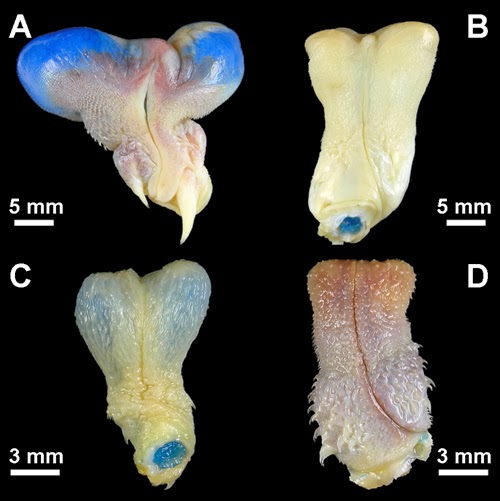
Some examples of snake hemipenes; photo by Robert Jadin
Hemipenes are one of the shared derived characters of squamates (snakes and lizards), distinguishing them from other reptiles (tuataras, turtles, crocodilians, and birds), all of which have either a single or no penis. In general, snake hemipenes are endowed with a groove, called the sulcus spermaticus, down which the sperm runs. Think of a canal rather than a pipe, although during mating the wall of the female's reproductive tract forms the other part of the tube that we mammals have. Hemipenes often have various spines, knobs, branches, and other projections, which typically correspond with the cloacal anatomy of female snakes of the same species, forming a sort of 'lock-and-key' mechanism that isolates species by discouraging mating among unrelated individuals. The amazingly variable structure of the hemipenes has often been used in snake taxonomy for this reason.

Hemipenes of:
top: Mountain Pit-viper
(Ovophis monticola)
middle: Spotted Slug-eater
(Pareas macularius)
bottom: Siamese Spitting Cobra
(Naja siamensis)
photos by Sjon Hauser
But why two? Wouldn't one penis do just as well, since male snakes only use one at a time anyway? Let's take a quick look at the timeline of snake reproduction. Boy snake meets girl snake. They spend some time together, intertwine their tails, and the male inserts one hemipenis so that his sperm find their way safely from cloaca to cloaca. But unlike in humans, female snakes have a lot of control over whether or not they get pregnant after mating. Because the best conditions for mating are not necessarily the best for ovulation and gestation, female snakes can store sperm for a long time, up to 5 years and possibly longer. They have specialized pockets in their reproductive tract where they do this. It can actually be rather difficult to distinguish between long-term sperm storage and facultative parthenogenesis (a form of asexual reproduction) without using molecular techniques to determine whether the offspring share all or just some of their genes with their mother. This is because in the former case, a female snake sometimes gets pregnant long after mating. If she has mated with multiple males, her clutch (in egg-laying species) or litter (in live-bearers) of offspring might be a mixture of offspring from multiple fathers. Amazingly, she can control which fathers' sperm she uses to fertilize her eggs, although exactly how she does this is still unclear. Because of this potential for delayed fertilization, sperm competition and cryptic female mate choice is thought to be more intense in reptiles than in species that usually follow insemination quickly with fertilization. Female snakes can mate with multiple males, and can then choose at their leisure among their sperm each time they reproduce over the next several years, so some male snakes might mate with many females but never produce offspring because their sperm are always judged to be inferior. This can also result in bizarre situations such as male snakes becoming fathers after they have died.

All this can complicate life for male snakes, because their paternity is even less certain than it is for other male vertebrates. As a result, a male snake's reproductive success is probably tied to the number of sperm he transfers to a female (although this is difficult to measure). This is probably a big part of why male snakes and lizards have two penises. Because each testis is dedicated to a single hemipenis, an alternating pattern of hemipenis use would allow a male a second chance to transfer a fresh batch of sperm if he has just mated recently. In humans and most other mammals, sperm from both testes is mixed together prior to ejaculation, so these species have just one chance to inseminate before they enter a refractory period (you know what I mean, guys). In fact, an alternating pattern is what we see when the kind of experiments every snake dreams of being a part of are conducted (in the spirit of full disclosure, most of these experiments were conducted with lizards, but the principle is similar). A male lizard mates with one female, which depletes sperm from that side of his reproductive tract, but he can then use his other hemipenis to inseminate a different female. He only alternates if the second mating opportunity comes during the refractory period, which lasts a few days. If mating opportunities are frequent and he is prevented from alternating (by placing a small piece of tape over one side of his cloaca), his sperm count is much lower on his second and third mating attempt.

Mating Western Diamondbacks, Crotalus atrox (from Clark et al. 2014)
It's advantageous for a female snake to mate with as many males as she can, so that she has a wide variety of sperm to choose from. Female adders with more mates have higher offspring survival, probably due to less inbreeding and more genetic diversity to choose from, especially in regions of the genome where diversity is important, such as the MHC, which codes for proteins involved in recognizing pathogens and initiating an immune response. Many species, including humans, select their mates at least partly on the basis of MHC dissimilarity (which they can judge by smell), and this may also be the case in snakes. However, many male and female snakes often have pretty limited time to get together, since they're only in the same place at the same time for short periods in spring and fall when they're entering and leaving hibernation sites, which might mean that they have to make rapid decisions about who to mate with. However, a recent paper by Rulon Clark and others showed that male Western Diamondback Rattlesnakes have distinct mating strategies depending on their body size. Larger males were more likely to guard their mates throughout the active season. Curiously, this behavior did not result in their fathering more offspring, possibly due to sperm the females had stored from previous years. In one of the most extreme examples of clustered mating, Common Gartersnakes in Canada emerge in huge numbers in spring and mate immediately upon emergence. Unlike in most snakes, there is conflict between males and females over how each sex best maximizes their reproductive success. There's also some evidence that male gartersnakes are "right-handed", preferring to use their right hemipenis unless they have just used it recently (it's connected to the larger right testis in this species). There are fewer studies of the mating systems of tropical snakes, which do not hibernate at all, but I suspect there is more diversity in parts of the world where it is always warm (we just don't know about it yet). One study found that larger male Slatey-grey Snakes (Stegonotus cucullatus) from tropical Australia fathered more offspring than smaller males, which is similar to the situation in many temperate snakes, but the exact evolutionary causes of this phenomenon are complex and have yet to be explained.

Hemipenes of:
top: Indo-chinese Ratsnake
(Ptyas korros)
middle: Banded Kukrisnake
(Oligodon fasciolatus)
bottom: Common Blackhead
(Sibynophis collaris)
All this raises some questions regarding the evolution of penises in vertebrates. I looked but could not find a single instance where a species of squamate had lost their hemipenes. The closest I came are snakes in the African subfamily Psammophiinae (which also includes the enigmatic scale-polishing snakes), which have small hemipenes and peculiar copulatory behavior, the causes and consequences of which are only two of the many things we don't know about psammophiines. The asymmetrical testes of male gartersnakes might be another example, but their left and right hemipenes are of equal size. Because penises don't fossilize well, we don't know very much about the anatomy of ancient snakes and lizards, but it's safe to assume that the common ancestor of all squamates had hemipenes. Although several other reptiles have lost their penises (and in some cases re-evolved some truly bizarre structures, such as the penises of ostriches, emus, ducks, alligators, turtles, and maybe even dinosaurs), there are some similarities between squamate hemipenes and the male reproductive organs of some of the most primitive mammals, the monotremes. Like snakes but unlike other mammals, echidnas have internal testes connected separately to a four-headed penis, similar to the hemipenes of snakes and lizards but joined at the base. Male echidnas only use one side (bearing two heads) at a time (video here), alternate sides just like snakes, and their sperm work cooperatively to reach the egg. The other monotremes, platypuses, have a forked penis, but only the left side is functional, because only the female's left ovary is functional. Many marsupials also have bifurcated penises, with scrotums that hang down in front of them. This suggests that a bifurcated penis might have appeared much earlier in amniote evolution than we think, although it could also be a case of convergent evolution caused by intense post-mating sexual selection on males. Detailed histological, embryological, and genetic studies would be required to answer this question, which would probably constitute the dissertation project you'd least want your family to know about. (update: I found out that Casey Gilman. a PhD student at UMass Amherst is working on this for his dissertation as we speak. You can donate to his crowd-funded project here).

ACKNOWLEDGMENTS

Thanks to Robert Jadin and Sjon Hauser for use of their photographs.

REFERENCES

Booth, W. and G. W. Schuett. 2011. Molecular genetic evidence for alternative reproductive strategies in North American pitvipers (Serpentes: Viperidae): long-term sperm storage and facultative parthenogenesis. Biological Journal of the Linnean Society 104:934–942 <link>

Clark, R. W., G. W. Schuett, R. A. Repp, M. Amarello, C. F. Smith, and H.-W. Herrmann. 2014. Mating Systems, Reproductive Success, and Sexual Selection in Secretive Species: A Case Study of the Western Diamond-Backed Rattlesnake, Crotalus atrox. PLoS ONE 9:e90616 <link>

Dubey, S., G. P. Brown, T. Madsen, and R. Shine. 2009. Sexual selection favours large body size in males of a tropical snake (Stegonotus cucullatus, Colubridae). Animal Behaviour 77:177-182 <link>

Greene, H. W. 1997. Snakes: The Evolution of Mystery in Nature. University of California Press, Berkeley <link>

S. D. Johnston, B. Smith, M. Pyne, D. Stenzel, and W. V. Holt. 2007. One‐Sided Ejaculation of Echidna Sperm Bundles. The American Naturalist 170:E162-E164 <link>

Laszlo, J. 1975. Probing as a practical method of sex recognition in snakes. International Zoo Yearbook 15:178-179.

Madsen, T., R. Shine, J. Loman, and T. Håkansson. 1992. Why do female adders copulate so frequently? Nature 355:440-441 <link>

Olsson, M. and T. Madsen. 2001. Promiscuity in Sand Lizards (Lacerta agilis) and Adder Snakes (Vipera berus): Causes and Consequences. Journal of Heredity 92:190-197 <link>

Sever, D. M. and W. C. Hamlett. 2002. Female sperm storage in reptiles. Journal of Experimental Zoology 292:187-199 <link>

Shine, R., M. M. Olsson, M. P. LeMaster, I. T. Moore, and R. T. Mason. 2000. Are snakes right-handed ? Asymmetry in hemipenis size and usage in gartersnakes (Thamnophis sirtalis). Behavioral Ecology 11:411-415 <link>

Tokarz, R. R. and J. B. Slowinski. 1990. Alternation of hemipenis use as a behavioural means of increasing sperm transfer in the lizard Anolis sagrei. Animal Behaviour 40:374-379 <link>

Tokarz, R. R. and S. J. Kirkpatrick. 1991. Copulation frequency and pattern of hemipenis use in males of the lizard Anolis sagrei in a semi-natural enclosure. Animal Behaviour 41:1039-1044 <link>

Zweifel, R. G. 1980. Aspects of the biology of a laboratory population of kingsnakes. Pages 141-152 in J. B. Murphy and J. T. Collins, editors. Reproductive biology and diseases of captive reptiles. Society for the Study of Amphibians and Reptiles, Lawrence, Kansas.

Creative Commons License

Life is Short, but Snakes are Long by Andrew M. Durso is licensed under a Creative Commons Attribution-NonCommercial-NoDerivs 3.0 Unported License.