If you need to identify a snake, try the Snake Identification Facebook group.
For professional, respectful, and non-lethal snake removal and consultation services in your town, try Wildlife Removal USA.
Showing posts with label Psammophiinae. Show all posts

Wednesday, March 19, 2014

Why do snakes have two penises?


Figure from Laszlo 1975
Recently somebody asked me "Why do snakes have two penises?" When I tried to answer, I realized that I didn't really know. I did know that they only use one at a time, and I had once heard that it was so that they could copulate with a female no matter which side she was on, but that doesn't really seem to make sense to me any more, especially considering that lizards also have two penises. Together, the two penises of squamates (snakes and lizards) are called hemipenes, and each individually is called a hemipenis. Each hemipenis is associated with a single testis, meaning that sperm produced in the right testis are ejaculated through the right hemipenis, and those produced on the left come out of the left. Hemipenes are normally stored inside out in the base of the tail, forming a pocket into which a probe can be, well, probed to check the sex of a lizard or snake. This is shown nicely in the above diagram. During mating, one hemipenis or the other is everted in a manner similar to taking off a sock. Sexual dimorphism is rare in snakes, except that male snakes almost always have longer, thicker tails than females, because they need someplace to store their hemipenes.

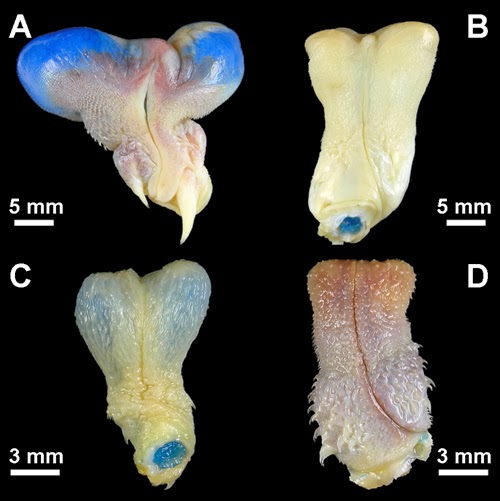
Some examples of snake hemipenes; photo by Robert Jadin
Hemipenes are one of the shared derived characters of squamates (snakes and lizards), distinguishing them from other reptiles (tuataras, turtles, crocodilians, and birds), all of which have either a single or no penis. In general, snake hemipenes are endowed with a groove, called the sulcus spermaticus, down which the sperm runs. Think of a canal rather than a pipe, although during mating the wall of the female's reproductive tract forms the other part of the tube that we mammals have. Hemipenes often have various spines, knobs, branches, and other projections, which typically correspond with the cloacal anatomy of female snakes of the same species, forming a sort of 'lock-and-key' mechanism that isolates species by discouraging mating among unrelated individuals. The amazingly variable structure of the hemipenes has often been used in snake taxonomy for this reason.

Hemipenes of:
top: Mountain Pit-viper
(Ovophis monticola)
middle: Spotted Slug-eater
(Pareas macularius)
bottom: Siamese Spitting Cobra
(Naja siamensis)
photos by Sjon Hauser
But why two? Wouldn't one penis do just as well, since male snakes only use one at a time anyway? Let's take a quick look at the timeline of snake reproduction. Boy snake meets girl snake. They spend some time together, intertwine their tails, and the male inserts one hemipenis so that his sperm find their way safely from cloaca to cloaca. But unlike in humans, female snakes have a lot of control over whether or not they get pregnant after mating. Because the best conditions for mating are not necessarily the best for ovulation and gestation, female snakes can store sperm for a long time, up to 5 years and possibly longer. They have specialized pockets in their reproductive tract where they do this. It can actually be rather difficult to distinguish between long-term sperm storage and facultative parthenogenesis (a form of asexual reproduction) without using molecular techniques to determine whether the offspring share all or just some of their genes with their mother. This is because in the former case, a female snake sometimes gets pregnant long after mating. If she has mated with multiple males, her clutch (in egg-laying species) or litter (in live-bearers) of offspring might be a mixture of offspring from multiple fathers. Amazingly, she can control which fathers' sperm she uses to fertilize her eggs, although exactly how she does this is still unclear. Because of this potential for delayed fertilization, sperm competition and cryptic female mate choice is thought to be more intense in reptiles than in species that usually follow insemination quickly with fertilization. Female snakes can mate with multiple males, and can then choose at their leisure among their sperm each time they reproduce over the next several years, so some male snakes might mate with many females but never produce offspring because their sperm are always judged to be inferior. This can also result in bizarre situations such as male snakes becoming fathers after they have died.

All this can complicate life for male snakes, because their paternity is even less certain than it is for other male vertebrates. As a result, a male snake's reproductive success is probably tied to the number of sperm he transfers to a female (although this is difficult to measure). This is probably a big part of why male snakes and lizards have two penises. Because each testis is dedicated to a single hemipenis, an alternating pattern of hemipenis use would allow a male a second chance to transfer a fresh batch of sperm if he has just mated recently. In humans and most other mammals, sperm from both testes is mixed together prior to ejaculation, so these species have just one chance to inseminate before they enter a refractory period (you know what I mean, guys). In fact, an alternating pattern is what we see when the kind of experiments every snake dreams of being a part of are conducted (in the spirit of full disclosure, most of these experiments were conducted with lizards, but the principle is similar). A male lizard mates with one female, which depletes sperm from that side of his reproductive tract, but he can then use his other hemipenis to inseminate a different female. He only alternates if the second mating opportunity comes during the refractory period, which lasts a few days. If mating opportunities are frequent and he is prevented from alternating (by placing a small piece of tape over one side of his cloaca), his sperm count is much lower on his second and third mating attempt.

Mating Western Diamondbacks, Crotalus atrox (from Clark et al. 2014)
It's advantageous for a female snake to mate with as many males as she can, so that she has a wide variety of sperm to choose from. Female adders with more mates have higher offspring survival, probably due to less inbreeding and more genetic diversity to choose from, especially in regions of the genome where diversity is important, such as the MHC, which codes for proteins involved in recognizing pathogens and initiating an immune response. Many species, including humans, select their mates at least partly on the basis of MHC dissimilarity (which they can judge by smell), and this may also be the case in snakes. However, many male and female snakes often have pretty limited time to get together, since they're only in the same place at the same time for short periods in spring and fall when they're entering and leaving hibernation sites, which might mean that they have to make rapid decisions about who to mate with. However, a recent paper by Rulon Clark and others showed that male Western Diamondback Rattlesnakes have distinct mating strategies depending on their body size. Larger males were more likely to guard their mates throughout the active season. Curiously, this behavior did not result in their fathering more offspring, possibly due to sperm the females had stored from previous years. In one of the most extreme examples of clustered mating, Common Gartersnakes in Canada emerge in huge numbers in spring and mate immediately upon emergence. Unlike in most snakes, there is conflict between males and females over how each sex best maximizes their reproductive success. There's also some evidence that male gartersnakes are "right-handed", preferring to use their right hemipenis unless they have just used it recently (it's connected to the larger right testis in this species). There are fewer studies of the mating systems of tropical snakes, which do not hibernate at all, but I suspect there is more diversity in parts of the world where it is always warm (we just don't know about it yet). One study found that larger male Slatey-grey Snakes (Stegonotus cucullatus) from tropical Australia fathered more offspring than smaller males, which is similar to the situation in many temperate snakes, but the exact evolutionary causes of this phenomenon are complex and have yet to be explained.

Hemipenes of:
top: Indo-chinese Ratsnake
(Ptyas korros)
middle: Banded Kukrisnake
(Oligodon fasciolatus)
bottom: Common Blackhead
(Sibynophis collaris)
All this raises some questions regarding the evolution of penises in vertebrates. I looked but could not find a single instance where a species of squamate had lost their hemipenes. The closest I came are snakes in the African subfamily Psammophiinae (which also includes the enigmatic scale-polishing snakes), which have small hemipenes and peculiar copulatory behavior, the causes and consequences of which are only two of the many things we don't know about psammophiines. The asymmetrical testes of male gartersnakes might be another example, but their left and right hemipenes are of equal size. Because penises don't fossilize well, we don't know very much about the anatomy of ancient snakes and lizards, but it's safe to assume that the common ancestor of all squamates had hemipenes. Although several other reptiles have lost their penises (and in some cases re-evolved some truly bizarre structures, such as the penises of ostriches, emus, ducks, alligators, turtles, and maybe even dinosaurs), there are some similarities between squamate hemipenes and the male reproductive organs of some of the most primitive mammals, the monotremes. Like snakes but unlike other mammals, echidnas have internal testes connected separately to a four-headed penis, similar to the hemipenes of snakes and lizards but joined at the base. Male echidnas only use one side (bearing two heads) at a time (video here), alternate sides just like snakes, and their sperm work cooperatively to reach the egg. The other monotremes, platypuses, have a forked penis, but only the left side is functional, because only the female's left ovary is functional. Many marsupials also have bifurcated penises, with scrotums that hang down in front of them. This suggests that a bifurcated penis might have appeared much earlier in amniote evolution than we think, although it could also be a case of convergent evolution caused by intense post-mating sexual selection on males. Detailed histological, embryological, and genetic studies would be required to answer this question, which would probably constitute the dissertation project you'd least want your family to know about. (update: I found out that Casey Gilman. a PhD student at UMass Amherst is working on this for his dissertation as we speak. You can donate to his crowd-funded project here).

ACKNOWLEDGMENTS

Thanks to Robert Jadin and Sjon Hauser for use of their photographs.

REFERENCES

Booth, W. and G. W. Schuett. 2011. Molecular genetic evidence for alternative reproductive strategies in North American pitvipers (Serpentes: Viperidae): long-term sperm storage and facultative parthenogenesis. Biological Journal of the Linnean Society 104:934–942 <link>

Clark, R. W., G. W. Schuett, R. A. Repp, M. Amarello, C. F. Smith, and H.-W. Herrmann. 2014. Mating Systems, Reproductive Success, and Sexual Selection in Secretive Species: A Case Study of the Western Diamond-Backed Rattlesnake, Crotalus atrox. PLoS ONE 9:e90616 <link>

Dubey, S., G. P. Brown, T. Madsen, and R. Shine. 2009. Sexual selection favours large body size in males of a tropical snake (Stegonotus cucullatus, Colubridae). Animal Behaviour 77:177-182 <link>

Greene, H. W. 1997. Snakes: The Evolution of Mystery in Nature. University of California Press, Berkeley <link>

S. D. Johnston, B. Smith, M. Pyne, D. Stenzel, and W. V. Holt. 2007. One‐Sided Ejaculation of Echidna Sperm Bundles. The American Naturalist 170:E162-E164 <link>

Laszlo, J. 1975. Probing as a practical method of sex recognition in snakes. International Zoo Yearbook 15:178-179.

Madsen, T., R. Shine, J. Loman, and T. Håkansson. 1992. Why do female adders copulate so frequently? Nature 355:440-441 <link>

Olsson, M. and T. Madsen. 2001. Promiscuity in Sand Lizards (Lacerta agilis) and Adder Snakes (Vipera berus): Causes and Consequences. Journal of Heredity 92:190-197 <link>

Sever, D. M. and W. C. Hamlett. 2002. Female sperm storage in reptiles. Journal of Experimental Zoology 292:187-199 <link>

Shine, R., M. M. Olsson, M. P. LeMaster, I. T. Moore, and R. T. Mason. 2000. Are snakes right-handed ? Asymmetry in hemipenis size and usage in gartersnakes (Thamnophis sirtalis). Behavioral Ecology 11:411-415 <link>

Tokarz, R. R. and J. B. Slowinski. 1990. Alternation of hemipenis use as a behavioural means of increasing sperm transfer in the lizard Anolis sagrei. Animal Behaviour 40:374-379 <link>

Tokarz, R. R. and S. J. Kirkpatrick. 1991. Copulation frequency and pattern of hemipenis use in males of the lizard Anolis sagrei in a semi-natural enclosure. Animal Behaviour 41:1039-1044 <link>

Zweifel, R. G. 1980. Aspects of the biology of a laboratory population of kingsnakes. Pages 141-152 in J. B. Murphy and J. T. Collins, editors. Reproductive biology and diseases of captive reptiles. Society for the Study of Amphibians and Reptiles, Lawrence, Kansas.

Creative Commons License

Life is Short, but Snakes are Long by Andrew M. Durso is licensed under a Creative Commons Attribution-NonCommercial-NoDerivs 3.0 Unported License.

Saturday, November 10, 2012

Snakes that polish their scales, and why they do it


Psammophis schokari eating a lizard, Phrynocephalus
mystaceus
, in Kazakhstan
I really like these snakes, and they have about them a pretty interesting mystery. In the tribe Psammophiini (in family Lamprophiidae), there are at least 50 species of snake in 8 genera native to Africa, the Mediterranean, the Middle East, and central Asia. They are united by several unusual synapomorphies, the most unique of which is the presence of a morphological feature called the external narial valve. This structure, located in the loreal region between the eye and the nostril, is the outlet of a special nasal gland that secretes fluid containing long-chain fatty acids. The function of this secretion is enigmatic. Some experiments show that it can serve to retard evaporative water loss, and some evidence suggests that some of these molecules could be pheromones used in marking territories. Territoriality is only slightly less non-existent among snakes than herbivory, but according to some it is apparently present among certain psammophines, few of which have been well-studied in the wild. Aside from a very interesting study suggesting that releasing small mammals from competition with large herbivores can indirectly increase the abundance of their snake predators (including Psammophis mossambicus), we don't know much about their ecology, but careful observations have revealed a little about the lives of these intriguing snakes.

Subadult Montpellier snake, Malpolon monspessulanus
The external narial valve was described in 1956 by renowned Russian herpetologist Ilya Darevsky, the second person ever to earn a PhD in the Soviet Union and the discoverer of parthenogenesis and polyploidy in reptiles. Darevsky described the gland from a specimen of the Montpellier snake (Malpolon monspessulanus), and such glands have now been reported from all eight genera in the Psammophini. In addition to the gland, psammophines also share peculiar hemipene morphology - that is, the male reproductive organs are unusually thin and smooth for an advanced snake, most of which possess thick, spiny hemipenes that enable prolonged copulation. Sexual dimorphism is also quite pronounced in many of these snakes, although not of tail length (typically, the tails of male snakes are longer and thicker than those of females). For example, male M. monspessulanus are stout, uniformly colored, and up to 2.3 m long, whereas females are slender, spotted, and reach only 1.4 meters.

Beginning in 1898, the earliest observations of these snakes mention their peculiar behavior. Psammophines press the outlet of their narial valve to their skin and thoroughly apply a coating of colorless, fast-drying valve secretion all over their body. Watch this Malpolon insignitus to get an idea, because it's hard to describe.


This behavior has been variously called self-rubbing, self-polishing, or  grooming, and seems to be present in all species of psammophine observed. Several keepers in Europe have made extensive efforts to acquire and videotape species of psammophines, and self-rubbing has now been documented in seven of the eight genera. More intriguing, conspecific psammophines housed together occasionally rub one another, presumably anointing the other snake with secretion from their narial valve. What could this mean?


Psammophis leightoni from Namibia
Several hypotheses have been put forth to explain this unique and intriguing behavior. To date, none have been sufficiently tested to unequivocality, nor are they mutually exclusive. Prior to the 1970s, the prevailing thought was that, since psammophines generally inhabit arid regions, the gland might aid in salt excretion, evaporative cooling, or water retention. In 1978, William Dunson and colleagues published their work on the histology of the gland, and concluded that it did not contain the specialized cytological features associated with salt secretion in the salt glands of reptiles such as sea snakes and marine iguanas. Dunson also characterized the chemical composition of the secretion for the first time, and suggested that the long-chain fatty acids he found might help retard water loss through the skin.


Dunson tested five Malpolon to see if their dermal water loss was unusually low, and indeed it was, approximately ten times lower than that of Kingsnakes (Lampropeltis getula), although water loss rate varied depending on where in the shedding cycle the snakes were. Malpolon also lost proportionally more water via the mouth and cloaca (and less via the skin) than did other reptiles. Dunson also kept Malpolon without giving them access to water, and they did not lose weight, indicating that they were capable of obtaining all the water they needed from their prey. In another experiment, he showed that dehydrated Malpolon did not secrete salt from their narial valve. He made the interesting observation that several frog species of the genus Phyllomedusa decrease their dermal water loss by wiping lipid secretions from skin glands over the surface of their skin:


Could psammophids be accomplishing the same thing with their narial valve secretions? Dunson did not test whether snakes that had just applied the secretion lost less water than those that had not. The snakes polish themselves frequently, especially after ecdyisis and feeding, so water loss rate could be tracked over time. 

Other mysterious pits have been described from the head scales of psammophines: parietal pits on the top of the head and infralabial pits on the lower jaw, both of which seem to be sporadically occurring. Series of shed skins from the very same snake sometimes show these features and sometimes do not. Because histology is lacking for these features, it is difficult to say what they might represent.


Dipsina multimaculata
Because of the remote areas inhabited by many of these snakes, most studies to date are insufficiently replicated to permit concrete conclusions about the function of the polishing behavior. Furthermore, determining the sex of living psammophines is quite difficult on account of their small hemipenes, so behavioral studies are often hampered by inadequate knowledge of the sex of the animals involved. Observations of captive psammophines suggest that these snakes have complex social behaviors, not the least of which is their tendency to polish one anothers' scales. Could this behavior represent mate guarding? A nuptial gift from males to females of fatty acids to help them avoid water loss during pregnancy? Do these snakes mark their territories? Only replicated, scientific studies will tell; until then, competing hypotheses will continue to wax on and wax off.


ACKNOWLEDGMENTS

Thanks to Heather Heinz for drawing my attention to this fascinating system, to Jane Bugaeva for translating Darevsky's 1956 article from Russian, and to photographers Bernard Dupont, Altyn Emel, Michael & Patricia Fogden, and Jeremy Holden, and videographer Ton Steehouder.

REFERENCES

Microdermatoglypic SEM photograph of Dipsina scale.
The lipid layer covering the scale is visible.
From de Pury 2010
Darevsky IS (1956) O stroyenni i funktsionirovani nosovoy zhelezy u yashtsheritsnoy zmei Malpolon monspessulanus Herm. (Reptilia, Serpentes). [On the structure and function of the nasal gland in the lizard snake Malpolon monspessulanus Herm. (Reptilia, Serpentes)] Zoologicheskij Zhurnal-Moskva 35:312-314

Dunson WA, Dunson MK, Keith AD (1978) The nasal gland of the Montpellier snake Malpolon monspessulanus: fine structure, secretion composition, and a possible role in reduction of dermal water loss. Journal of Experimental Zoology 203:461-473

de Grijs P (1898) Beobachtungen an reptilien in der gefangenschaff. Zoologischer Garten 39:233-247

de Haan CC, Aymerich M (2012) Des comportements frotteur et marqueur, pour la chasse et la vie sociale. In: Aymerich M (ed) A la Découverte de la Faune du Maroc Oriental

de Haan CC, A Cluchier (2006). Chemical marking behaviour in the psammophiine snakes Malpolon monspessulanus and Psammophis phillipsi. Proceedings of the 13th Congress of the Societas Europaea Herpetologica, 211-212. <link>

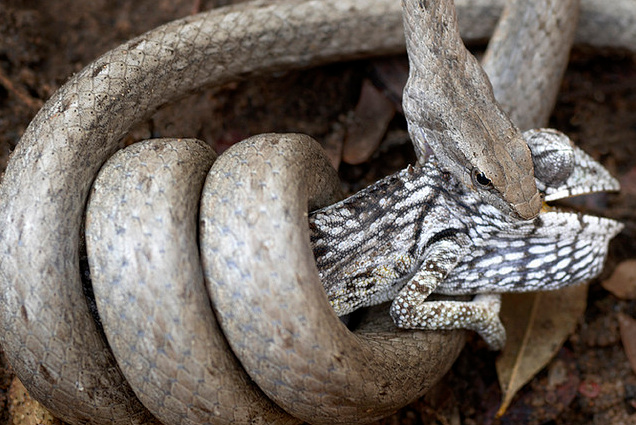
Mimophis mahfalensis killing a chameleon in Madagascar
de Haan CC (2003) Extrabuccal infralabial secretion outlets in DromophisMimophis and Psammophis species (Serpentes, Colubridae, Psammophiini). A probable substitute for ‘self-rubbing’ and cloacal scent gland functions, and a cue for a taxonomic account. Comptes Rendus Biologies 326:275-286. <link>

de Pury S (2010) Analysis of the Rubbing Behaviour of Psammophiids: A Methodological Approach. PhD dissertation, Rheinischen Friedrich-Wilhelms-Universität Bonn, Bonn, Switzerland.

McCauley, D. J., Keesing, F., Young, T. P., Allan, B. F. & Pringle, R. M. 2006: Indirect effects of large herbivores on snakes in an African savanna. Ecology 87, 2657-2663. <link>


Creative Commons License

Life is Short, but Snakes are Long by Andrew M. Durso is licensed under a Creative Commons Attribution-NonCommercial-NoDerivs 3.0 Unported License.