If you need to identify a snake, try the Snake Identification Facebook group.
For professional, respectful, and non-lethal snake removal and consultation services in your town, try Wildlife Removal USA.
Showing posts with label Farancia. Show all posts

Monday, November 30, 2015

Snakes that are Good Parents

Almost all mammals and birds care for their young to some extent, but most amphibians and reptiles do not. We tend to think of snakes as particularly asocial, and in many cases this is probably true. But, a growing body of evidence contradicts the generalization, made as recently as 1978, that "all reptiles produce precocial offspring without postnatal parental care", and shows that some snakes, in particular, are more caring parents than we typically think.

Vipers

A female Timber Rattlesnake (Crotalus horridus)
with her newly-born young
Probably the group of snakes most well-known for parental care are now the vipers, which is somewhat ironic considering the fierce but undeserved reputation of these venomous snakes. Although it was documented as early as 1850, parental care by vipers was not widely known or accepted by the scientific community until the 1990s; like crocodilians, it was assumed that these animals were too vicious to exhibit such caring behavior. When Laurence Klauber, at the time the world's foremost authority on rattlesnakes, wrote in 1956 that "Their propinquity [to aggregate]...does not result from any maternal solicitude; rather it is only because the refuge sought by the mother is also used as a hiding place by the young.", he was uncharacteristically incorrect; in hindsight, his words now seem almost willfully ignorant. In the 1990s, credible reports of parental care in wild pitvipers began to accumulate, corroborating the many older stories listed by Klauber, and in 2002, a seminal review paper based around two studies using radio-telemetry and DNA proved once and for all that mother rattlesnakes do stay with and care for their young. Today, you can read a whole blog about parental care in rattlesnakes, and we think that parental care is widespread (but not ubiquitous) among the ~230 species of pitvipers (aka crotalines or New World vipers). This is particularly remarkable because many of them give birth to live young, which they guard until the young's first shed, even though they may not have eaten for 9-10 months beforehand. It appears that the completion of the first shed cycle is the cue for them to separate, an event which is mediated by the same hormone in snakes as it is in birds and mammals. Because snakes swallow their food whole, the mother can't really feed her offspring, and they forage for themselves after they disperse. Pitvipers are the only snakes known to care for their living young; other snakes with parental care limit themselves to care of their eggs.

Pythons

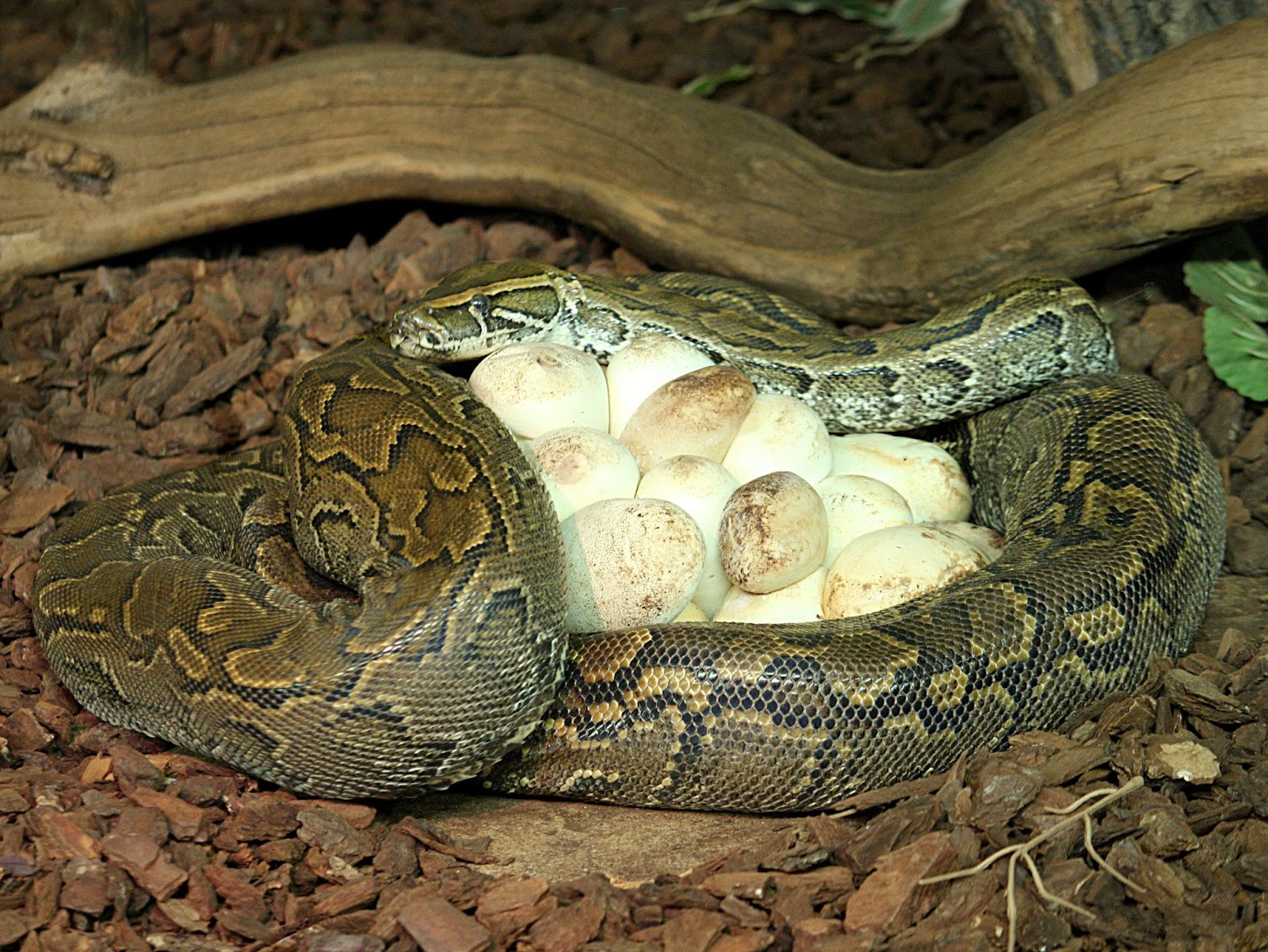
A mother African Rock Python (Python sebae)
brooding her eggs
The next most well-known example of parental care in snakes is egg-brooding behavior in pythons, first documented in 1835. All 40 species of pythons lay eggs, and most of them coil tightly around them throughout incubation, forsaking food. As with vipers, early reports of this behavior were dismissed, but by the 1930s observations of pythons in zoos showed that they did indeed brood their eggs. Some species that live in cold climates, such as Indian Pythons (Python molurus) and Carpet Pythons (Morelia spilota), also generate heat using muscle contractions ("shivering"). Measurements taken of brooding Indian Pythons have shown that they can increase the temperature of their clutch by 7-10°F. Even though mother pythons may brood for up to 2 months, studies have found that, at normal temperatures, they rarely shiver and lose only about 6% of their body mass, suggesting that the costs of brooding are relatively small compared to the benefits, which also include reduced water loss by the eggs and hatchlings that develop faster and are larger and more active. The brooding instinct in mother pythons is very strong—lab experiments have shown that they will brood the eggs of other pythons just as readily as they will brood their own, and they will even brood rocks that are the same size as their eggs (a behavior reminiscent of the well-known fixed-action pattern of egg-retrieval behavior in graylag geese). Today, pythons are frequently used as models to study female reproductive behavior and life-history trade-offs.

King Cobras

Top: A female King Cobra guarding her nest
Bottom left: A diagram of a typical King Cobra nest
Bottom right: King Cobra eggs in an excavated nest chamber
From Hrima et al. 2014
That female King Cobras (Ophiophagus hannah) use their coils to build a nest of sticks and bamboo leaves and guard their eggs for two to three months has been known at least since 18921. Detailed observation of nest-building and attendance were made in captivity at the Bronx Zoo from 1953-1956, and wild King Cobra nests were surveyed and detailed observations made in 19692. King Cobra nests are the largest and most complex of any snake's, measuring up to four feet in diameter and rising to a similar height, with an internal chamber for the 20-50 eggs and sometimes a second one above for the snake, which abandons the nest just before the eggs hatch. The female must select her nesting material and bring it to the nest site, because the species of bamboo that are most commonly used in building the nest are not the most abundant species in the surrounding area. There are also some anecdotal reports that male King Cobras will guard the nest and/or the female. Some sources suggest that female King Cobras are more aggressive towards humans when they are guarding their nests, but most suggest that their behavior is no different than at any other time.

Other snakes

A female Mudsnake (Farancia abacura)
coils around her eggs in a subterranean nest
Maternal attendance or guarding of clutches of eggs is widespread in snakes, but observations in the wild are still fairly uncommon, mostly due to the difficulty of locating nesting sites. There are several excellent reviews of this topic, including those written by Rick Shine (1988), Carl Gans (1996), Louis Somma (2003), and Zach Stahlschmidt and Dale DeNardo (2011).

Other snakes that have been observed guarding their eggs in the wild include:
It's worth noting that, unlike the case with pythons, survival or physiological benefits to the eggs have not been documented in any of these cases. In addition, there are numerous anecdotal reports of egg attendance in other snakes, many of which are based on hearsay and are not backed up by data, photographs, or even descriptions. So, expect this list to grow, but keep in mind that parental care in snakes is still, and will probably always be, the exception rather than the rule.

Costs and benefits

Except for pythons and pitvipers, the costs and benefits of parental care in snakes have not been examined, and I've mentioned some of the evidence for both in pythons already. Why do rattlesnakes and other pitvipers care for their eggs or young? There are several non-mutually-exclusive theories, including:

A mother Pigmy Rattlesnake (Sistrurus miliarius) with
her brood. Because rattlesnake rattles are made of segments
that form each time the snake sheds its skin, newborn snakes
have only one segment and cannot yet make sound.
1. To protect them from predators. This might involve any or all of the following:

  • Physical concealment, especially of the eggs, which are less well-camouflaged than the adults.
  • Deterrence of predators, which may recognize an adult viper as a threat but not an egg or a juvenile.
  • Active defense from predators, using venom or the threat thereof. This may be especially important prior to the first shed of the young, since they would probably suffer their heaviest mortality during this stage because of their small size, inexperience, hampered eyesight and pit organ sensitivity, and, in rattlesnakes, their inability to use their rattle.
  • Socially-facilitated retreat from predators, in which the parent helps the young escape an attack by physically moving them, showing them what to do, or distracting the predator. These may seem like surprisingly sophisticated behaviors for snakes, but several observations of mother snakes and their young support this idea, and we are learning that many snakes have subtle but complex social lives and communication abilities that have long been underappreciated.

Antipredator benefits of parental care in snakes may vary geographically or in other ways, because some species of pitvipers do not seem to change their defensive behavior when they are guarding their young, but others are more defensive, and still others are less defensive but more distracting.
Young Tiger Snakes (Notechis scutatus) snuggling
and data showing that the more litter-mates
they snuggle with, the more slowly they cool off
From Aubret & Shine 2009
2. Litters or clutches of several species of young snakes, including some rattlesnakes, aggregate together, without their mothers, in order to conserve water or heat—which, if they were mammals, we would call snuggling. Experiments have shown that they prefer to snuggle—sorry, I mean aggregate—inside shelters that contain their own scent cues, and that snuggling kept them warm, which helped them slither to shelter faster. No one has tested whether young pitvipers that snuggle with their mothers have higher body temperatures or lower rates of evaporative water loss than those snuggling with one another, but physics suggests that they would, since larger animals have a lower surface-area-to-volume ratio and thus lose heat and water more slowly. The presence of the mother may also offset the increased visibility or olfactory conspicuousness to predators of a bunch of aggregated young snakes. If this is the primary benefit, it is easy to see how maternal attendance of eggs could evolve into maternal attendance of the young, because we think that live birth has evolved many times in snakes, and parental care may have evolved and been lost as many as six and ten times, respectively, in vipers. It's probable that we will continue to fill in the gaps in our knowledge. For example, perhaps we're overlooking the behavior in some poorly-studied vipers, as we did in North American pitvipers for over a century.

Viper family tree showing the evolution of parental care.
A few details have changed but the basic shape of the tree
is the same. Abbreviations: O=oviparous, V=viviparous;
Tr=tropical, Te=temperate. From Greene et al. 2002
3. The week or so of parental care may represent an imprinting period for the young snakes to learn the scent of their mother and of one another, similar to the time a young sea turtle spends imprinting on its natal beach or a young salmon on its natal stream. This would be especially important for snakes in cold climates because they use each others' scent trails to locate hibernation sites. Although there is no direct evidence for the third hypothesis, it is suggestive that, at least in the Americas, temperate pitvipers stay with their young, but live-bearing tropical pitvipers, which do not need to hibernate, do not3. Other explanations include that memories of their siblings' scents help young snakes avoid inbreeding later in life, or that they promote other social behaviors, such as communal basking. Some new data suggest that the adult behavior of pitvipers differs when they are deprived of a maternal attendance period. Tall tales about snakes abound, and initially social behavior ranked among them (there are still false tales about parental behavior in snakes, such as the idea that they swallow their young). Parental care in vipers may just be the tip of their social iceberg. Research over the last decade has shown that vipers make use of chemical information left behind by other vipers when they choose their foraging sites, like a dog sniffing a fire hydrant. This kind of cryptic sociality in snakes can lead to things like inheritance of birthing rookeries, nesting sites, and hibernation sites over many generations. Some research even suggests that pair-bonding might happen between male and female copperheads. Some lizards build multi-generational homes; might we one day discover snakes doing the same? If we do, my money is on vipers.


1 Rudyard Kipling's The Jungle Book, containing the story Rikki Tikki Tavi, which describes a King Cobra pair, nest, and parental behavior, was originally published in 1893-4, just a year later.↩


2 The Kenyan herpetologist J.H.E. Leakey collected eggs from these nests and acknowledged in his paper the support of "the management of the International Hotel, who never once raised any objections to our housing live King Cobras in our rooms."↩


3 Intriguingly, the only two Neotropical pitvipers known to have parental care are also the only two that lay eggs. One is the Colombian toad-headed pitviper (Bothrops colombianus), about which very little is known. The other, the Bushmaster (Lachesis muta), well-known by comparison, is nevertheless a secretive denizen of primary rain forests. In 1910, Inaugural Bronx Zoo herp curator Raymond Ditmars and his Trinidad correspondent, R. R. Mole, were the first to publish a photograph of a female Bushmaster guarding her eggs. They wrote of Bushmasters guarding their eggs in the wild, and numerous subsequent captive snakes have borne these observations out. Although Eyelash Pitvipers (Bothriechis schlegelii) have not been observed to guard their young, they may do so because their young shed several days after birth, like those of temperate pitvipers, rather than within 24 hours of birth, like most tropical live-bearing pitvipers. The pattern of parental care in Old World vipers, about which we have far less information, appears to be more complicated still.↩
ACKNOWLEDGMENTS

Thanks to my parents, for indulging my interest in snakes and encouraging me to pursue a career studying them, and to Jim Williams, Peter May, J. Lanki, and Matt Nordgren for the use of their photos.

REFERENCES

Aubret, F., X. Bonnet, R. Shine, and S. Maumelat. 2005. Energy expenditure for parental care may be trivial for brooding pythons, Python regius. Animal Behaviour 69:1043-1053 <link>

Aubret, F., X. Bonnet, R. Shine, and S. Maumelat. 2005. Why do female ball pythons (Python regius) coil so tightly around their eggs? Evolutionary Ecology Research 7:743-758 <link>

Aubret, F., and R. Shine. 2009. Causes and consequences of aggregation by neonatal tiger snakes (Notechis scutatus, Elapidae). Austral Ecology 34:210-217 <link>

Bates, M. F. 1985. Notes on egg clutches in Lamprophis inornatus and Psammophylax rhombeatus rhombeatus. The Journal of the Herpetological Association of Africa 31:21-22.

Benedict, F. G., E. L. Fox, and V. Coropatchinsky. 1932. The incubating python: a temperature study. Proceedings of the National Academy of Sciences 18:209-212 <link>

Brashears, J., and D. F. DeNardo. 2012. Do brooding pythons recognize their clutches? Investigating external cues for offspring recognition in the Children's Python, Antaresia childreni. Ethology 118:793-798 <link>

Brown, G. P., and R. Shine. 2007. Like mother, like daughter: inheritance of nest-site location in snakes. Biology Letters 3:131-133 <link>

Brown, W. S., and F. M. MacLean. 1983. Conspecific scent-trailing by newborn timber rattlesnakes, Crotalus horridus. Herpetologica 39:430-436 <link>

Butler, J.A., T.W. Hull, and R. Franz. 1995. Neonate aggregations and maternal attendance of young in the Eastern Diamondback Rattlesnake, Crotalus adamanteus. Copeia 1995:196–198 <link>

Campbell, J. A., and W. W. Lamar. 1992. The taxonomic status of miscellaneous Neotropical viperids, with the description of a new genus. Occasional Papers of the Museum, Texas Tech University 153:1-31 <link>

Case, T. J. 1978. Endothermy and parental care in the terrestrial vertebrates. American Naturalist 112:861-874 <link>

Clark, R. W. 2007. Public information for solitary foragers: timber rattlesnakes use conspecific chemical cues to select ambush sites. Behavioral Ecology 18:487-490 <link>

Clark, R. W., W. S. Brown, R. Stechert, and H. W. Greene. 2012. Cryptic sociality in rattlesnakes (Crotalus horridus) detected by kinship analysis. Biology Letters 8:523-525 <link>

Cunningham, G. R., S. M. Hickey, and C. M. Gowen. 1996. Crotalus viridis viridis (Prairie Rattlesnake). Behavior. Herpetological Review 27:24 <link>

DeNardo, D. F., O. Lourdais, and Z. R. Stahlschmidt. 2012. Are females maternal manipulators, selfish mothers, or both? Insight from pythons. Herpetologica 68:299-307 <link>

Gans, C. 1996. An overview of parental care among the Reptilia. Pages 145-157 in J. S. Rosenblatt and C. T. Snowdon, editors. Parental Care: Evolution, Mechanisms, and Adaptive Significance. Academic Press, San Diego, California, USA <link>

Graves, B. M. 1989. Defensive behavior of female prairie rattlesnakes (Crotalus viridis) changes after parturition. Copeia 1989:791-794 <link>

Greene, H.W., P.G. May, D.L. Hardy, J.M. Sciturro, and T.M. Farrell. 2002. Parental behavior by vipers. Pp. 179-206 In Biology of the Vipers. Schuett, G.W., M. Höggren, M.E. Douglas, and H.W. Greene (Eds.).  Eagle Mountain Publishers, Eagle Mountain, UT <link>

Hibbard, C. W. 1964. A brooding colony of the blind snake, Leptotyphlops dulcis dissecta. Copeia 1964:222 <link>

Hoss, S.K. and R.W. Clark. 2014. Mother Cottonmouths (Agkistrodon piscivorus) alter their antipredator behavior in the presence of neonates. Ethology 120:933-941 <link>

Hoss, S. K., D. H. Deutschman, W. Booth, and R. W. Clark. 2015. Post-birth separation affects the affiliative behaviour of kin in a pitviper with maternal attendance. Biological Journal of the Linnean Society 116:637-648 <link>

Hoss, S.K., M.J. Garcia, R.L. Earley, and R.W. Clark. 2014. Fine-scale hormonal patterns associated with birth and maternal care in the cottonmouth (Agkistrodon piscivorus), a North American pitviper snake. General and Comparative Endocrinology 208:85-93 <link>

Leakey, J. 1969. Observations made on king cobras in Thailand during May 1966. Journal of the National Research Council of Thailand 5:1-10 <link>

Mori, A., and T. M. Randriamboavonjy. 2010. Field observation of maternal attendance of eggs in a Madagascan snake, Leioheterodon madagascariensis. Current Herpetology 29:91-95 <link>

Oliver, J. A. 1956. Reproduction in the king cobra, Ophiophagus hannah Cantor. Zoologica 41:145-152.

Reiserer, R., G. Schuett, and R. Earley. 2008. Dynamic aggregations of newborn sibling rattlesnakes exhibit stable thermoregulatory properties. Journal of Zoology 274:277-283 <link>

Savary, W. 1999. Crotalus molossus molossus (northern blacktail rattlesnake). Brood defense. Herpetological Review 30:45 <link>

Schuett, G., R. Repp, M. Amarello, and C. Smith. 2013. Unlike most vipers, female rattlesnakes (Crotalus atrox) continue to hunt and feed throughout pregnancy. Journal of Zoology 289:101-110 <link>

Shine, R. 1988. Parental care in reptiles. Pp. 275-330 In Biology of the Reptilia. Gans, C. and R.B. Huey (Eds.).  Alan Liss, New York <link>

Smith, C. F., and G. W. Schuett. 2015. Putative pair-bonding in Agkistrodon contortrix (Copperhead). Northeastern Naturalist 22:N1-N5 <link>

Somma, L. A. 2003a. Parental Behavior in Lepidosaurian and Testudinian Reptiles: A Literature Survey. Krieger Publishing Company, Malabar, Florida, USA.

Somma, L. A. 2003b. Reptilian parental behaviour. The Linnean 19:42-44 <link>

Stahlschmidt, Z.R. and D.F. DeNardo. 2011. Parental care in snakes. Pp. 673-702 In Reproductive Biology and Phylogeny of Snakes. Aldridge, R.D. and D.M. Sever (Eds.).  Science Publishers, Enfield, New Hampshire <link>

van Mierop, L. H. S., and E. L. Bessette. 1981. Reproduction of the ball python, Python regius in captivity. Herpetological Review 12:20-22 <link>

Wall, F. 1924. The Hamadryad or King Cobra, Naja hannah (Cantor). Journal of the Bombay Natural History Society 30:189-195 <link>

Walters, A. C., and W. Card. 1996. Agkistrodon piscivorus conanti (Florida Cottonmouth). Brood defense. Herpetological Review 27:203 <link>

Wasey, G. K. 1892. A nest of King Cobra's eggs. Journal of the Bombay Natural History Society 7:257 <link>

Whitaker, N., P. G. Shankar, and R. Whitaker. 2013. Nesting ecology of the King Cobra (Ophiophagus hannah) in India. Hamadryad 36:101-107.


Creative Commons License

Life is Short, but Snakes are Long by Andrew M. Durso is licensed under a Creative Commons Attribution-NonCommercial-NoDerivs 3.0 Unported License.

Tuesday, May 27, 2014

Snakes long-lost


Clarión Nightsnake (Hypsiglena unaocularis)
Photograph from Mulcahy et al. 2014
Just over one year ago, a team of scientists from the Smithsonian and the Red de Interacciones Multitróficas rediscovered a species of nightsnake (genus Hypsiglena) on remote Clarión Island in the eastern Pacific Ocean, over 400 miles southwest of Cabo San Lucas. Called the Clarión Nightsnake (Hypsiglena unaocularus), it was originally discovered by the renowned American naturalist William Beebe in 1936, during a nocturnal sea turtle nesting survey. Because Clarión Island is only accessible via military escort, biologists have not visited the island frequently since Beebe's time, and in 1955 herpetologist Bayard Brattstrom suggested that perhaps Beebe's locality information had been an error, since only a single specimen existed and several other Clarión Island expeditions had not turned up another. However, the type specimen collected by Beebe, resting in the herpetology collection of New York's American Museum of Natural History, was sufficiently distinct from any other Hypsiglena specimen that it prompted herp phylogeographer Dan Mulcahy to reexamine Beebe's book and field notes, which contained a pretty clear description of the circumstances under which Beebe found the snake:

“We walked on, flashing the light all around. Not far from the water on the black lava 
I saw a small dark brown snake. It seemed to be unlike the one I had found in daylight, 
having lines of black spots on the body, so I picked it up and cached it in my shirt.” 
(p. 282 of Zaca Venture)

Location of Clarión Is.
From Mulcahy et al. 2014
Click to enlarge
As their name implies, Nightsnakes mostly come out at night (although I found one in southern Utah at about 9:30 in the morning a few weeks ago), and even then they are normally only active under certain conditions - in particular, they prefer to be active when there is not much moonlight, such as on cloudy nights or when the moon is new. Even if one is specifically searching for Nightsnakes, they can be difficult to find. Combined with their generally secretive nature, this could explain the failure of several Clarión Island expeditions to find the Clarión Nightsnake - until Mulcahy's expedition in May of 2013, which found 11 individuals in 15 days. Using phylogenetics, they determined that the Clarión Nightsnake is most closely related to the Santa Catalina Nightsnake (H. catalinae), which is found on Santa Catalina Island in the Gulf of California (which is not the same as the well-known Santa Catalina Island off of the US state of California). Nightsnakes are found all around the shoreline of the Gulf of California, and they are obviously exceptional over-water dispersers, because they occur on many of the islands in that region as well.

This remarkable story of rediscovery is a testament to the kind of attention to detail that it takes to be a good natural historian, but it's not the only species of snake that has been rediscovered many years after its initial description. Here are a few others:

Angel’s Stream Snake (Paratapinophis praemaxillaris)
Photograph from Murphy et al. 2008
Angel’s Stream Snake (Paratapinophis praemaxillaris) was described from two newborn specimens from northern Laos in 1929. At that time it was placed into a new genus because of an unusual process on its nose, but a few years later it was moved into the cosmopolitan genus Opisthotropis. Two more specimens were collected in the 1980s, but it wasn't until 2008, when five adult specimens were collected from a pool at the base of a waterfall on the Nan River in northern Thailand, that it became clear that the nose structure was actually an egg tooth, a structure normally lost a few days after hatching. At that time, Paratapinophis was placed back into its own genus because of several other formerly-overlooked unique features, including sexually dimorphic color, pattern, and scale ornamentation. Like most other natricines, this species eats fishes.

Chersodromus rubriventris
Photograph from Ramírez-Bautista et al. 2013
Chersodromus rubriventris, the Redbelly Earth Runner, was discovered in a cloud forest in San Luis Potosí, Mexico, just after the end of World War II and described a few years later by American herpetologist and spy Edward H. Taylor, who also used his biology as a cover for work in the Philippines, Russia, and Sri Lanka during both world wars. Two other specimens, one from the late 1960s and the other from the early 1980s, were known, but in 2013, a team of herpetologists from the Universidad Autónoma del Estado de Hidalgo found three individuals in a cloud forest in nearby Hidalgo, doubling the number of specimens and photographing the snake alive for the first time. Stomach contents included beetle larvae and ants, both of which are unusual prey for a dipsadid snake.

Atractus wagleri
Photograph from Passos & Arredondo 2009
The genus Atractus, a group of burrowing snakes found from Panama to Argentina, is the most diverse alethinophidian snake genus, with over 130 species, most of which are only known from a few specimens. Recently Paulo Passos of the Brazilian National Museum matched up several previously mis- or unidentified Atractus specimens in South American museums with their species, constituting rediscoveries of sorts. For example, Wagler's Ground Snake (Atractus wagleri) was described in 1945 from a single specimen from western Colombia, and that specimen was lost in a fire in 1948. In 2009 Passos located three additional specimens of this poorly known snake in museums in Colombia. Another species, the Modest Ground Snake (Atractus modestus), was described in 1894 by the great Belgian zoologist George Boulenger, from a single specimen from western Ecuador. In 2007 Passos located more specimens in Ecuadorian museums, expanding the range of the species across most of the country. Although species of Atractus are seemingly quite rare, occurring at high elevations and having secretive fossorial habitats, a large number of Atractus specimens remain misidentified or unidentified in herpetological collections, so our knowledge of these snakes stands to improve dramatically as these are examined and described.

Argus Snail Sucker (Sibon argus)
The Lichen-coloured or Argus Snail Sucker (Sibon argus) is an extremely slender arboreal dipsadine snake with eye-like ("ocellate") spots. It was originally described from a single specimen from southeastern Costa Rica in 1876, by renowned paleontologist Edward Drinker Cope (who feuded with O.C. Marsh in the "Bone Wars" over who could discover more dinosaurs, the subject of an upcoming film starring Steve Carrell as Cope). The validity of the species was uncertain because of the subsequent description of other gracile snakes with ocellated patterns from the same region. In his classic revision of Neotropical snail- and slug-eating snakes, James Peters suggested that Cope's specimen might be aberrant, or perhaps that it represented one half of a species with strong sexual dimorphism (which is rare in snakes), because the only known S. argus specimen  was a male, and another species, Sibon longifrenis, was known at the time from just two specimens, both females. Males and females of the same species had been described as separate species before. Ultimately, Peters decided that the two species were probably different, and he was proven right in 1992, when tropical herpetologist Jay Savage was preparing his opus on Costa Rican herpetofauna. Savage discovered both male and female specimens that best matched Cope's 1876 S. argus in the collections of the University of Kansas and the Universidad de Costa Rica. The snakes had been collected in evergreen forests in Panama and Costa Rica, near the type locality of S. argus. With Roy McDiarmid, Savage redescribed the species, which has become much more well-known since. A recent study by Julie Ray and colleagues documented a more diverse diet for this species than previously expected, including other gooey prey such as oligochaete worms and frog eggs. Unfortunately for Sibon argus, both of these prey types are in decline in the neotropics, the worms due to overcollection of their bromeliad homes for horticulture, and the amphibians due to the devastating effects of the amphibian chytrid fungus Batrachochytrium dendrobatidis.

Brygophis coulangesi
Photograph from Andreone & Raxworthy 1998
Other examples of rediscovered snakes abound. The Uluguru Worm Snake (Letheobia uluguruensis) was described from four specimens collected in 1926 from the Uluguru Mountains of eastern Tanzania, a mountain range with dozens of endemic species, and was not seen again until 2004, when four were dug up by local people employed by a group of herpetologists from the London Natural History Museum and the University of Glasgow to search for caecilians. Another blindsnake, Typhlops tasymicris, was rediscovered on Union Island, St. Vincent and the Grenadines, in 2010. An entire genus of blindsnake, Xenotyphlops, was rediscovered in Madagascar, in 2007, 102 years after it's description. A rare sea snake, Hydrophis parviceps, was originally collected by the Danish research vessel Dana and described in 1935 and was seen again only once in 1960 until three turned up in fisheries bycatch off of Vietnam in 2001. Another species of rare sea snake, H. bituberculatus, was rediscovered off Sri Lanka in the late 1980s, over 100 years after the first one was collected (although the fishermen who collected the specimen were so secretive that they refused to divulge the location). One of the rarest snakes in Madagascar, a slow-moving reddish-orange species called Brygophis coulangesi, was first collected in 1968, when one fell from a tree and vomited up a chameleon, with a second specimen found on a cloudy, rainy night during a rain forest survey in 1998, over 300 miles to the north of the first. A second specimen of another Malagasy lamprophiid, Alluaudina mocquardi, was discovered in a pitch-black cave in northern Madagascar in 1982, 50 years after the first was found in a different cave nearby. I don't think any more have been found since, so this one should be getting ready to be rediscovered again soon (edit: City University of New York snake biologist Frank Burbrink informed me that on his recent trip to Madagascar they turned up an Alluaudina mocquardi in tsingy rock at Ankarana - see photo here)!

March 2010 Herp. Review cover
featuring Crotalus lannomi
A high-profile rediscovery graced the cover of the March 2010 issue of the journal Herpetological Review, which featured a photograph of a long-sought-after species of rattlesnake, the Autlán Long-tailed Rattlesnake (Crotalus lannomi). Discovered in the summer of 1966 by Joseph Lannom, C. lannomi became sort of a “holy grail” of rattlesnakes in the decades that followed, as numerous herpetologists ventured into the mountains of western Jalisco in search of it. They were stymied by heavy fog and dangerous flooding, roads with treacherous curves and highway robberies, and drug-related violence. In 2008, five specimens of C. lannomi were found in the foothills of Colima, roughly 50 km from the type locality in Jalisco, in some of Mexico's most pristine forest habitat.

Although most of this was new to me, I've actually written about a different rediscovered viper before, the Spider-tailed Adder (Pseoducerastes urarachnoides) of Iran, which was discovered in 1968 and was at first thought to have either a tumor, a congenital defect, or a growth caused by a parasite, or maybe a spider clinging to its tail (turns out its tail is modified into a lure to attract spider-eating birds). Also, in one of my first articles, I wrote about the South Florida Rainbow Snake (Farancia erytrogramma seminola), described by Wilfred T. Neill in 1964 from Fisheating Creek in Glades County near Lake Okeechobee, Florida, and presumed extinct, never seen again since. To the best of my knowledge this subspecies has yet to be rediscovered, despite a $500 reward from the Center for Snake Conservation and Center for Biological Diversity. (Edit: a diligent reader reminded me that I also wrote about another snake that hasn't been seen since 1975 in one of my earliest articles, the Round Island Burrowing Boa, Bolyeria multocarinata).

Undoubtedly there are numerous snake species left to be discovered and rediscovered, and in many cases almost nobody's out there looking. The Reptile Database has predicted that the total number of described reptile species will surpass 10,000 in 2014, and that non-avian reptiles will perhaps eclipse birds in diversity soon after that. With snakes currently at 3,466, representing just over one third of reptiles, maybe you will be the next to rediscover a snake thought lost!

ACKNOWLEDGMENTS

Thanks to Dan Mulcahy and Don Filipiak for the use of their photographs.

REFERENCES

Andreone, F. and C. Raxworthy. 1998. The colubrid snake Brygophis coulangesi (Domergue 1988) rediscovered in north-eastern Madagascar. Tropical Zoology 11:249-257 <link>

Beebe, CW. 1938. Zaca Venture. Harcourt, Brace and Co. Inc., New York <link>


Cope, E. D. 1875. On the batrachia and reptilia of Costa Rica : With notes on the herpetology and ichthyology of Nicaragua and Peru. Journal of the Academy of Natural Sciences Philadelphia 2:93-157 <link>


Gower, D. J., S. P. Loader, and M. Wilkinson. 2004. Assessing the conservation status of soil‐dwelling vertebrates: Insights from the rediscovery of Typhlops uluguruensis (Reptilia: Serpentes: Typhlopidae). Systematics and Biodiversity 2:79-82 <link>


Lanza, B. 1990. Rediscovery of the Malagasy colubrid snake Alluaudina mocquardi Angel 1939. Tropical Zoology 3:219-223 <link>


Mulcahy, D. G., J. E. Martínez-Gómez, G. Aguirre-León, J. A. Cervantes-Pasqualli, and G. R. Zug. 2014. Rediscovery of an endemic vertebrate from the remote Islas Revillagigedo in the eastern Pacific Ocean: The Clarión Nightsnake lost and found. PLoS ONE 9:e97682 <link>


Mulcahy, D. G. and J. R. Macey. 2009. Vicariance and dispersal form a ring distribution in nightsnakes around the Gulf of California. Molecular Phylogenetics and Evolution 53:537-546 <link>


Murphy, J. C., T. Chan-Ard, S. Mekchai, M. Cota, and H. K. Voris. 2008. The rediscovery of Angel’s Stream Snake, Paratapinophis praemaxillaris Angel, 1929 (Reptilia: Serpentes: Natricidae). The Natural History Journal of Chulalongkorn University 8:169-183 <link>


Passos, P. and J. C. Arredondo. 2009. Rediscovery and redescription of the Andean earth-snake Atractus wagleri (Reptilia: Serpentes: Colubridae). Zootaxa 1969:59-68 <link>


Passos, P., D. F. Cisneros-Heredia, and D. Salazar-V. 2007. Rediscovery and redescription of the rare Andean snake Atractus modestus. The Herpetological Journal 17:1-6 <link>


Peters, J. A. 1960. The snakes of the subfamily Dipsadinae. Miscellaneous Publications of the Museum of Zoology, University of Michigan 114:1-228 <link>


Ramírez-Bautista, A., C. Berriozabal-Islas, R. Cruz-Elizalde, U. Hernández-Salinas, and L. Badillo-Saldaña. 2013. Rediscovery of the snake Chersodromus rubriventris (Squamata: Colubridae) in cloud forest of the Sierra Madre Oriental, México. Western North American Naturalist 73:392-398 <link>


Rasmussen, A. R. 1992. Rediscovery and redescription of Hydrophis bituberculatus Peters, 1872 (Serpentes: Hydrophidae). Herpetologica 48:85-97 <link>


Rasmussen, A. R., J. Elmberg, K. L. Sanders, and P. Gravlund. 2012. Rediscovery of the rare sea snake Hydrophis parviceps Smith 1935: identification and conservation status. Copeia 2012:276-282 <link>


Ray, J. M., C. E. Montgomery, H. K. Mahon, A. H. Savitzky, and K. R. Lips. 2012. Goo-eaters: Diets of the Neotropical snakes Dipsas and Sibon in central Panama. Copeia 2:197-202 <link>


Reyes-Velasco, J., C. I. Grünwald, J. M. Jones, and G. N. Weatherman. 2010. Rediscovery of the rare Autlán Long-tailed Rattlesnake, Crotalus lannomi. Herpetological Review 41:19-25 <link>


Rodríguez, M. J. R., E. J. Bentz, D. P. Scantlebury, R. R. John, D. P. Quinn, J. S. Parmerlee Jr, R. W. Henderson, and R. Powell. 2011. Rediscovery of the Grenada Bank endemic Typhlops tasymicris (Squamata: Typhlopidae). Journal of Herpetology 45:167-168 <link>


Savage, J. M. and R. W. McDiarmid. 1992. Rediscovery of the Central American colubrid snake, Sibon argus, with comments on related species from the region. Copeia 1992:421-432 <link>


Taylor, E. H. 1949. A preliminary account of the herpetology of the state of San Luis Potosí, Mexico. University of Kansas Science Bulletin 33:169-215 <link>


Wallach, V., V. Mercurio, and F. Andreone. 2007. Rediscovery of the enigmatic blind snake genus Xenotyphlops in northern Madagascar, with description of a new species (Serpentes: Typhlopidae). Zootaxa 1402:59-68 <link>


Weaver, R. E. 2010. Activity Patterns of the Desert Nightsnake (Hypsiglena chlorophaea). The Southwestern Naturalist 55:172-178 <link>


Creative Commons License

Life is Short, but Snakes are Long by Andrew M. Durso is licensed under a Creative Commons Attribution-NonCommercial-NoDerivs 3.0 Unported License.

Wednesday, June 26, 2013

What the State Snakes Should Be: Part I

The 50 United States have various state symbols, including state trees, flowers, songs, drinks, and even fossils. Just over half the states have a state reptile, and none have a state snake (although a few of the state reptiles are snakes). This post was inspired by the witty and spot-on post 'The State Birds: What They SHOULD Be' from thebirdist.com, which struck a chord with me because I've always been underwhelmed by the state birds, many of which are uncreative and absurd. The selection of state reptiles has been characterized by the same lack-of-creativity, bordering on willful ignorance of a state’s unique and endemic biodiversity, as the selection of state birds. In fact, it's probably worse, since most people can at least name several different kinds of birds whereas even distinguishing reptiles from amphibians or fishes (or worms) is apparently beyond many. Perhaps having a state snake would help remedy this problem as well as improve upon the massive and undeserved PR problem faced by snakes in general.

At the risk of catalyzing a scandal on par with my home state of North Carolina's State Fruit Fiasco of 2001, which in an effort not to alienate any of several fruit growing lobbies resulted in an official state red berry (the strawberry), state blue berry (wait for it…the blueberry), and state fruit (the scuppernong grape), I've taken the liberty of choosing a state snake for each of the 50 U. S. states, 44 of which I've been to and almost half of which I've caught snakes in. This was surprisingly hard to do, because some snakes have too many good choices and others have too few. I used the same rules as thebirdist: I didn't repeat any species. Feel free to chime in with your opinion about what your state's snake should be, if it differs from my choice.

1. Alabama. Eastern Diamond-backed Rattlesnake (Crotalus adamanteus)

Crotalus adamanteus
The Eastern Diamondback is iconic in the southeast, appearing on America's first flag, the Gadsden flag (better known as the 'Don't Tread on Me' flag) and in the first political cartoon appearing in an American newspaper (Ben Franklin's 'Join, or Die'). State symbolism of the world's largest rattlesnake might help abate pressure from rattlesnake roundups in Alabama and other states, which have caused declines so serious that this species has been considered for listing under the Endangered Species Act.

2. Alaska. Northwestern Gartersnake (Thamnophis ordinoides)

Thamnophis ordinoides
Alaska's only got one snake, and I do mean one: a road-killed juvenile gartersnake was found outside of Haines, Alaska, in August of 2005. The poor condition of the specimen prevented a positive identification based on morphology alone, so some of my colleagues including my fellow USU graduate student Lori Neuman-Lee sequenced genes from the snake and identified it as a T. ordinoides. This highly variable species eats mostly slugs. Because the closest known population of Northwestern Gartersnakes is over 600 miles south of Haines, the snake might have been transported there accidentally. However, reports of gartersnakes on the banks of the Taku and Stikine rivers in Alaska, including one ostensibly vouchered (now lost) specimen, keep the door open for future discovery of a naturally occurring population of snakes in The Last Frontier. Don't lose hope, Alaska! If nothing else, gartersnakes from British Columbia will probably disperse there eventually if climate change keeps up the way it's been going.

3. Arizona. Arizona Ridge-nosed Rattlesnake (Crotalus willardi)

Crotalus willardi
This actually is the state reptile of Arizona! Way to go, Arizona! This snake is a phenomenal choice for its beauty and uniqueness. Principally a Mexican species, it is found in scattered, isolated "Sky Island" mountain ranges separated by uncrossable desert. Former Staten Island Zoo reptile curator and herping godfather Carl Kauffeld, in his classic 1957 memoir Snakes and Snake Hunting, called this species "sublime" and said of finding one that "no greater triumph is possible". It was the last rattlesnake species discovered in the United States, in  1905 (just as the "Baby State," as it was once known, was one of the last states to enter the union, seven years after C. willardi was discovered). These small rattlesnakes grow to be only one to two feet long and as a result are relatively unthreatening. Few bites have been recorded, none serious, although I wouldn't go picking one up. Runner up: Glossy Snake (Arizona elegans), which shares its genus name with the state.

4. Arkansas. Cottonmouth (Agkistrodon piscivorus)

Agkistrodon piscivorus
When I asked my colleague Geoff Smith, a native Arkansan, about snakes iconic to Arkansas, he first informed me that, as someone born above the Arkansas River, he was an Arkansawyer rather than an Arkansan. He went on to suggest that the Cottonmouth was a good choice because every snake someone sees in Arkansas is identified as a Cottonmouth (a joke that is all too true, poor Nerodia). He also suggested some similarities between Arkansans and Cottonmouths: they stink1, they're fat, they like to eat fish. I decided not to contradict him because 1. I haven't been to Arkansas, and 2. he's from there so he can say that. In the end, we decided that a generalist state needed a generalist snake. Because Arkansas' diverse landscapes encompass the range edges of many species that are more characteristic of other places (for example, Queensnakes, Coralsnakes, and Western Diamond-backed Rattlesnakes can all be found in the state), choosing a widespread generalist is appropriate. I know of few better examples than the Cottonmouth, a denizen of river swamps that eats a variety of other vertebrates. Furthermore, Cottonmouths might have the worst PR problem of any snake: in addition to being misidentified, they suffer from exaggerated accounts of their aggression, size, breeding habits and even basking behavior ("A Water Moccasin tried to get in my boat!"). State snakehood might help with that.

5. California. Giant Gartersnake (Thamnophis gigas)

Thamnophis gigas
This largest of gartersnakes is endemic to California's Central Valley, where it historically occupied tule marshes but today persists mostly in rice fields and their associated canals and drains, where it mostly eats introduced fishes and Bullfrogs. Because of the massive agricultural use of this area, this species has lostmuch of its habitat and is on the edge of extinction, so it could use some positive PR. It is highly aquatic, with habits more similar to eastern Nerodia watersnakes than to its  western congeners - the same could be said of many Golden State residents in terms of their political opinions and attitudes.

6. Colorado. Great Plains Ratsnake (Pantherophis emoryi)

Pantherophis emoryi
Once considered a western subspecies of the Cornsnake, Great Plains Ratsnakes were re-elevated to full species status in 2002 by College of Staten Island snake taxonomist Frank Burbrink. Although Colorado's majestic landscapes are home to many beautiful snakes, not one but two geographically-separated forms of Great Plains Ratsnakes are found in the state: the larger, more brightly colored nominate subspecies in the high plains and tablelands of southeastern Colorado, and the smaller, drabber Intermountain Ratsnake (P. e. intermontanus) on the Colorado Plateau in the west-central part of the state. Originally named by Baird & Girard for surveyor and U.S. Army officer William H. Emory, these large constrictors are more subtly colored than other ratsnakes but just as harmless and beautiful.

7. Connecticut. Northern Watersnake (Nerodia sipedon)

Nerodia sipedon
Northern Watersnakes are some of the most common snakes in eastern North America. Found in almost every aquatic habitat, they are frequently seen basking on fallen logs, from which they will drop into the water at the slightest provocation. Leo Finneran reported this species from the Branford area in the 1940s, saying that it was "a very common snake occurring along water bodies in all parts of the town" and noting that some carried heavy loads of parasites, which is common in watersnakes. You can remember how to tell this species from its southern counterpart because the bands across its back fail to connect near the tail. OK, I'm stretching a bit for this one. Keep reading, it gets better.

8. Delaware. Copperhead (Agkistrodon contortrix)

Agkistrodon contortrix
Delaware was the first state, and the Copperhead is the first snake you should learn to identify if you live within its range. Delaware's Brandywine Valley is reminiscent of New England, whereas its middle and lower parts resemble the tidewater South. Both regions are inhabited by Copperheads, which are found from New York to Texas, where they are the most common venomous snakes in many suburban areas. Due to the high encounter rate, more than a third of U. S. venomous snakebites are from Copperheads. Fortunately, they seldom require antivenin, because they have the least potent venom of any North American viper, and the fatality rate is negligible. Furthermore, the vast majority occur when someone deliberately attempts to handle or kill the snake. In this way, Copperheads and their relatives are distinctly "antiwar," eponymous as they are of the vocal antebellum Democrats that once represented Delaware and other Union states in Congress.

9. Florida. Eastern Coralsnake (Micrurus fulvius)

Micrurus fulvius
Florida as a state is unlike any other U. S. state. Coralsnakes are unlike any other North American snakes - they are more closely related to cobras and sea snakes, which live on other continents or in the oceans. They're also brightly colored, like the iconic pink flamingos often seen on Sunshine State lawns. Coralsnakes spend most of their time underground and are difficult to find. When asked how to see one in the wild, most herpers reply: "Go to Florida." Although Coralsnakes are quite venomous, they are secretive and non-aggressive, so very few Coralsnake bites ever occur. Runners up: Short-tailed Snake (Lampropeltis [Stilosoma] extenuatum) or Rim Rock Crowned Snake (Tantilla oolitica), both endemic to the state.

10. Georgia. Eastern Indigo Snake (Drymarchon couperi)

Drymarchon couperi
The largest snakes in North America and literal "lords of the forest" (from the Greek drymos: forest and archos: commander), Eastern Indigo Snakes are in decline due to habitat loss and fragmentation. Georgia boasts some of the best remaining indigo habitat (both Fort Stewart and Fort Benning harbor large, unfragmented tracts of longleaf pine savanna with healthy populations of Gopher Tortoises, the actual Peach State reptile and the burrows of which these snakes depend upon) and the headquarters of the Orianne Society, a non-profit formed to help conserve indigo snakes and other rare reptiles.

11. Hawaii. Yellow-bellied Sea Snake (Pelamis platura)

Pelamis platura
This is the Aloha State's only native snake, making it a pretty easy choice. It's also awesome! Yellow-bellied Sea Snakes are the only pelagic snakes, and the most widely distributed and specialized of the sea snakes. They are most commonly seen in Hawaiian waters in El Niño years, when average water temperatures are in the upper 70s. Pelamis have fast-acting venom that they use to kill fishes. They shed their skin often to remove barnacles, using a knotting behavior to compensate for the absence of objects to brush against in the open ocean. Paying homage, a Scottish tidal energy company adopted the genus name of this snake for both their company and the offshore wave energy converter itself, although the company closed its doors in 2014.

12. Idaho. Rubber Boa (Charina bottae)

Charina bottae
I've written about Rubber Boas before, but man are they cool. Some of the best research on Rubber Boa thermal biology and behavior was conducted in southeastern Idaho, and Craters of the Moon National Monument is a great place to see them. Incredibly, these snakes are active at temperatures as low as 40°F, which is good news for them given that they live in Idaho's mountains. Roughly the same color as a potato, Rubber Boas mostly eat small mammals, which they kill by constriction similar to their larger relatives, which include Anacondas and Boa Constrictors. As is fitting for the Gem State, their small, smooth scales have a rubbery shine.

13. Illinois. Prairie Kingsnake (Lampropeltis calligaster)

Lampropeltis calligaster
Illinois, like Arkansas, contains many ecoregions but is not dominated by any one that isn't more iconic of elsewhere. There are actually more species of snakes in Illinois than in many southern and eastern states, due to its mixture of northern, southern, eastern, and western ecosystems. I lived here for a while, but it was hard to pick a snake for Illinois because its habitats are so varied. Prairie Kingsnakes are common along Illinois roads and lake shores in spring. Unfortunately, many are run over by vehicles during this time, and still more are mistaken for venomous snakes are maliciously killed. In fact, these large and harmless constrictors are highly beneficial, consuming mice and voles that would otherwise overrun farms, gardens, and homes. In the agricultural desert of the Prairie State, Prairie Kingsnakes are one species that seems to do reasonably well.

14. Indiana. Eastern Ribbonsnake (Thamnophis sauritus)

Thamnophis sauritus
The slender, long-tailed ribbonsnakes share a genus with gartersnakes, from which they are not terribly different. Ribbonsnakes show a preference for wetter habitats and eat predominantly fishes and amphibians. Indiana harbors two subspecies of Eastern Ribbonsnakes, which together are found essentially throughout the state where suitable habitat still exists. Because of the Hoosier State's intensive agricultural land use, a state snake that requires intact wetlands with healthy prey populations could encourage a shift towards sustainable agricultural practices that use minimal pesticide and fertilizer and promote healthy waterways.

15. Iowa. Western Foxsnake (Pantherophis ramspotti)

Pantherophis ramspotti
These large constrictors used to be considered the same species as Eastern Foxsnakes, Pantherophis vulpinus, but were elevated to full species status by Brian Crother and colleagues in 2011. Rapid northward expansion by Foxsnakes from refugia in various southern states following the last glacial maximum has resulted in their odd modern distribution: two species apparently separated not by the gap in the range of the eastern in Michigan but by the Mississippi River. Because they no longer occupy any of the habitat where their fossils are found, it seems that Foxsnakes simply filled in the new habitat made available by the retreat of the glaciers. They had few barriers since the glaciers flattened the topography, and few states beat the Hawkeye State for flat.

16. Kansas. Milksnake (Lampropeltis triangulum)

Lampropeltis triangulum
The Red Milksnakes of Kansas are like jewels. Essentially fancy kingsnakes, these beauties are easy to find underneath large, flat rocks in prairies and fields almost throughout the state. They eat lizards as well as small mammals and other snakes, which should be easy for them to find since they all live under the same rocks. The late herpetologist extraordinaire Henry Fitch undertook detailed natural history studies of nearly every Kansas snake during his long and productive career, publishing hundreds of articles of the highest caliber, and his 1970 paper on milksnake ecology and natural history is no exception. About as popular as a snake can get, the Red Milksnake (L. t. syspila) is an easy choice for the state snake of the Sunflower State. All those states within the range of the Scarlet Kingsnake (L. t. elapsoides) only wish they weren't also home to so many other strong contenders.

17. Kentucky. Plain-bellied Watersnake (Nerodia erythrogaster)

Nerodia erythrogaster
Common elsewhere, a threatened subspecies of Plain-bellied Watersnake, the Copper-bellied (N. e. neglecta), is found in isolated spots in the western part of the Bluegrass State, as well as in adjacent areas in Illinois and Indiana. It is the most terrestrial of the ten species of watersnakes in the US, in part because it prefers frogs and toads to the other, more aquatic prey of its congeners. Uniquely among watersnakes, this species may possess resistance to toad toxin. It has been found that, atypically for a watersnake, these snakes tend to choose hibernacula close to wetlands, such as crayfish burrows and muskrat lodges. During spring floods, they are often submerged, but somehow are not drowned or swept away. The presence of these amazing snakes helps justify wetland buffers and adjacent upland conservation as part of the innovative Copperbelly Watersnake Conservation Agreement made between coal mining companies and state environmental groups within the range of the snake, particularly in Kentucky.

18. Louisiana. Louisiana Pinesnake (Pituophis ruthveni)

Pituophis ruthveni
Notable for its large eggs and small clutch sizes, the Louisiana Pinesnake is indigenous to west-central Louisiana and eastern Texas, where it relies strongly on Baird's pocket gophers for burrows and food. The Louisiana Pinesnake is rarely seen in the wild and is considered to be one of the rarest snakes in North America. The demise of the species is due to its low fecundity coupled with the extensive loss and degradation of suitable habitat, the longleaf pine savannas of the Gulf coastal plain. Now nearly a lost cause, some positive PR could help ensure that the last fragments of longleaf pine are preserved in perpetuity, for Louisiana Pinesnakes as well as their other unique flora and fauna.

19. Maine. Smooth Greensnake (Opheodrys vernalis)

Opheodrys vernalis
Although the Pine Tree State has a reputation for being snowy and cold, it is actually replete with snakes, at least in summer along its rocky coast. In the crumbling foundations of homes in old fields live many Smooth Greensnakes, a species that is a good example of the ecosystem services that snakes provide because it eats so many insects and spiders. Only a few species of snakes eat insects, this one chief among them. Less arboreal than their rough-scaled congeners, Smooth Greensnakes are quite beautiful and most people seem to know that they are harmless. A ranger in Acadia National Park found them "common" from sea level to above 1000 feet in 1938. Smooth Greensnakes are even found on Isle au Haut, a remote island in the outer reaches of Maine's Penobscot Bay first settled by Europeans in 1792, so it is likely that this is one of the first North American snakes ever seen by Europeans. Isle au Haut is home to Microneta bowditchiae, an endemic spider, which is undoubtedly eaten by the local O. vernalis.

20. Maryland. Queensnake (Regina septemvittata)

Regina septemvittata
Named for Queen Henrietta Maria of France and crisscrossed by myriad freshwater habitats, including the cool crayfish-filled streams preferred by Queensnakes, Maryland is a beautiful but densely-populated state. From the Central Appalachians in the west to the tidal marshes and barrier islands of the Delmarva peninsula and Chesapeake Bay, Maryland seems to represent the entire gamut of eastern North American habitats. Queensnakes inhabit most of these, although they are absent from the lowest and highest elevations and from brackish water. Research has shown that Queensnakes are exquisitely sensitive to the crayfish molting hormone ecdysone. Because numerous stream contaminants are known to imitate ecdysone and disrupt the arthropod molting cycle, this finding may have important implications for the conservation of Queensnakes and their conegners.

21. Massachusetts. Red-bellied Snake (Storeria occipitomaculata)

Storeria occipitomaculata
These little slug-eaters are named for a Massachusetts herpetologist, David Humphreys Storer, who wrote Report on the fishes, reptiles and birds of Massachusetts in 1839. Being one of the original 13 colonies, Massachusetts should show a little appreciation for its herpetological history. In my experience, these snakes are more common in New England's forests than they are throughout the rest of their range, particularly in Maine, which was once a part of Massachusetts. The Bay State gets kudos for actually selecting a group of snakes as their state reptile: the genus Thamnophis, the gartersnakes, is not an inapt choice, although it is a little vague.

22. Michigan: Eastern Massasauga (Sistrurus catenatus)

Sistrurus catenatus
The Eastern Massasauga Rattlesnake has declined dramatically over the last century and is critically endangered in nearly every state where it occurs. Due to human persecution and the nearly complete conversion of native wet prairie habitats to agriculture, this formerly widespread and abundant species is seemingly relegated to just a few viable populations within its historic range in Wisconsin and Illinois. Michigan is its stronghold, and state snakehood might help keep it that way.


23. Minnesota. Plains Gartersnake (Thamnophis radix)

Thamnophis radix
These beautiful gartersnakes are common in the plains of southern Minnesota. In northwestern part of the Land of 10,000 Lakes, the prairie-forest ecotone is characterized by the westward extension of the forests, which terminate roughly along the Big Stone Moraine, from which scattered areas of relict prairie form "fingers" that extend eastward into the woodland. Both Plains and Common (T. sirtalis) Gartersnakes co-occur there, but are not usually found together in high densities, perhaps because the diets of both species consist essentially of the same items: earthworms, minnows, and frogs. Unfortunately, Minnesota's many lakes (the combined shorelines of which exceed those of California, Florida, and Hawaii combined) are too cold, young, and oligotrophic to support any endemic snakes.

24. Mississippi. Mudsnake (Farancia abacura)

Farancia abacura
The Mississippi Mudsnakes has a good ring to it. Found in swamps, which abound in the western part of Mississippi, these gorgeous snakes eat mostly giant aquatic salamanders such as sirens and amphiumas. Seldom seen, their name belies their fabulous coloration, which more than compensates for their clandestine nature. Any state in their range would be proud to honor the Mudsnake with a state snakehood. Mudsnakes prefer still, acidic waters with aquatic vegetation and bottom debris. They also occur along small, acidic streams with swampy edges. Runner up: The Mississippi Green Watersnake (Nerodia cyclopion) shares its name with the state.

25. Missouri. Lined Snake (Tropidoclonion lineatum)

Tropidoclonion lineatum
Little is known about the tiny Lined Snake, a small relative of watersnakes and gartersnakes whose scientific name is longer than it is. Little is left of their original habitat, wet prairies, now mostly converted to agriculture. Lined Snakes, often incongruously misheard as "lion snakes," are secretive and semifossorial. The Forest Park neighborhood of St. Louis, south of the zoo and near the wonderful Turtle Park, was built on a hill during the 1920s and harbors a dense population due to the relatively light disturbance to the area's soil, so many urban residents of this city and others in the Show-Me State could show themselves their state snake by turning over paving stones or garden gnomes in their yard or garden.

Stay tuned, faithful reader, for Part II!


1 Life is Short but Snakes are Long does not officially endorse the views of interviewed persons.↩


Creative Commons License

Life is Short, but Snakes are Long by Andrew M. Durso is licensed under a Creative Commons Attribution-NonCommercial-NoDerivs 3.0 Unported License.