If you need to identify a snake, try the Snake Identification Facebook group.
For professional, respectful, and non-lethal snake removal and consultation services in your town, try Wildlife Removal USA.
Showing posts with label snake sheds. Show all posts

Wednesday, August 17, 2016

Why snakes are long (and other recent updates)

This post will soon be available in Spanish 

A Western Hog-nosed Snake (Heterodon nasicus)
depredating a turtle nest in Nebraska
As I did in March and June, I wanted to highlight some recent and exciting updates to some of my earlier articles. There is so much recent snake news this month, which is lucky for me because I've been writing my dissertation, which I'll be defending next month, so I haven't had much time to write. anything else! I hope to return to longer-form content in October.

Also, although I rarely promote my own research on this blog, I'm very excited to have just published the second chapter of my masters thesis, documenting the diet of Western Hog-nosed Snakes (Heterodon nasicus) in Illinois using stable isotopes to quadruple our sample size. We showed that the diet of juveniles was composed mostly of Six-lined Racerunners (Aspidoscelis sexlineata) and their eggs, whereas adults mostly feed on aquatic turtle eggs! Surprisingly, we found very little evidence that these snakes were eating amphibians, which are considered to be staples of their diet elsewhere.

Snake Genomes, Lizards of Glass, and Why Snakes are Long

Variation in the length of different vertebrate bodies,
including a Rosy Boa (Lichanura)
From Head & Polly 2015
Researchers from the Gulbenkian Institute of Science in Portugal used data from the king cobra and Burmese python genomes as part of new research that's too meta for me not to write about. The developmental biology of snakes deserves a whole article (and, indeed, is the subject of an entire book chapter), but snake development is uniquely interesting from the perspective of understanding the evolution of both limblessness and body elongation. A very recent article in the journal Developmental Cell shed light on the genetic regulation of body length in vertebrates, which varies from a dozen or fewer in humans and most vertebrates to over 200 in many snakes and caecilians and exceeds 400 in some snake species.

For a long time, scientists thought that Hox genes, which control many aspects of body layout and development, probably controlled body length too. But, so far experiments modifying Hox genes have failed to produce differences in body length, and most snake Hox genes are not substantially different from those of other vertebrates. Instead, the new study showed that the "junk DNA" surrounding a different gene, called Oct4, apparently influences body length in developing vertebrate embryos. Although the Oct4 gene itself was already known to play a role in regulating stem cell flexibility, the surrounding DNA was formerly considered to be "junk DNA" because it was not translated into RNA and seemed to have no purpose. Measurements showed that Oct4 is active for longer in developing snake embryos than in mouse embryos, which is probably what causes their bodies to grow so long. And, just by copying snake "junk DNA" into mouse embryos, the researchers were able to artificially increase both the level of expression of Oct4 in mouse embryos as well as the length of their bodies. Comparing the genomes of snakes, lizards, and mammals showed that the Oct4 "junk DNA" of snakes differed from that of lizards and mammals. Interestingly, glass lizard (Ophisaurus) Oct4 "junk DNA" was similar to that of geckos and anoles, even though these limbless lizards share an elongated snake-like body form with snakes.

Conservation Successes with Indigo Snakes

Seasonal variation in the probability of moving of female (top)
& male (bottom) Eastern Indigo Snakes (Drymarchon couperi)
in Florida. From Bauder et al. 2016
Many snakes make seasonal movements to and from hibernacula, in search of food or mates, or for other reasons. Often, we think of these movements as driven by the changing of seasons, either the wet and dry seasons in the tropics or the four well-defined temperate seasons. But, we don't know much about the seasonal movements of snakes that live in tropical and sub-tropical zones. For a species with such a small range, Eastern Indigo Snakes have fairly different requirements in the northern part of their range, where frosty Georgia winter nights force them to rely on deep, warm Gopher Tortoise (Gopherus polyphemus) burrows, and in sub-tropical peninsular Florida, where they are less reliant on such particular shelters. A recent study by a group of Florida scientists, including Orianne Society staff, used radio-telemetry to document a seasonal pattern of movement in Florida Indigo Snakes that differs from their pattern in Georgia. In particular, male Florida Indigos are most likely to move in the late fall and early winter, when they are searching for mates, whereas both males and females stay put during the spring, for reasons yet unknown. In contrast, Indigos in the rest of their range maintain small winter home ranges on xeric sandhills but use much larger home ranges and a greater diversity of habitats during the rest of the year.

Malagasy Leaf-nosed Snakes

A female Langaha pseudoalluaudi
Photo from iNaturalist
Global all-taxa citizen science portal iNaturalist's observation of the week this week was a very rare snake indeed, a photograph of Langaha pseudoalluaudi. Less than two dozen other individuals of this species have ever been found by scientists. The first was collected in 1966 and described in 1988, and the second individual was photographed in 2003 by a Durrell Wildlife Conservation Trust biologist. Since that time, a handful of other records have trickled in from the field in Madagascar, including a few photos on Flickr and the only known photo of a male, published in a field guide in 2007. This individual was found by group of Operation Wallacea volunteers on a conservation research expedition, one of whom, Victoria Jackson, a student of Biological Sciences at the University of Exeter, posted it on iNaturalist. Of the three species of Langaha, none of which are particularly well-known, L. pseudoalluaudi is by far the rarest and most poorly-known. Perhaps the most fascinating aspect of Langaha biology is their obvious anatomical sexual dimorphism, a feature that is very rare among snakes. Females of all three Langaha species have a serrated snout that resembles a small flower that has not fully bloomed. Female L. pseudoalluaudi also have protruding horn-like scales above their eyes. Males have smooth, pointed snouts instead that resemble the seed pods of a Madagascan legume. We have very little idea why these snakes might be sexually dimorphic—the nose ornaments could be shaped by sexual selection, or they might function to make the snakes more cryptic to predators or prey, if the sexes forage or hide in different environments or on different foods.

Do Snakes Sleep?

Sleep in Bearded Dragons
From Shine-Idelson et al. 2016
There has only ever been one study of sleep in snakes. It was conducted in France in 1969 on an African Rock Python (Python sebae), which produced sleep-like brain waves almost 16 hours a day, increasing to over 20 hours following feeding. The data suggest that these brainwaves corresponded with slower breathing and heart rate, some muscle relaxation, and perhaps a lowered behavioral response threshold. There was no evidence for REM sleep in this snake. Evidence for REM sleep in other reptiles is mixed. The April 29th issue of Science contained new data from the Max Planck Institute for Brain Research documenting slow-wave and rapid eye movement (REM) sleep in Bearded Dragons (Pogona vitticeps). [Edit 4/19/2017: This research has since been criticized for failing to exclude the possibility that putative REM sleep was actually partial or full awakenings from sleep, which looks very similar.] This is pretty cool because Bearded Dragons and snakes might be pretty close relatives (if phylogenetic trees using molecular data are to be believed) and it suggests that not only do reptiles definitely sleep, they may also dream. Previously, scientists had hypothesized that slow-wave and REM sleep evolved independently in birds and mammals and, like parental care, could be linked to endothermy. The unequivocal [see above edit] evidence for these sleep phases in reptiles suggest that REM sleep evolved much earlier and probably only once. The senior author on the study, neuroscientist Gilles Laurent was quoted as saying "If you forced me to speculate and to use a loose definition of dreaming, I'd speculate that [Bearded Dragon] dreams are about recent notable events: insects, maybe a place where there are good insects, an aggressive male in the next terrarium, et cetera. If I were an Australian dragon living in Frankfurt, I'd be dreaming of a warm day in the sun."

The 9,999th Reptile

Geophis lorcana
From Canseco-Márquez et al. 2016
Snake species number over 3,600 this month, in part because of the description of a new species of Geophis from Mexico. The beautiful Geophis lorcana is the 50th species in the genus Geophis and the 8th new species in that genus since the turn of the century. It was discovered in the cloud forests of the Sierra Zongolica and Sierra de Quimixtlán mountains by biologist Miguel Ángel de la Torre Loranca, in whose honor the new species is named. Like other Geophis, this snake is fossorial and secretive, and has a small geographic range. Further exploration of this region combined with molecular and anatomical data is likely to yield additional new species, although the habitats in which they are likely to be found are vulnerable to a variety of threats. Other new snake species from the past year include 10 new blindsnakes in the genus Epictia from Central and South America, a new boa from the Bahamas that sheds light on the island biogeography of the Caribbean, and a new species of Neotropical watersnake (genus Helicops) whose specific epithet is taken from one of Tolkien's Elvish languages.

Identifying Snake Sheds

Antaresia stimsoni inside its shed skin
Video still from Alice Springs Reptile Centre
It's not peer-reviewed research, but a recent video from the Alice Springs Reptile Centre in Alice Springs, Australia showed an unusual occurrence—a shedding Stimson's Python (Antaresia stimsoni) that seemed to have gotten stuck inside of an endless loop of its own shed skin. The snake must have crawled into the mouth orifice of the shed skin before it finished shedding the skin from the posterior part of its body. According to a Facebook post, the Alice Springs Reptile Centre staff reported that they had not observed this phenomenon before and that the python was able to free itself after about three hours of crawling in a circle by making a small, tidy exit hole in the shed. The video was featured on the popular IFLS science fan site.

ACKNOWLEDGMENTS

Thanks to John Iverson for the use of his photo.

REFERENCES

Female Langaha pseudoalluaudi
From its original description
in Domergue 1988
Aires, R., Jurberg, Arnon D., Leal, F., Nóvoa, A., Cohn, Martin J. & Mallo, M. (2016) Oct4 is a key regulator of vertebrate trunk length diversity. Developmental Cell, 38, 262-274 <link>

Aulsebrook, A. E., T. M. Jones, N. C. Rattenborg, T. C. Roth, II, and J. A. Lesku. Sleep Ecophysiology: Integrating Neuroscience and Ecology. Trends in Ecology & Evolution 31:590-599 <link>

Bauder, J.M., Breininger, D.R., Bolt, M.R., Legare, M.L., Jenkins, C.L., Rothermel, B.B. & McGarigal, K. (2016) Seasonal variation in Eastern Indigo Snake (Drymarchon couperi) movement patterns and space use in peninsular Florida at multiple temporal scales. Herpetologica, 72, 214-226 <link>

Canseco-Márquez, L., C. J. Pavón-Vázquez, M. A. Lòpez-Luna, and A. Nieto-Montes de Oca. 2016. A new species of earth snake (Dipsadidae, Geophis) from Mexico. ZooKeys 610:131-145 <link>

Costa, H. C., D. J. Santana, F. Leal, R. Koroiva, and P. C. A. Garcia. 2016. A New Species of Helicops (Serpentes: Dipsadidae: Hydropsini) from Southeastern Brazil. Herpetologica 72:157-166 <link>

Domergue, C. A. 1988. Notes sur les serpents de la région malgache. VIII: Colubridae nouveaux. Bulletin du Muséum national d'histoire naturelle. Section A, Zoologie, biologie et écologie animales 10:135-146 <link>

Durso, A. M. and S. J. Mullin. 2016. Ontogenetic shifts in the diets of Plains Hog-nosed Snakes (Colubridae: Heterodon) revealed by stable isotope analysis. Zoology DOI:10.1016/j.zool.2016.07.004 <link>

Head, J. J. and P. D. Polly. 2015. Evolution of the snake body form reveals homoplasy in amniote Hox gene function. Nature 520:86-89 <link>

Held Jr., L. I. 2014. The snake. Pages 75-94 in L. I. Held Jr., editor. How the Snake Lost its Legs. Cambridge University Press, Cambridge <link>

Kuchling, G. (2003) New record, range extension, and colouration in life of Langaha pseudoalluaudi (Reptilia: Colubridae) in north-western Madagascar. Salamandra, 39, 235-240 <link>

Reynolds, R. G., A. R. Puente-Rolón, A. J. Geneva, K. J. Aviles-Rodriguez, and N. C. Herrmann. 2016. Discovery of a Remarkable New Boa from the Conception Island Bank, Bahamas. Breviora 549:1-19 <link>

Shein-Idelson, M., Ondracek, J.M., Liaw, H.-P., Reiter, S. & Laurent, G. (2016) Slow waves, sharp waves, ripples, and REM in sleeping dragons. Science, 352, 590-595 <link>

Wallach, V. 2016. Morphological review and taxonomic status of the Epictia phenops species group of Mesoamerica, with description of six new species and discussion of South American Epictia albifrons, E. goudotii, and E. tenella (Serpentes: Leptotyphlopidae: Epictinae). Mesoamerican Herpetology 3:216-374 <link>

Creative Commons License

Life is Short, but Snakes are Long by Andrew M. Durso is licensed under a Creative Commons Attribution-NonCommercial-NoDerivs 3.0 Unported License.

Wednesday, June 8, 2016

Virgin Birth, the Color of Fossil Snakes, and More Recent Updates

This post will soon be available in Spanish

As I did in March, I wanted to highlight some recent and exciting updates to some of my older articles.

Snakes That Give Virgin Birth

Phylogenetic pattern of parthenogenesis in snakes
Molecular tree on left, morphological tree on right
From Booth & Schuett 2016
When I wrote about asexual reproduction in snakes in February 2014, new records of this phenomenon were rapidly accumulating, from snakes as distantly related as cottonmouths and boa constrictors. In a new paper, Warren Booth and Gordon Schuett review the knowns and unknowns of "virgin birth" in snakes, a subject which has become their specialty (it even has its own Facebook group). Although obligate parthenogenesis is still known only from Brahminy Blindsnakes (Indotyphlops braminus), the new summary reports that facultative parthenogenesis has now been documented in 20 species of alethinophidian1 snakes, and this list is anticipated to grow, although so far confirmed cases are limited to five lineages: boids, pythonids, Acrochordus, Crotalinae, and Natricinae. This new synthesis formalizes one of the trends that I wrote about in 2014, namely distinguishing between "Type A" facultative parthenogenesis, in which the offspring produced are large clutches of viable females that seem to have a strange "WW" sex chromosome arrangement (apparently typical of boas and pythons), and "Type B" facultative parthenogenesis, which is where all the offspring are male and few are born alive, many with extreme developmental abnormalities (apparently typical of colubroids).

Most intriguing is the hypothesis laid out for explaining this dichotomy: that boas and pythons (and possibly other basal alethinophidian snakes) might have an XY sex determination system rather than a ZW one like most snakes. Changes from ZW to XY or vice versa (and between genetic and temperature-dependent sex determination) have been documented in geckos and turtles, and could have been overlooked in boas and pythons due to their similar-looking sex chromosomes (tests are currently underway to falsify or verify this hypothesis). If true, this would explain the production of all-female offspring by facultative parthenogenesis; instead of WW, those females would be XX, just like humans!

Identifying Snake Sheds

True-color representation of the fossil snake
(MNCN 66503) in McNamara et al. 2016.
The dentition looks too solenoglyphous for a
colubrid, although the 10-million year old specimen,
which is missing its head, has not and
probably can not be identified to species.
Ever since the first reports of color from the skin and feathers of dinosaur fossils were published in Science in 2010, I've been fascinated by the ability of paleontologists to see in color when they look into the past. A new paper in the journal Current Biology reveals the color of a fossil snake, determined from using scanning electron microscopy (SEM) to examine microfossils of certain types of skin cells, called chromatophores. So far, only melanin-based chromatophores (melanosomes, which are responsible for brown and black color) have been detected in fossilized skin and feathers, probably because they are the most resistant to the decomposition process. But, this study was also able to detect and measure other types of chromatophores from fossilized skin, including xanthophores (responsible for yellow, orange, or red color, derived from carotenoids or pteridines) and iridophores (responsible for iridescence). By comparing the fossil's chromatophore abundance and position to that of living reptiles, they were able to reconstruct the original color and pattern of the fossil snake's skin. For example, in the skin of living snakes, xanthophores with many more pteridine granules than carotenoid granules produce a red hue, whereas xanthophores with equal amounts of carotenoid granules and pteridine granules—as in the fossil—produce yellowish hues. Skin regions with abundant iridophores and xanthophores, but relatively few melanophores, are associated with green hues in some living skinks, whereas skin regions with many melanophores, a few xanthophores, and no iridophores suggest correspond to dark brown or black tones. As you can see in the depiction, this snake seems to have had a pale, creamy venter and a green back and sides, with areas of brown/black and yellow/green, perhaps not unlike modern Green Watersnakes (Nerodia floridana) or Boomslangs (Dispholidus typus).

Snakes Flying Without Planes

Photo and diagram of courtship behavior of Chrysopelea paradisi
Taken at the Sepilok Jungle Resort in Sabah, Malaysia
Female shown in gray, males in blue, green, and orange
From Kaiser et al. 2016
A new report on the mating behavior of Paradise Flying Snakes (Chrysopelea paradisi) showed that their courtship can involve multiple males. Although several experiments have been performed on the gliding behavior of these snakes, almost nothing is known about their natural history in the wild. Males of many species of snakes court females en masse by rubbing their chins along their bodies, a behavior which allows them to sense her sex pheromones and jockey for position. The role played by the female in choosing a male is unclear in most snake species; although conventional biological wisdom suggests that females should be the choosy sex, male-male competition seems to dominate courtship behavior in several species of snakes. Multi-male courtship behavior precedes mating in some well-studied temperate snakes (e.g., gartersnakes emerging from hibernation), as well as in some tropical species (e.g., anacondas, some other southeast Asian colubrids, such as Boiga irregularis and Dryophiops rubescens). Of course, it seems that most female snakes can store sperm for long periods of time, and they may have some control over which male's sperm to use to fertilize their eggs, so the genetic contribution of a female snake's male partners may not follow from their courtship or mating success. Unlike the terrestrial or aquatic mating balls documented for other snakes, the flyingsnakes in this observation were able to move as a unit for almost 50 feet through complex habitat—under a porch, up a tree—an adaptation that seems to fit their active, arboreal lifestyle and might help reduce the likelihood of a predatory attack during what must otherwise be a vulnerable time.


1 In a few places, the authors use "alethinophidian" to refer to boas, pythons, and their relatives but not caenophidians, when instead they should have either used "henophidian" or "basal alethinophidian" (they mostly use the latter term throughout). Many people don't like the term "henophidian" because it is a paraphyletic group, but it is a convenient way to refer to non-scolecophidian, non-caenophidian snakes. In my mind it's essentially synonymous with "basal/stem alethinophidian". Alethinophidians are all snakes except for blindsnakes (scolecophidians), and Caenophidia is a subset of Alethinophidia. There are also at least three references to "Caenophidia + Colubroidea", which is confusing because Colubroidea is a subgroup of Caenophidia, and Caenophidia = Colubroidea + Acrochordus, which is perhaps what they meant.↩

ACKNOWLEDGMENTS

Thanks to Gordon Schuett for clearing up some of the details of his recent paper.

REFERENCES

Booth W, Schuett GW (2016) The emerging phylogenetic pattern of parthenogenesis in snakes. Biological Journal of the Linnaean Society 118:172-186 <link>

Gamble, T., J. Coryell, T. Ezaz, J. Lynch, D. Scantlebury, and D. Zarkower. 2015. Restriction site-associated DNA sequencing (RAD-seq) reveals an extraordinary number of transitions among gecko sex-determining systems. Molecular Biology and Evolution 32:1296-1309 <link>

Kaiser H, Lim J, Worth H, O’Shea M (2016) Tangled skeins: a first report of non-captive mating behavior in the Southeast Asian Paradise Flying Snake (Reptilia: Squamata: Colubridae: Chrysopelea paradisi). Journal of Threatened Taxa 8:8488–8494 <link>

Kuriyama, T., K. Miyaji, M. Sugimoto, and M. Hasegawa. 2006. Ultrastructure of the Dermal Chromatophores in a Lizard (Scincidae: Plestiodon latiscutatus) with Conspicuous Body and Tail Coloration. Zoological Science 23:793-799 <link>

Li, Q., K. Q. Gao, J. Vinther, M. D. Shawkey, J. A. Clarke, L. D’Alba, Q. Meng, D. E. G. Briggs, and R. O. Prum. 2010. Plumage color patterns of an extinct dinosaur. Science 327:1369 <link>

McNamara, Maria E., Patrick J. Orr, Stuart L. Kearns, L. Alcalá, P. Anadón, and E. Peñalver. 2016. Reconstructing Carotenoid-Based and Structural Coloration in Fossil Skin. Current Biology <link>

McNamara, M. E., D. E. G. Briggs, P. J. Orr, D. J. Field, and Z. Wang. 2013. Experimental maturation of feathers: implications for reconstructions of fossil feather colour. Biology Letters 9 <link>

Creative Commons License

Life is Short, but Snakes are Long by Andrew M. Durso is licensed under a Creative Commons Attribution-NonCommercial-NoDerivs 3.0 Unported License.

Sunday, November 18, 2012

Identifying snake sheds, part III


I noticed that a huge proportion of the hits on this site are for the posts about identifying snake sheds (parts I and II), which I expect is a result of people searching for a key or guide to use to ID a snake shed that they have seen or found. Even though there is some useful information in those other posts, they are written more like detective stories with a particular conclusion in mind, and they certainly aren't comprehensive.

Here, however, I've attempted to put together a more complete how-to guide on how to ID sheds of snakes found in the United States and Canada. One excellent free reference on this subject is an electronic pamphlet by Brian Gray called A Guide to the Reptiles of Erie County, Pennsylvania. Even if you don't live in Erie County, Brian's section on shed snake skins is a very useful guide to many of the common species found in the eastern United States, because it contains many excellent, high-resolution images of the scale characters, and it is organized as a dichotomous key: a series of questions, each with two choices, that inevitably leads to an identification (it's sort of like a choose-your-own-adventure book). Brian's more comprehensive book, The Serpent's Cast, is also an excellent resource, containing images of shed skins that have been painstakingly prepared for viewing the details of the scales necessary for identification to species. Although shed skins that you are trying to identify won't always be that cleanly preserved, often many of the identifying features are still visible.

From Cardwell 2011; viper (top) and colubrid (bottom)
The first thing that many readers will want to know will be whether or not the snake whose shed skin they have found is a venomous species. This distinction corresponds nicely with determining what family the snake is in. In most of North America, there are two families: Viperidae (vipers, which are venomous) and Colubridae (colubrids, which are not1). The easiest way to distinguish these two families by their shed skins is to locate the sub-caudal scales (the scales under the tail). Colubrids have a double row of scales under the tail, whereas vipers have a single row. This is a pretty invariant character2, especially near the anterior part of the tail, and it can help you tell the family of the snake whose shed you've found every time. Coral snakes, which are in the family Elapidae, also have a double row of scales under the tail, but if you think you have found a coral snake shed, post a pic because that's an amazingly lucky find. More about these, and a few other options, later. First, colubrids:

Divided anal scale
Single anal scale
Once you have figured out the family, a second pair of characteristics can help you narrow down which genus of colubrid you might have. These are 1) the texture (smooth or keeled) of the dorsal scales (these are the relatively small scales that cover the snake's entire back and sides) and 2) the condition (single or divided) of the anal scale or anal plate (the scale covering the cloaca). Keeled dorsal scales have a ridge running down the center, whereas smooth dorsal scales have no ridge, like so:

Smooth (left) and keeled (right) dorsal scales
Using these characteristics in tandem should allow you to divide the colubrids in to four groups: single/smooth, divided/smooth, single/keeled, and divided/keeled. These are not taxonomic groups (that is, not all single/smooth snakes are each others' closest relatives), but they are useful for distinguishing genera of colubrids when all you have to go on is the shed skin. All North American vipers have keeled scales and a single anal scale, so these characters are less useful for distinguishing them, but more on these later. Most of the species of North American snake are colubrids (about 80%, or 105 of our 131 species). Here is a quick guide to the colubrids of the US and Canada, by dorsal and anal scale characteristics:


A few genera are split among multiple categories: Gyalopion because G. quadrangulare has a single anal scale whereas G. canum has a divided anal scale, and Opheodrys and Virginia because one species of each has keeled scales and the other has smooth (these are helpfully called Rough and Smooth Green and Earth Snakes, respectively). It's also worth noting that anal scales of Farancia are pretty variable, although your chances of finding a Farancia shed are slim (but see part I).

As you can see, we are using the process of elimination to narrow down the possible candidate species for your shed. A quick look at the range maps in a regional field guide will allow you to cross off about half the genera on the above list, depending on where you live, probably leaving you with 2-6 possibilities. The overall size of the shed can also be of help, although keep in mind that large snakes are born small and that snake sheds stretch somewhat as they are removed. Still, many of the snakes on the above chart reach adult sizes of only 12-24", so they could potentially be eliminated on the basis of size. Width of the ventral scales can help too, because it gives you an idea of body shape, and this does not change as much during the shedding process. However, at this point, the most useful thing to do next is to look at another scale meristic. One that can help you distinguish among the several genera within each group requires counting the dorsal scale rows. Dorsal scales are arranged in rows, the number of which can be counted from left to right, like so:

Three equally good ways to count dorsal scale rows (in C, scale 1 not shown). Modified from K. Jackson (2013)
You'll want to start with the first dorsal in contact with a ventral on one side and proceed over the back and down the other side so that the last scale counted is the dorsal scale in contact with a ventral on the other side of the snake. Although the conventional way (A) is for this to be the same ventral scale as the one your first dorsal scale row was in contact with (that is, count in a ‘V’ shape, as depicted above, so that you are counting all the scales associated developmentally with a single pair of ribs), you should get the same result even if your 'V' is asymmetrical (B), or even if you count in a straight line (C), which can be easier since you don't have to decide where to change direction on the 'V'. Often it doesn't matter, although it's worth noting that in some snakes the number of dorsal scale rows varies along the length of the snake. The best way to guard against this is to count a row in the middle of the body, which is the number meant if only one is given in most keys. More often, you will see numbers of dorsal scale rows given in the format “15-17-15”, indicating the number of dorsal scale rows at three places on the body (in order): the neck, midbody, and a bit (about one head length) before the cloaca.

In North America, you should almost always get odd numbers, and although these numbers can sometimes be fairly variable, combining them with decisions you made above based on the subcaudals, anal scale, dorsal texture, body size, and range should allow you to decide on a genus in almost 100% of cases. Here is a list of the dorsal scale formula ranges for the North American colubrids (remember, it's neck, midbody, and before the cloaca). Where ranges are given in parentheses, species within that genus have differing scale formulas. Where ranges are given without parentheses, there is regional or other variation within one or more of the species in that genus. In a few cases, only the scale row counts at midbody are given.


Knowledge of the number, shape, and relative size of the head scales is usually necessary to distinguish among species within a genus (for example, to tell a Scarlet Kingsnake from a Mole Kingsnake), and unfortunately many sheds are missing their heads or the heads are in poor condition. Other clues can be obtained from pattern, which is often visible in good light, and from counting the total number of subcaudal or ventral scales (impossible if you only have a partial shed). If you have taken your shed to genus and want to send me pictures of the head for help identifying it to species, feel free. I would recommend using your digital camera's macro setting (almost all cameras have one, the symbol is a little flower) to photograph snake sheds. You can also find details of the head scalation of all species of North American snakes in the book Snakes of the United States and Canada by Ernst & Ernst, and much of this information is available online as well. It's often helpful to keep the shed in a Ziploc bag for later reference. I like to write on the bag with a Sharpie the date, location, and tentative ID of the snake.

Non-colubrids

As I mentioned above, all North American vipers have single subcaudals, keeled dorsal scales, and a single anal scale, so these characters are less useful for distinguishing them from one another. However, there are only three genera: Agkistrodon (Copperheads and Cottonmouths), which have no rattles, and two genera of rattlesnakes, Crotalus (which have small scales on the tops of their heads) and Sistrurus (which have large scales on their heads). Telling the different species of Crotalus by their sheds could be tricky, but unless you live in Arizona, there are usually only one or two options in any given location in the US. Size and pattern could also be helpful. Feel free to share pictures (remember to use macro). Copperhead and Cottonmouth sheds can be hard to distinguish, but range, size, and habitat can help, as well as the presence or absence of a loreal scale (the scale on the face between but not in contact with either the eye or the nostril), which Copperheads have and Cottonmouths do not.

Micrurus fulvius
If you live in certain parts of the US, there are a few other snakes that aren't colubrids or viperids whose sheds you might find. One familiar group is the elapids, represented in North America by the Coral Snakes. One species is found in Arizona and New Mexico, and the other in the southeastern coastal plain from Texas to North Carolina. I have never seen a Coral Snake shed, but I would imagine that the highly contrasting, distinctly banded pattern would be easily visible. However, these can also be distinguished by their scale characteristics: Micrurus fulvius has smooth dorsal scales in 15 rows and a divided anal plate, and Micruroides euryxanthus has smooth dorsal scales in a 17-15-15 pattern with a divided anal plate. The other US elapid, the Yellow-bellied Sea Snake (Pelamis platurus, found in the Pacific Ocean off southern California) sheds at sea, so unless you are in very unusual circumstances the sheds will not be found. They have smooth scales with a 39-47, 44-67, 33-46 row formula and a divided anal plate.

Lichanura trivirgata
If you live in southern California or the intermountain west, there are two species of temperate boids, the Rubber (Charina) and Rosy (Lichanura) Boas, whose sheds you could find. Boa sheds are very different from those of other snakes. Boas have small, round dorsal scales that are very numerous - Charina and Lichanura have 32-53 and 33-49 dorsal scale rows, respectively, so you should be able to tell a boa shed by the small size and number of dorsal scales. Rubber Boas have blunt tails and specialized head scales, whereas Rosy Boas have long tails and unspecialized head scales, and their ranges do not overlap. If you live in southern Florida, you might find sheds of Boa Constrictors or Burmese Pythons, which you should be able to tell by their huge size, or any number of other exotic snakes (good luck with those).

Rena humilis
Finally, the southwestern US is home to several species of scolecophidian blindsnakes in the genera Rena and Leptotyphlops. These are tiny and have undifferentiated body scales, meaning that all scale rows around the entire body (including the underside) are the same width. They are iridescent and extremely difficult to count, which has given rise to one of my all-time favorite quotes from a scientific paper: "We castigate the ancient lineage that begat Liotyphlops, for it is obviously the worst designed snake from which to obtain systematic data" (Dixon & Kofron 1983). An additional species, Ramphotyphlops braminus, is introduced in Florida, Louisiana, and Hawaii, as well as in many other locations around the world (it's parthenogenetic and so a really good invader because it only takes one!). Blindsnakes shed their skins in a series of rings rather than in a single piece, and they are so small that any sheds found would be unlikely to belong to any other kind of snake and so fairly easy to identify.

Feel free to comment or email with questions or photographs. Happy herping!


1 I am making a distinction between North American snakes that are dangerously venomous to humans (vipers & coralsnakes) and those that aren't (colubrids). Although some species of colubrid snake possess deadly venom, such as boomslangs and twigsnakes, these are not native to North America. Other colubrids, including some North American species such as Hog-nosed Snakes (Heterodon), are venomous in the sense that their Duvernoy's gland secretions are toxic to their prey, but are harmless or nearly so to humans. For a very thorough discussion of this issue, check out the book "Venomous" Bites from Non-Venomous Snakes.
↩


2 Long-nosed Snakes in the genus Rhinocheilus can have a mixture of divided & undivided subcaudal scales.
↩

ACKNOWLEDGMENTS

Thanks to Brian Gray, Jack Goldfarb, and JD Willson for their excellent photographs.

REFERENCES

Cardwell MD (2011) Recognizing Dangerous Snakes in the United States and Canada: A Novel 3-Step Identification Method. Wilderness & Environmental Medicine 22:304-308. <link>

Dixon JR, Kofron CP (1983) The Central and South American anomalepid snakes of the genus Liotyphlops. Amphibia-Reptilia 4:2-4. <link>

Ernst CH, Ernst EM (2003) Snakes of the United States and Canada. Smithsonian Institution Press, Washington D.C. <link>

Gray BS (2011) A Guide to the Reptiles of Erie County, Pennsylvania. Natural History Museum at the Tom Ridge Environmental Center, Erie, Pennsylvania. <link>

Weinstein SA, Warrell DA, White J, Keyler DE (2011) "Venomous" Bites from Non-Venomous Snakes: A Critical Analysis of Risk and Management of "Colubrid" Snake Bites. Elsevier, Amsterdam. <link>


Creative Commons License

Life is Short, but Snakes are Long by Andrew M. Durso is licensed under a Creative Commons Attribution-NonCommercial-NoDerivs 3.0 Unported License.

Sunday, May 13, 2012

Identifying snake sheds, part II


Not long ago, I posted about some techniques I used to identify a couple of snake sheds that I found in  Florida. I didn't plan a second post, because snake sheds are rarely found intact, but this week in southern Utah I had the opportunity to identify another snake shed, this one in nearly perfect shape. I found it snaked through the grass pointing at the opening of a burrow with an opening about the size of a quarter. Surely the snake had gone down the burrow, which led underneath a rock that was too large to lift (or else I would have!).

Habitat from the area
Despite being relatively fresh, the shed had already dried out, because it was extremely windy where I found it, at the base of a dam at Quail Lake State Park. In extricating it from the grass, I tore it at the midbody, which luckily didn't impair my ability to identify it later on. Importantly, the head was in perfect shape. I cupped it in my hands during the long walk back to the car, to prevent it being torn or blown away by the strong wind. As a result, I didn't get a chance to actually look at it closely for about half an hour, during which time a slew of possibilities ran through my mind as to what it could be. I am new to the southwest, so many of the species here are still unfamiliar to me. Because of what appeared to be a blunt head, as well as the overall small size (about 10 inches in SVL and 11.5 inches in total length), I first thought of a blindsnake, something I have wanted to see for quite some time. If the shed proved to be a blindsnake, I was prepared to recruit some serious help in lifting that rock. However, a glance through my fingers revealed differentiated ventral scales, which are characteristic of advanced snakes. I ruled out Scolecophidia.

Utah Blindsnake, Leptotyphlops humilis
There were many other possibilities, because the southwestern corner of Utah is in the Mojave desert, home to many species of reptiles that are not found in the rest of Utah. Another possibility that crossed my mind was the Southwestern Black-headed Snake, Tantilla hobartsmithi. Like the blindsnake, this species is adapted for burrowing. It is named for esteemed herpetologist Hobart Smith, who was born in 1912 and continues to conduct research and publish papers on reptiles and amphibians today, at age 99, despite having retired twice, in 1968 and 1983. Having published more than 1,600 manuscripts, Smith is the most published herpetologist of all time. He has described 102 species of reptile and amphibian, ranking 13th among all biologists in this regard.

Southwestern Black-headed Snake, Tantilla hobartsmithi
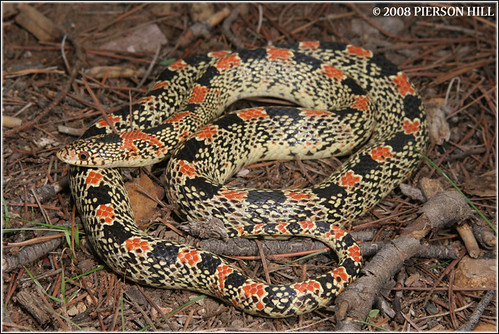
When the shed and I were safely in the car, however, I noticed that the head of my snake shed was not dark. Furthermore, the dorsal scales were boldly patterned with regularly-spaced dark blotches, twenty-eight in all (twenty-six on the body and two on the tail). The tail tip was broken, so I would guess that there were either thirty or thirty-one blotches in total. This was an important clue. The blotches were somewhat reminiscent of a kingsnake, milksnake, or long-nosed snake. However, they were restricted to the dorsal scales, rather than ringing the body as in king and milksnakes, and their edges were very clean, with no pattern in between, unlike the messier blotches of the long-nosed snake. Other options included the nightsnake and the glossy snake, but the blotches of my snake were very dark and regular, whereas these species have smaller, more irregular blotches.

Western Long-nosed Snake, Rhinocheilus lecontei
Finally, I turned to the scales for clues. As always, scale counts provide the most unambiguous evidence, although at this point I had a pretty good idea of what I thought it was. The dorsal scales were smooth and shiny, in 15 rows, and the subcaudal scales were divided, as was the anal plate. The head scales, most important, were somewhat reduced, consistent with a fossorial (burrowing) lifestyle. There were two postocular scales and only a single temporal scale in the first row, followed by two small temporals in the second row that I mistook for undifferentiated occipital scales at first. The upper labials were difficult to count, because the shed had already dried a little, and the snake had probably scraped it off using the labials as a leverage point. The same was true of the lower labials, but only a single pair of chin shields was evident.

Anterior part of the shed

Dorsal, lateral, and ventral views of the head

Rest of the body
After consulting some books to make sure I was right, I concluded that the shed belonged to a Ground Snake, Sonora semiannulata. These small snakes are highly variable in their body coloration and pattern, without consistent within-population variation. Although it is primarily restricted to the Mojave portion of Utah, records from the northeastern and central parts of the state suggest that it might be more widespread. It is found from southwestern Missouri west to southern California, north to Oregon and Idaho, and south to Mexico. Like other members of the tribi Sonorini, Ground Snakes eat mostly arthropods, including insects,  scorpions, spiders, and centipedes. Little is known about the species despite its wide range.

Ground Snake, Sonora semiannulata
It was exciting, almost forensic, to identify the shed of a species I had never seen before. Now I had a debate on my hands about whether to include it on my life list or not (a life list is a compilation of all the species of something - often birds, but in my case herps - that an individual has seen in their life). My friend Kerry Nelson and I have had lengthy discussions about what counts and what doesn't, including whether animals that others find are valid, whether dead animals are valid, and whether or not species seen in dreams (including those that exist only in dreams) are valid. What do you think? Would you count a shed, unambiguously identified, as seeing a species? I decided against it, but I'm very much looking forward to finding a live ground snake so I can add it to the list!

ACKNOWLEDGMENTS

I would like to thank Brian Eager, Matthijs Hollanders, Pierson Hill, and William Flaxington for use of their photographs.

REFERENCES

Cox DT, WW (1995) Snakes of Utah. Bean Life Science Museum, Provo, UT

Ernst CH, Ernst EM (2003) Snakes of the United States and Canada. Smithsonian Institution Press, Washington D.C.

Uetz P (2010) The original descriptions of reptiles. Zootaxa 2334:59-68 <link>


Creative Commons License

Life is Short, but Snakes are Long by Andrew M. Durso is licensed under a Creative Commons Attribution-NonCommercial-NoDerivs 3.0 Unported License.