Click here to read this post in Spanish!
Haga clic aquí para leer este mensaje en español!
Click here to read Part I.
Haga clic aquí para leer este mensaje en español!
Click here to read Part I.
Last month I wrote about "serpentine royalty": the first species of snakes to be formally described using the Linnaean system—those described by Linnaeus himself in the 1758 10th edition of Systema Naturae. Out of 100 snake species in that tome, let's take a closer look at the royal among royals, the four that still bear their original names.
 |
| Infographic showing the "tenure" of 807 snake genera used by more than one taxonomist. An additional 387 genera used only once are not shown, for a total of 1,194. Of these, about 500 are currently in use. The three longest lines at the top are the original three genera coined by Linnaeus in 1758 and still in use today. Data span 1758-2010, from The Reptile Database. Click for full version. |
Coluber constrictor
In the immortal words of Jeffrey C. Beane: "Linnaeus first gave me my scientific name, but reflecting upon it, I think: “What’s his game?” Perhaps he was drunk on that day (or smoked pot), for a snake I am, yes, but constrictor I’m not."
 |
| The Racer (Coluber constrictor) is one of only four snakes that have gone by the same scientific name since 1758. Today Coluber contains only 14 species, 11 of which were recently reallocated to it from Masticophis. In 1758 Linnaeus placed 61 species into Coluber, of which only C. constrictor remains. |
Many contemporary naturalists have been puzzled by the scientific name of the North American Racer, which normally crams its live prey into its mouth rather than constricting it. Linnaeus's descriptions ("Inhabits Canada. Triangular head1. It approaches men, twisting itself around their feet, but it is harmless."[10th ed.]/"Inhabits North America. Runs swiftly and bites very hard, but is not poisonous. Twists itself around the legs of such as approach it. Very smooth and slender. Black, pale blue beneath, white throat."[12th ed.]) glibly paraphrase that of his student Pehr Kalm2, who gave a several-page account of racers in his 1753 book Travels in North America. Among other myths, Kalm recounts tales told by "numbers of credible people" that racers, especially males interrupted during mating in the spring, will chase and trip people, but he was unable to reproduce the behavior despite his best efforts, saying "I know not for what reason they shunned me, unless they took me for an artful seducer". He was also doubtful of the claim that racers and other snakes enchant or hypnotize their prey, but he was reluctant to discount the possibility entirely because "many of the worthiest and most reputable people have related [the story], and...it is so universally believed here that to doubt it would be to expose one's self to general laughter." Given their willingness to accept these and other myths, it's not unlikely that Kalm and some of his informants, including the naturalists John Bartram and Cadwallader Colden, also confused racers with ratsnakes, both species being black along the east coast, which accounts for Kalm's descriptions of racers constricting and climbing large trees to eat birds' eggs, and might explain their perpetual misnomer.
 |
| Racer plate from Catesby's Natural History. Catesby also described cornsnakes but not ratsnakes, suggesting that perhaps he too confused ratsnakes and racers. |
The English naturalist Mark Catesby3 had previously described racers, which he called Anguis niger, and other snakes in his 1731 Natural History of Carolina, Florida and the Bahama Islands, the first published account of the flora and fauna of North America. Apparently Linnaeus didn't think much of this book, because he dismissed it in his introduction to the reptiles by writing "Catesby sketched a few serpents more beautifully than he made notes about them". He must have had some respect for Catesby, though, for he named both the lily-thorn Catesbaea and the bullfrog Rana catesbeiana after him. It is a bit of a mystery where the racer specimen that Linnaeus saw originated, or if he even saw one. If he did, it must have been collected and sent to him by Kalm, but the whereabouts of Kalm's specimens of North American snakes, if they exist, are unknown. There is a specimen of a racer in the Royal Museum in Stockholm which is marked with a Linnaean label. An 1802 catalogue states that the specimen came from the King, but of all the snakes with these labels it is the only one Linnaeus does not describe in his 1764 manuscript on the King's collection, Museum Adolphi Friderici (where the binomial system is used for the first time), so this information is probably erroneous. Also described by Linnaeus but subsequently lost are Kalm's specimens of Northern Watersnakes (today, Nerodia sipedon) and Common Gartersnakes (today, Thamnophis sirtalis), as well as two more mysterious specimens which Linnaeus named Coluber leberis and Coluber ovivorus4.
Boa constrictor
 |
| Top: Boa constrictor Bottom: Boa constrictor plate from Linnaeus & Sundius's 1748 Surinamensa Grilliana, drawn by P. A. Petersson and engraved by C. Bergquist |
Unlike racers, this snake is the eponymous constrictor. The name boa comes from the Latin boa for ‘large snake,’ after an animal mentioned in the Natural History of Pliny the Elder, which ate cows ('bos' in Latin). Linnaeus, whose descriptions were written in a kind of telegram style, without verbs, in a deliberate effort to be as brief as possible and save space, was particularly laconic if descriptions had already been published by himself or others. Of this species he said only that it "inhabits the [West] Indies and warm parts of the Americas", because boa constrictors had already been described by two of his primary sources on snakes, the Dutch naturalists Albertus Seba and Laurens Gronovius. Additionally, a specimen collected in Surinam by Claes Grill reached Linnaeus in the 1740s, and is described and illustrated in a dissertation defended by Peter Sundius, one of Linnaeus's early students. The catalogue of the King of Sweden's natural history collection also contains a description of one. However, Linnaeus could have been even more succinct had he recognized that a dark-colored specimen from the collection of Charles de Geer, a Swedish entomologist, was also a Boa constrictor. This collection was also the source of his anaconda, Burmese Python, and a handful of other snakes he had seen nowhere else, all of which are now in the Royal Museum in Stockholm, but he did not recognize that the boa in de Geer's collection was the same species that he had already called Boa constrictor.
The confusion may have arisen because de Geer's specimen had many more ventral scales than other boas Linnaeus had examined. Linnaeus preferred to use the number of ventral and subcaudal scales to distinguish species of snakes over their color or pattern (like his quantitative sexual system for classifying plants, Linnaeus's methods were a predecessor to modern ones), but he recognized that even these scale counts varied considerably within species. Kalm stated that his teacher thought "it was better to make use of an imperfect character than none at all" and he was hopeful that "time, and greater acquaintance with this class of animals may perhaps clear up their natural characters". Linnaeus named Boa constrictor earlier on the page than Boa orophias, which is why we use the former name rather than the latter, which is now used for a subspecies from St. Lucia. In his defense, Linnaeus did write of B. orophias: "Face of the constrictor, but dark", suggesting that he thought they might be the same snake. To Linnaeus's terse description, Gmelin, writing in the 13th edition of Systema Naturae, added: "beautifully variegated with rhombic spots, belly whitish" and noted that it is "of vast strength and size, measuring sometimes 12 yards long, and by twisting itself round the bodies of deer, leopards, and other larger quadrupeds, breaks the bones, and after covering them over with a slimy mucus gradually swallows them". Certainly these descriptions helped popularize these large and impressive snakes, specimens of which were curios of the highest value. This popularization led to many explorers and travel writers calling any large snake a boa constrictor (including pythons) for centuries to come.
Because of their tails, Linnaeus thought that rattlesnakes were so unusual that he placed them in their own genus, Crotalus, separating them from other vipers (which he placed in the genus Coluber despite their solenoglyphous fangs). Linnaeus described three species of rattlesnakes: Crotalus horridus (see below), C. durissus, and C. dryinas. Like Boa constrictor and B. orophias, we now consider the latter two species to be the same, but unlike the boa names we use the name durissus for the species even though dryinas precedes it on the page5. Although most rattlesnakes are North American, Linnaeus's C. durissus specimen was collected by Claes Grill in Surinam and originally described in detail in 1748 in the same dissertation that contained the boa constrictor description. In contrast, the "C. dryinas" specimen was from the king of Sweden's collection and lacked geographic data. It is clear that King Adolf Frederick was not the most attentive curator—his curatorial record is incomplete, and over time many of his specimens have been lost and their labels mixed up or deliberately modified. He wasn't the most assertive head of state either, described as "little more than a state decoration"—although apparently he did like snakes. Both rattlesnake specimens from his collection that Linnaeus examined have apparently been lost for over 100 years, and the Grill specimen is lost as well. As a result, and because Linnaeus's descriptions are so terse, the names of the three rattlesnakes (horridus, durissus, and dryinas) were for many years confusingly and inconsistently applied. For example, both Holbrook and Duméril referred to the timber rattlesnake as C. durissus in their respective classic works, Duméril additionally called the neotropical rattlesnake C. horridus, and Boulenger refers to the eastern diamondback as C. durissus in his catalogue of snakes in the British Museum.
 |
| Image of an African Python (Python sebae) from Charles Challié Long's 1876 book Central Africa: Naked Truths of Naked People The caption reads "Capture of a Boa-Constrictor" |
Crotalus durissus
Rattlesnakes have captured the attention of Europeans ever since they first started settling the New World. Using their Nahuatl (Aztec) name, Teuhtlacocauhqui, Francisco Hernández described them in his 1615 Quatro Libros de la Naturaleza: "When they strike, the bite is fatal unless treated promptly...It has a tail with rattles, one for each year of its life...It has two curved fangs in its upper jaw to inject its venom...It moves in a slithering fashion. Indians hunt and capture them and hang them around their necks...Those who raise them at home say they can live for up to a year without eating anything...When wounded and angry, it whips around, shaking its rattles, and raises its neck to frighten those nearby. However, it does not bite unless provoked." Hernández's book also contains the earliest illustration of a rattlesnake, which is certainly Crotalus durissus. Many other 16th and 17th century authors also wrote about rattlesnakes, dating back to their earliest mention in print, by Cieça de Leon in 1554. Many of these writings contain both accurate information and the first printed iterations of several still-current myths. Clearly, native Americans had known of rattlesnakes since ancient times; the Aztecs and Mayans had a rattlesnake constellation which may have been part of their zodiac.
 |
Global distribution of 35 species of the genus Crotalus
Data from IUCN; click for a larger version
|
 |
| Top: Neotropical Rattlesnake (Crotalus durissus) Bottom: The earliest illustration of a rattlesnake in a book, from Hernández 1628 |
Crotalus horridus
 |
| Crotalus horridus is the type species of the genus Crotalus, which today contains 39 species. |
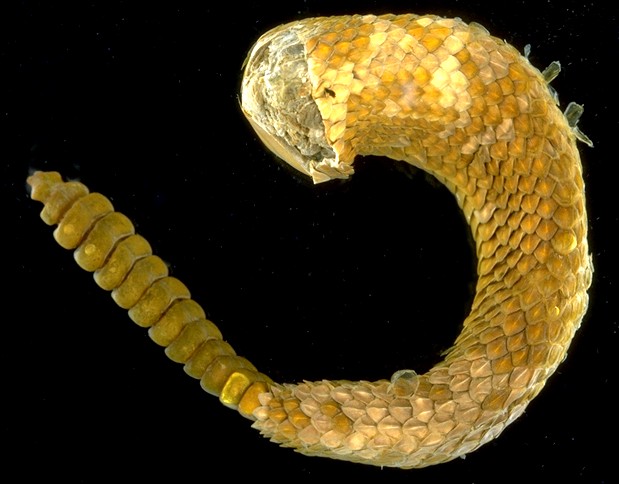
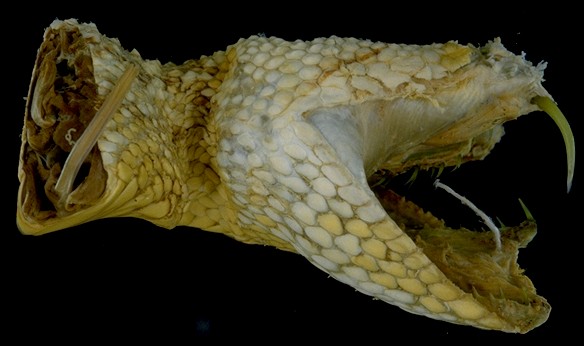
Of this snake which would come to symbolize America, Linnaeus wrote (appropriately) "Lives in America. Very venomous; its antidote is Senega (snakeroot). It is eaten by pigs, and calls down birds and squirrels from the trees into its jaws." This is a lengthy description for him, especially considering that timber rattlesnakes had already been described in 1683 (by Edward Tyson, who dissected one), 1721 (by Richard Bradley), 1734 (by Albertus Seba), and in 1745 and 1754 by Linnaeus himself (the first time in a dissertation defended by Barthold Rudolph Hast describing specimens from Count Carl Gyllenborg's collection of rare herps, insects, corals, and minerals, and the second time in his description of the collection of the Swedish king, Museum Adolphi Friderici). C. horridus is the only North American snake Linnaeus described that was not sent to him by Kalm or by his other primary North American informant, Alexander Garden. The specimen that he described had 7 rattle segments, and he was able to give a count of the ventral scales (167), which indicates that he examined a complete specimen, but the specimen that is now in the Royal Museum in Stockholm is represented only by a severed tail, which has 12 rattle segments, and a head, which is actually from a bushmaster (Lachesis muta). Like the specimens of the neotropical rattlesnakes, apparently the original specimen has been missing since at least 1899, and possibly much earlier.6
Although Kalm did not collect a rattlesnake for Linnaeus, he gave a lengthy, detailed, and incredibly accurate description of rattlesnakes and their relationship with humans, which is as much an account of snake biology as it is of the cultural history of colonial America. His words suggest that rattlesnakes were already on their way out in eastern North America in the mid-1700s: "In all my travels, I saw only 3 living specimens. I frequently heard them in the nearby thicket, but it seemed inadvisable to pursue them." It is a testament to Kalm's scientific training that he surpassed many modern observers in accurately stating that "The snake is usually 3 to 4 feet long. The largest one I saw was 6 feet long and as thick as the calf of a man's leg. Usually they are as thick as the wrist" and "They travel slowly, thus one need not fear being overtaken" and "The rattler is peculiar in that he usually does not injure a person unless forced to defend himself." Despite these honest observations, Kalm had no special love of snakes, including them in a list of reasons that he preferred Sweden to America: "The rattlesnakes, horned-snakes, red-bellied, green, and other poisonous snakes, against whose bite there is frequently no remedy, are in great plenty here".
 |
| Catesby's Timber Rattlesnake (which he called Vipera caudisona, but which Linnaeus and we call Crotalus horridus). Kalm considered this "an incomparable illustration". |
 |
| Timber Rattlesnake from Bradley (1721) |
Other notable snake species described by Linnaeus
Linnaeus described 83 other snake species between his 10th and 12th editions that are still considered valid today, plus 31 that are not (including Crotalus dryinas and Boa orophias). These include many familiar, widespread, and notable species, including 2 scolecophidians, Anilius scytale, and an Asian pipesnake from Sri Lanka (all of which he placed in the genus Anguis, which we today use for legless lizards), several huge constrictors including the Indian Python, Boa Constrictor, and Green Anaconda (but also three smaller tree boas and two sand boas, the latter also in Angius), 13 vipers including the fer-de-lance, copperhead, European adder, bushmaster, and pygmy rattlesnake, a pair of homalopsids, 46 colubrids (including many familiar European and American species but also an African egg-eater and an Asian flying snake), 5 lamprophiids, and 9 elapids (including 3 cobras, 2 coralsnakes, and 2 sea snakes). He also made a few brief comments about snake anatomy and biology as footnotes or in his introductory material, including his method for counting ventral and subcaudal scales (first used in Amphibia Gyllenborgiana and still in use today) as well as the correct observations that "Serpents of our country hibernate and in the early spring shed their skin, that is to say, their old age" and "Serpentes often swallow down prey twice as thick as their neck, on account of their expandable, unarticulated jaws". In other works, he presents a great deal of information on snakebite and, the consummate botanist, its treatment using various medicinal plants. Although Linnaeus bore no special love for snakes, he treated them as he did other biodiversity, and I encourage all modern biologists to do the same—to view snakes as wildlife rather than pests, as a beautiful and diverse part of our natural heritage, to see them as what they are rather than what we imagine them to be.
It is tempting to imagine Linnaeus as a brilliant solitary taxonomist, aided and sent specimens by his correspondents, colleagues, and students but intellectually working alone. But, as today, Linnaeus relied heavily on his network both to obtain specimens and to describe them with reference to those who had gone before. Of the 74 species in the 10th edition, only four were brand new original descriptions (these were Vipera aspis from southern Europe, Epicrates cenchria from South America, Erythrolamprus triscalis from Curaçao, and Duberria lutrix from Africa), and the 12th contained scarcely more, mostly southeastern North American species sent to Linnaeus by Alexander Garden. Almost ten times that many new snakes were described last year alone.
Linnaeus described 83 other snake species between his 10th and 12th editions that are still considered valid today, plus 31 that are not (including Crotalus dryinas and Boa orophias). These include many familiar, widespread, and notable species, including 2 scolecophidians, Anilius scytale, and an Asian pipesnake from Sri Lanka (all of which he placed in the genus Anguis, which we today use for legless lizards), several huge constrictors including the Indian Python, Boa Constrictor, and Green Anaconda (but also three smaller tree boas and two sand boas, the latter also in Angius), 13 vipers including the fer-de-lance, copperhead, European adder, bushmaster, and pygmy rattlesnake, a pair of homalopsids, 46 colubrids (including many familiar European and American species but also an African egg-eater and an Asian flying snake), 5 lamprophiids, and 9 elapids (including 3 cobras, 2 coralsnakes, and 2 sea snakes). He also made a few brief comments about snake anatomy and biology as footnotes or in his introductory material, including his method for counting ventral and subcaudal scales (first used in Amphibia Gyllenborgiana and still in use today) as well as the correct observations that "Serpents of our country hibernate and in the early spring shed their skin, that is to say, their old age" and "Serpentes often swallow down prey twice as thick as their neck, on account of their expandable, unarticulated jaws". In other works, he presents a great deal of information on snakebite and, the consummate botanist, its treatment using various medicinal plants. Although Linnaeus bore no special love for snakes, he treated them as he did other biodiversity, and I encourage all modern biologists to do the same—to view snakes as wildlife rather than pests, as a beautiful and diverse part of our natural heritage, to see them as what they are rather than what we imagine them to be.
It is tempting to imagine Linnaeus as a brilliant solitary taxonomist, aided and sent specimens by his correspondents, colleagues, and students but intellectually working alone. But, as today, Linnaeus relied heavily on his network both to obtain specimens and to describe them with reference to those who had gone before. Of the 74 species in the 10th edition, only four were brand new original descriptions (these were Vipera aspis from southern Europe, Epicrates cenchria from South America, Erythrolamprus triscalis from Curaçao, and Duberria lutrix from Africa), and the 12th contained scarcely more, mostly southeastern North American species sent to Linnaeus by Alexander Garden. Almost ten times that many new snakes were described last year alone.
 |
| Coronella austriaca from Laurenti 1768 |
1 In the 10th edition Linnaeus confused specimens of racers with those of the black form of the Eastern Hognose Snake (Heterodon platirhinos), but by the 12th edition these had been separated and the phrase "triangular head" removed from the description of the racer.↩
2 After whom the mountain laurel genus Kalmia is named.↩
3 Like Maria Sibylla Merian before him, Catesby was among the first naturalists to draw his plants and animals interacting in their natural habitats, a style of representation that would later be used by Alexander Wilson and John James Audubon. He was also the first to abandon the Native American names for his subjects, instead establishing scientific binomials based on relationships a la Linnaeus. Had his work been published three decades later, he might have been immortalized as the father of North American herp taxonomy, and many of the scientific names that we use today could have been very different. Catesby's book, richly illustrated, was much more popular than Linnaeus's.↩
4 The specimen named Coluber leberis was likely a Storeria, the only genus found in the area traversed by Kalm (Pennsylvania, New York, New Jersey, and southern Ontario) with matching scale counts. Although the scale counts and pattern description match S. occipitomaculata better and this species is more common than S. dekayi in northeastern North America, the specimen could have been either, and since we cannot examine it, the name is not used. Coluber ovivorus is even more enigmatic, because the description does not match any northeastern snake well.↩
5 This is because, by the time it was all sorted out, the name C. durissus had ended up being in more widespread use, so the "proper" name dryinas was suppressed by the International Commission on Zoological Nomenclature.↩
6 There is a reasonable chance that the specimen that Linnaeus first named C. horridus was actually from South America, and thus was really C. durissus as well, but since we cannot prove this beyond a shadow of a doubt, in 1926 the International Commission on Zoological Nomenclature decided to continue to use it for the timber rattlesnake.↩
7 Little is known about Laurenti. No picture of him exists, and his 1768 thesis, Specimen medicum, was his only publication. In it, he elevated Linnaeus's order Reptilia to a class, distinguishing it from class Amphibia, into which Linnaeus lumped both amphibians and reptiles. Laurenti also tripled the number of reptile genera, coining some of today's most familiar genus names, including Vipera, Natrix, Laticauda, Dipsas, and Naja.↩
ACKNOWLEDGMENTS
Thanks to Todd Pierson, Patrick Jean, and JD Willson for the use of their photos, and to my mom for getting me William Blunt's Linnaeus for Christmas this year, which inspired this article.
REFERENCES
Andersson, L.G. 1899. Catalogue of the Linnaean type-specimens of snakes in The Royal Museum in Stockholm. Bihang till Kongl. Svenska Vetenskaps-Akademiens Handlingar 24:1-35 <link>
Blunt, W. 2002. Linnaeus: The Compleat Naturalist. Princeton University Press, Princeton, New Jersey, USA <link>
Bradley, R. 1721. A philosophical account of the works of nature, London <link>
Campbell, J.A. and W.W. Lamar. 2004. The Venomous Reptiles of the Western Hemisphere (2 Vol.). Cornell University Press, Ithaca, New York <link>
Catesby, M. 1731. The Natural History of Carolina, Florida, and the Bahama Islands, London.<link>
Cieça de Leon, P. 1554. La Crónica del Perú, Seville <link>
Gronovius, L.T. 1756. Museum Ichthyologicum. Theodorum Haak, Lugduni-Batavorum <link>
Hernández, F. 1615. Quatro libros. De la naturaleza, y virtudes de las plantas, y animales que estan receuidos en el vso de medicina en la Nueua España, y la methodo, y correccion, y preparacion, que para administrallas se requiere con lo que el doctor Francisco Hernandez escriuio en lengua latina <link>
Kalm, P. 1771. Travels Into North America. T. Lowndes, London <link>
Kitchell, K. and H.A. Dundee. 1994. A trilogy on the herpetology of Linnaeus's Systema Naturae X. Smithsonian Herpetological Information Service 100 <link>
Klauber, L.M. 1941. The rattlesnakes listed by Linnaeus in 1758. Bulletin of the Zoological Survey of San Diego 17:81-95 <link>
Klauber, L.M. 1948. Some Misapplications of the Linnaean Names Applied to American Snakes. Copeia 1948:1-14 <link>
Klauber, L.M. 1956. Rattlesnakes: their habits, life histories, and influence on mankind. University of California Press <vol 1/vol 2>
Krecsák, L. and R. Wahlgren. 2008. A survey of the Linnaean type material of Coluber berus, Coluber chersea and Coluber prester (Serpentes, Viperidae). Journal of Natural History 42:2343-2377 <link>
Larsen, E.L. 1957. Pehr Kalm's Account of the North American Rattlesnake and the Medicines Used in the Treatment of its Sting. American Midland Naturalist 57:502-511 <link>
Laurenti, J.N. 1768. Specimen medicum: exhibens synopsin reptilium emendatam cum experimentis circa venena et antidota reptilium austriacorum. Typ. Joan. Thomae nob. de Trattnern, Vienna, Austria <link>
Linnaeus, C. 1745. Amphibia Gyllenborgiana. Uppsala University, Uppsala <link>
Linnaeus C. 1746. Fauna Svecica Sistens Animalia Sveciæ Regni: Quadrupedia, Aves, Amphibia, Pisces, Insecta, Vermes, Distributa per Classes & Ordines, Genera & Species. Differentiis Specierum, Synonymis Autorum, Nominibus Incolarum, Locis Habitationum, Descriptionibus Insectorum. Stockholmiæ [Stockholm] (Sweden): Sumtu & literis Laurentii Salvii <link>
Linnaeus, C. 1746. Museum Adolpho Feidericianum. Uppsala University, Uppsala <link>
Linnaeus, C. 1748. Surinamensia Grilliana. Uppsala University, Uppsala <link>
Linnaeus, C. 1764. Museum S:ae R:ae M:tis Adolphi Friderici Regis Svecorum, Gothorum, Vandalorumque &c. &c. &c. in quo Animalia rariora imprimis & exotica: Aves, Amphibia, Piscis describuntur. Tomi secundi Prodromus. Holmiae. Pp 110. <link/translated>
Linnaeus, C. 1758. Systema naturae per regna tria naturae, secundum classes, ordines, genera, species, cum characteribus, differentiis, synonymis, locis. Tomus I. Editio decima, reformata. Holmiae, 823 pp. <link>
Linnaeus, C. 1762. Morsura Serpentum. Uppsala <link>
Linnaeus, C. 1766. Systema naturae per regna tria naturae, secundum classes, ordines, genera, species, cum characteribus, differentiis, synonymis, locis. Tomus I. Editio duodecima, reformata. Holmiae, 532 pp <link>
Lönnberg, E. 1896. Linnean type-specimens of birds, reptiles, batrachians and fishes. Bihang till Kongl. Svenska Vetenskaps-Akademiens Handlingar 22:1-45 <link>
McIvor, R.S. 2010. Aztec Constellations Preserved by Duran. Journal of the Royal Society of Canada 104:46-50 <link>
Seba, A. 1734-1765. Locupletissimi rerum naturalium thesauri accurata descriptio, et iconibus artificiosissimis expressio, per universam physices historiam :opus, cui, in hoc rerum genere, nullum par exstitit. Apud Janssonio-Waesbergios & J. Wetstenium & Gul. Smith, Amstelaedami <link>
Smit, P. 1979. The zoological dissertations of Linnaeus. Svenska Linnesallskapets Arsskrift 1978:118-136 <link>
Tyson, E. 1683. Vipera Caudi-Sona Americana, Or the Anatomy of a Rattle-Snake, Dissected at the Repository of the Royal Society in January 1682/3 by Edw. Tyson MD Coll. Med. Lond. Cand. & RS Soc. Philosophical Transactions (1683-1775) 13:25-46 <link>

Life is Short, but Snakes are Long by Andrew M. Durso is licensed under a Creative Commons Attribution-NonCommercial-NoDerivs 3.0 Unported License.