If you need to identify a snake, try the Snake Identification Facebook group.
For professional, respectful, and non-lethal snake removal and consultation services in your town, try Wildlife Removal USA.
Showing posts with label WCH7. Show all posts

Tuesday, March 19, 2013

Non-toxic venoms?


This article is part of a series highlighting new research in snake biology presented by herpetologists at the World Congress of Herpetology VII in Vancouver, British Columbia. If you want to learn more about the WCH, check out the June 2012 issue of Herpetological Review, or follow the Twitter hashtag #wch2012, with which I will tag all posts in this series.

A while back we heard about reasons why rattlesnakes frequently miss strikes at their squirrel prey. When they do hit their target, however, the prey tend to run off a little ways before kicking the bucket. This is because, although snake venoms are quick-acting, they mostly do not incapacitate immediately (although there are some sea snake venoms that are very, very quick). As a result, snakes that hunt using venom must be able to track down their prey after it has been bitten. This necessity has led Anthony SaviolaSteve Mackessy, and their colleagues at the University of Northern Colorado to an answer for a question that snake biologists have been asking for a long time: why do snake venoms contain molecules that are non-toxic?

Venom is a complex mixture of over one hundred proteins, peptides, enzymes, and small organic and inorganic molecules, many of which are toxic. It is essentially very strong saliva, capable of both breaking down food and chemically incapacitating or killing it. The evolution of venom has allowed many species of advanced snakes to utilize chemical rather than mechanical means of dispatching prey, which helps them avoid retaliation from sharp teeth and claws. Yet a few venom components serve neither to digest nor to kill prey. What on earth is their function?

Timber Rattlesnake, Crotalus horridus
Observations back to the 1960s suggest that rattlesnakes prefer the scent of envenomated mice over non-envenomated ones. When a rattlesnake strikes a prey item, a stereotypic behavior known as strike-induced chemosensory searching (SICS) is induced. This behavior is a fixed-action pattern that involves tongue-flicking to collect chemical information and a stereotyped searching movement pattern that allows the snake to determine which of the many chemical trails in its vicinity should be followed to find the envenomated prey.

To what chemical cues are rattlesnakes responding when they perform SICS? Mackessy separated Western Diamondback Rattlesnake (Crotalus atrox) venom into distinct fractions, each containing molecules of different sizes. This is accomplished by exploiting differences in the weight of each molecule, using techniques that allow different molecules to travel different distances through a gel medium based on how heavy they are. In the same amount of time, smaller, lighter molecules travel farther than larger, heavier ones. When Mackessy injected mice with the fractions containing the larger exonucleases, metalloproteinases, and phospholipases (classes of enzymes that break down, respectively, DNA, proteins, and fatty acids - so, the venom components that are active in digestion and incapacitation), the snakes showed little interest. Together, these well-known active compounds comprise about 85% of the total venom by mass, and they are responsible for all of the venom's digestive and killing activity, so it's a little surprising that snakes should show no interest in mice injected with them.

Structure of disintegrin heterodimer from Echis carinatus
However, when Mackessy injected mice with a venom fraction containing smaller molecules, called crotatroxin disintegrins, not known to have any enzymatic or toxic activity, the snakes behaved as they normally would have when scent-trailing mice injected with whole venom. Although disintegrins make up less than 10% of the venom by mass, they are clearly critical for the snake to find its prey following envenomation. What's more, the disintegrins alone don't induce trail-following behavior in snakes; rather, it is the product of the interaction of the disintegrins with the dead prey tissue that causes snakes to follow their trail.

Crotalus oreganus lutosus
Disintegrins are abundant in the venoms of most Western Rattlesnakes (Crotalus viridis sensu lato)1, and are also found in other rattlesnakes, in Copperheads (Agkistrodon contortrix) and other snakes of the genus Agkistrodon (where they may be undergoing rapid evolution), and in most adult vipers. However, in juvenile rattlesnakes, and in many elapid snakes (cobras, coralsnakes, and other proteroglyphous snakes) disintegrins are present only at low levels or are absent entirely. Why should this be? One possible explanation is that elapids and juvenile vipers are more likely to hold onto their prey following a strike, so they don't need a chemical tracer to follow it because it doesn't usually get that far away. Some elapids do have disintegrins, however, and there is evidence that disintegrins in vipers also function to inhibit blood coagulation. In fact, a disintegrin molecule from Copperhead venom has been shown to slow the spread of breast and ovarian cancer in mice, so there could be much more to this story. One thing is sure: the Mackessy lab is one to watch if you're interested in snake venoms, and this won't be my last post on their fascinating research.

1 Many of the nine previously recognized subspecies of the Western Rattlesnake (Crotalus viridis sensu lato) occur in the southwestern United States, and the complex has been subject to several molecular studies to reevaluate the taxonomic status of these subspecies. The consensus opinion largely follows Ashton and de Queiroz (2001), which recognized two species: C. viridis (Prairie Rattlesnake, two subspecies) and C. oreganus (Western Rattlesnake, six subspecies). This is the only species of rattlesnake that occurs where I live, in northeastern Utah.

ACKNOWLEDGMENTS

Thanks to Todd Pierson for his photograph and to Steve Mackessy and Anthony Saviola for their coordination on this article, which was delayed in its release to coincide with the publication of their paper in BMC Biology.

REFERENCES

Ashton KG, de Queiroz A (2001) Molecular systematics of the western rattlesnake, Crotalus viridis (Viperidae), with comments on the utility of the D-loop in phylogenetic studies of snakes. Molecular Phylogenetics and Evolution 21:176-189. <link>

Calvete J, Sanz L, Juárez P, Mackessy S (2009) Snake venomics and disintegrins: portrait and evolution of a family of snake venom integrin antagonists. In: Mackessy S (ed) Handbook of Venoms and Toxins of Reptiles. CRC Press, Boca Raton, Florida, pp 337-357


Finn R (2001). Snake Venom Protein Paralyzes Cancer Cells. Journal of the National Cancer Institute 93:261-262 <link>

Furry K, Swain T, Chiszar D (1991) Strike-induced chemosensory searching and trail following by prairie rattlesnakes (Crotalus viridis) preying upon deer mice (Peromyscus maniculatus): chemical discrimination among individual mice. Herpetologica 47:69-78. <link>


Mackessy SP, Tu AT (1993) Biology of the sea snakes and biochemistry of their venoms. In: Tu AT (ed) Toxin-related Diseases: Poisons Originating from Plants, Animals and Spoilage. Oxford & IBH Publishing Co., New Delhi, pp 305-351 

<link>

Saviola AJ, Chiszar D, Busch C, Mackessy SP. 2013. Molecular basis for prey relocation in viperid snakes. BMC Biology 11 <link>

Soto JG et al. (2006) Genetic variation of a disintegrin gene found in the American copperhead snake (Agkistrodon contortrix). Gene 373:1-7. <link>


Creative Commons License

Life is Short, but Snakes are Long by Andrew M. Durso is licensed under a Creative Commons Attribution-NonCommercial-NoDerivs 3.0 Unported License.

Wednesday, October 3, 2012

Why are there no herbivorous snakes?

This article is part of a series highlighting new research in snake biology presented by herpetologists at the World Congress of Herpetology VII in Vancouver, British Columbia. If you want to learn more about the WCH, check out the June 2012 issue of Herpetological Review, or follow the Twitter hashtag #wch2012, with which I will tag all posts in this series. This article was inspired in part by the research of Beck Wehrle, who did his Master's work on the microbial communities of iguanas, and by Cyndi Carter.


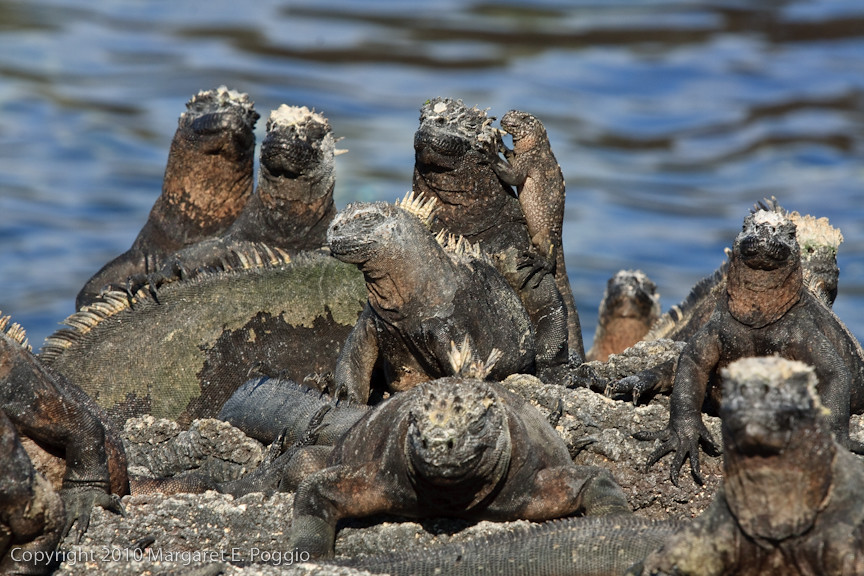
Herbivory (eating plants or their parts) is widespread among vertebrates. There are many herbivorous mammals: think of cows, deer, and other ungulates, as well as lagomorphs (rabbits and their relatives), kangaroos, elephants, sloths, hyraxes, manatees, and even some primates, including many humans. Many birds are herbivorous, including notably the Hoatzin of the Amazon basin, which eats only leaves, but more broadly the many seed- and grain-eating birds such as sparrows, buntings, chickadees, and many other familiar species. Among reptiles, there are herbivorous lizards (including several Filipino monitors, such as Gray's and Panay Monitors, which eat fruit, and Marine Iguanas, which eat only seaweed), turtles (Green Sea Turtles and most tortoises), and even some crocodilians (Simone Brito and colleagues reported Broad-nosed Caimans eating fruit in 2002). Nearly all frogs are herbivorous as tadpoles (and some as adults), and some salamanders, the sirenids, eat algae. There are also many herbivorous fishes: the Pacu of South America, many koi and goldfishes, parrotfishes, and some cichlids and catfishes. Notably absent, then, are the snakes.

A python eats a deer while ignoring plants
There are over 3400 species of snakes, representing >10% of all tetrapods: more than any other group except mammals, birds, and frogs. So why are there no herbivorous species of snake?

At least part of the secret is that nearly all these herbivores (at least, those that eat leaves and parts of plants that have high cellulose content) have something in common: they don't actually digest their own food. You see, much of the energy in plants is stored in their cellulose, a polymer (chain-like molecule) of several hundred to over ten thousand glucose (a common, energy-rich sugar) molecules linked together by β(1,4) bonds. Animals cannot make cellulase enzymes to break the β bonds in cellulose and obtain the monosaccharide glucose, which they can metabolize for energy. Instead, sophisticated endosymbiotic microbes that live in their guts do it for them. The microbes and their herbivorous hosts are digestive symbionts, or indispensable partners. This poses a problem: how do newborn herbivorous organisms get their gut colonies in the first place? The answer: from older members of the same species, including their parents. The transfer is facilitated by processes like live birth, nursing, and coprophagy (eating others' poop), as well as more generally by plenty of social contact thorough pair bonding and parental care, most of which are generally not present in snakes. To be fair, about 15-20% of snakes give live birth, and some have limited parental care and are social at times. But generally speaking, opportunities for microbe transfer between snakes are few and far between. What's more, restrictions of functional morphology probably restrict snakes' ability to evolve herbivory. The kinetic skull with its highly specialized musculature and dentition for swallowing large prey would be extremely unsuitable for the mastication required to pre-digest most plant tissue. There also isn't very much space in a snake's body for the exceptionally long/convoluted gut that seems to be necessary to house the microbial fauna necessary for complete digestion of plant tissue.

Galápagos Marine Iguanas (Amblyrhynchus cristatus)
It's interesting to consider what natural history attributes a herbivorous snake might share with other herbivorous reptiles. Most herbivorous lizards are social, including the Green Iguana and the Marine Iguana. Additionally, herbivory seems to be especially common among lizards on islands, where animal prey  abundance is chronically or periodically low. Predation pressure might also be low on such islands, allowing would-be ectothermic herbivores to meet their energetic demands by eating plants, digestion of which requires prolonged basking to achieve high body temperatures  which could increase predation risk. Many plants reward their herbivores with tasty fruits or nectar in exchange for seed dispersal or pollination - lizards in the MediterraneanNew Zealand, and Mauritius are plant pollinators, and there are lots of examples of mammalian, avian, and invertebrate pollinators. Is it such a stretch to imagine a snake somewhere that enters into this kind of relationship with a flowering plant?

Bagheera
The recent discovery of herbivory in a species of jumping spider, named Bagheera kiplingi by a Jungle Book aficionado,  means that another predominantly carnivorous group contains at least one herbivorous member. These spiders eat Beltian bodies (little packets of fat and protein produced by Acacia trees to reward their ant mutualists/defenders), although they also eat insects. Some other spiders also feed on nectar and might be pollinators. Intriguingly, members of the genus Bagheera are also unusually social for spiders. No word yet on the composition of their digestive microflora, but other plant-tissue-eating arthropods, the termites, rely on similar endosymbioses to vertebrate herbivores.

Tentacled Snake (Erpeton tentaculatum)
Herbivory by a snake has actually kinda-sorta been reported in the peer-reviewed literature once or twice. As far back as 1875, when French naval physician and naturalist Albert Morice wrote the first detailed account of the fauna of Cochinchina, he remarked on how often algae and fragments of aquatic plants were found in the digestive system of the Tentacled Snake, Erpeton tentaculatum. Other authors have remarked on this as well, and according to Morice's account, the local people told him that they knew the snake consumed plants. Hubert Saint Girons, writing in 1972, suggested that in the course of hunting fish in a vegetation-rich freshwater environment, parts of plants might be uprooted and swallowed with the prey. More recent herpetologists have concluded that the presence of plant debris in the stomach contents of E. tentaculatum is, in fact, probably accidental. Furthermore, because there are no  morphological modifications to the dentition or digestive system of E. tentaculatum that would suggest a herbivorous diet, there is no reason to suspect that these plants are consumed on purpose. Nevertheless, the statement that Erpeton is a herbivorous snake has been propagated in several sources, although it is not really accurate.

The more compelling case comes from a study done on island Cottonmouths (Agkistrodon piscivorus) by Harvey Lillywhite and colleagues, published in the journal BioScience in 2008. During a study of pitviper scavenging in the intertidal zone conducted on Florida's Seahorse Key, Lillywhite observed Cottonmouth turds containing relatively large amounts of seaweed (up to 54 grams, or pretty much the entire turd). This seemed like a lot of material to be secondarily or accidentally ingested, and Lillywhite speculated that the Cottonmouths might be eating seaweed because it smelled like fish. Then he and his team went further: to test this idea, they presented Cottonmouths snakes in the laboratory with marine plant materials with and without fish present. The snakes thoroughly investigated the algae lacking fish scent for several minutes, with frequent tongue flicking, pushing, and probing, but they did not attempt to ingest it. When the presentation was repeated using plant materials rubbed with a dead fish or loosely enveloping a piece of fish, the snakes voluntarily swallowed the marine plants that had contacted fish, whether or not the fish was still present. Pics or it didn't happen? Here's the proof:

Figure from Lillywhite et al. 2008

I researched this topic a while ago and intended to make a post about it at some point. What reminded me was actually an experience I had while I was at the WCH: an interesting piece of evidence for a very strange kind of herbivory in a snake came to my attention. My good friend Cyndi Carter, a student of ecology at the University of Georgia, told me I had three chances to guess what she found in a Cottonmouth stomach, and that if I got it she would buy me a large ice cream. My first guess was a dead cat, which they have been known to eat. As a hint, she told me that she found it when she tried to inject the snake with formalin and couldn't get the needle in. After two more wrong guesses on my part (turtle, rock), she showed me this picture:


That's right, a pine cone. Can Cyndi, Joe Mendelson (whose snake it was), or I explain this? We cannot. Maybe it smelled like a fish.


ACKNOWLEDGMENTS


Thanks to Cyndi Carter for the picture of the pine cone, James Van Dyke for articulating what I meant to say about constraints of functional morphology at the end of the third paragraph, Joe Mendelson for clueing me in to the herbivorous frog Xenohyla truncata, and Patrick Prévost for his excellent article and  photograph of Erpeton tentaculatum, one of my favorite snakes.

REFERENCES

Brito, S. P., D. V. Andrade, and A. S. Abe. 2002. Do caimans eat fruit? Herpetological Natural History 9:95-96.

Cowen, R. 1989. Alimentary, My Dear Hoatzin: Ruminations on a Gutsy Bird. Science News 136:269-270.

Dunn, E. R. 1924. Siren, A herbivorous salamander? Science. 59:145.

Farlow, J. O. 1976. Speculations about the diet and foraging behavior of large carnivorous dinosaurs. American Midland Naturalist. 95:186-191.

Fleming, T. H. and K. R. Lips. 1991. Angiosperm endozoochory: were pterosaurs Cretaceous seed dispersers? American Naturalist. 138:1058-1065.

Lillywhite, H. B., C. M. Sheehy III, and F. Zaidan III. 2008. Pitviper scavenging at the intertidal zone: an evolutionary scenario for invasion of the sea. BioScience 58:947-955 <link>

Meehan CJ, Olson EJ, Reudink MW, Kyser TK, Curry RL (2009) Herbivory in a spider through exploitation of an ant–plant mutualism. Current Biology 19:R892-R893. 

Moll, D. and K. P. Jansen. 1995. Evidence for a role in seed dispersal by two tropical herbivorous turtles. Biotropica. 27:121-127. 

Morice, A. 1875. Sur les habitudes d'un remarquable serpent de la Cochinchine: I'Herpeton tentaculatum. Annales des Sciences Naturelles 6:128-129. 

Olesen, J. M. and A. Valido. 2003. Lizards as pollinators and seed dispersers: an island phenomenon. Trends in Ecology & Evolution 18:177-181. 

Pryor, G. S., D. P. German, and K. A. Bjorndal. 2006. Gastrointestinal fermentation in Greater Sirens (Siren lacertina). Journal of Herpetology 40:112-117. 

Sokol, O. M. 1967. Herbivory in lizards. Evolution. 21:192-194. 

Van Damme, R. 1999. Evolution of herbivory in lacertid lizards: effects of insularity and body size. Journal of Herpetology. 33:663-674. 

Walls, G. Y. 1981. Feeding Ecology of the Tuatara Sphenodon punctatus on Stephens Island, Cook Strait. New Zealand journal of ecology 4:89-97.


Creative Commons License

Life is Short, but Snakes are Long by Andrew M. Durso is licensed under a Creative Commons Attribution-NonCommercial-NoDerivs 3.0 Unported License.

Wednesday, September 12, 2012

Recent conservation successes with Indigo Snakes

This article is part of a series highlighting new research in snake biology presented by herpetologists at the World Congress of Herpetology VII in Vancouver, British Columbia. If you want to learn more about the WCH, check out the June 2012 issue of Herpetological Review, or follow the Twitter hashtag #wch2012, with which I will tag all posts in this series.


An Eastern Indigo I was very fortunate to see in 2010.
Ask anyone: the Eastern Indigo Snake (Drymarchon couperi) is one of the most commanding and majestic snakes anywhere. Once found throughout Florida and in the coastal plain of southern Georgia, extreme south Alabama, and extreme southeast Mississippi, today the Eastern Indigo survives in numbers only in peninsular Florida and southeast Georgia. Although the species persists in low numbers in the Florida panhandle, it has been extirpated from the rest of its range as a result of declines in and alterations to the longleaf pine (Pinus palustris) ecosystem that it inhabits and on which it critically depends.

One of the largest snakes native to North America, D. couperi is one of five species belonging to a genus that ranges from Georgia to Argentina. Closely related to Racers (Coluber), Patch-nosed Snakes (Salvadora), and Whipsnakes (Masticophis), Indigo Snakes are charismatic and harmless. Carl Kauffeld called them "truly handsome and impressive" in his classic 1957 book Snakes and Snake HuntingMy herpetology professor, Whit Gibbons, told us a story of an exotic dancer who called his lab asking to borrow one to use in her show. This was during the early 1970s, when Eastern Indigos were common in the pet trade, before their federal listing under the Endangered Species Act (one of the first and still one of the only snakes ever listed).

A Gopher Tortoise basks at the entrance of its burrow.
When fire suppression closes the canopy, their basking
and egg-laying microhabitat is lost.
Unfortunately, Indigo Snakes are one of North America's most endangered snake species, primarily as a result of habitat destruction and fragmentation. Research by Natalie Hyslop showed that male Indigo Snakes in southeastern Georgia have home ranges as large as 3,000 acres (nearly five square miles), and one male Indigo Snake moved a distance of about 13 miles (22 km) over two years. As anyone familiar with the southeastern United States knows, it is almost impossible to find five square miles without a road interrupting it, and, as a result, many Indigo Snakes are run over and killed as they cross busy highways and interstates. Conservation of such a highly mobile species is extremely difficult, and by the early 2000s, population strongholds in Georgia were limited to two military bases, Fort Benning and Fort Stewart, where large tracts of uninterrupted sandhill habitat still remain. Furthermore, the degradation of longleaf pine sandhills via fire suppression encourages the growth of hardwood deciduous trees that close the canopy and push out Gopher Tortoises (Gopherus polyphemus), the burrows of which are critical Indigo Snake microhabitats during the winter breeding season. Although habitat degradation is the most insidious factor contributing to Indigo Snake declines, over-collection for the pet trade and malicious killing (both intentional and collateral, as when gasoline fumes are pumped down a tortoise burrow to kill rattlesnakes) are also considerable threats.

In 2008, a non-profit group called The Orianne Society was founded with the purpose of saving the Eastern Indigo Snake from extinction, which seemed inevitable given the rate of land development and habitat degradation in the southeast. TOS has advanced Indigo Snake conservation in a myriad of ways, from acquiring and restoring land to captive breeding. At the Mopani Indigo Snake Preserve in south-central Georgia, TOS biologists are tracking Indigo Snakes using wildlife detector dogs, also used to track other elusive wildlife, from whales to bats to salamanders. Last winter, I was generously invited to witness firsthand the effectiveness of CJ and his handler, biologist Kiley Briggs, at tracking Indigo Snakes at Mopani.

A very happy Orianne Society volunteer holds an Indigo Snake
Indigo Snakes are known to feed primarily on other snakes, lizards, turtles, small mammals, frogs, and birds. Juveniles might feed on fish in the wild, because they spend the early part of their lives in mesic lowland areas and readily consume fishes in captivity. Unusual food items, in comparison to that of other snakes, include small Gopher Tortoises and all venomous snake species native to the Southeastern US (including Copperheads, Cottonmouths, Coral Snakes, and several rattlesnakes). For this last reason, Indigo Snakes generally have a more positive reputation than other snake species among rural residents of the southeast.

Sign alerting motorists to the presence of Indigo Snakes
At the WCH7, Jim Godwin, a zoologist with the Alabama Natural Heritage Program, and Jimmy Stiles, a student with  herpetologist Craig Guyer at Auburn University, brought us good news regarding the Eastern Indigo Snake in Alabama. Due to the collaborative efforts of over a dozen institutions and organizations, including the Alabama Department of Conservation and Natural Resources and TOS, captive-reared Eastern Indigo Snakes have recently been released into Covington County, Alabama's Conecuh National Forest. These snakes were born in captivity from wild females caught in Georgia and head-started at Zoo Atlanta. The plan was to test the effects of a hard (unpenned) or soft (penned) release on snake survival by following snakes with radio telemetry, but the 1 hectare pens built to contain the soft release animals "are just a suggestion to the snakes", according to Godwin. Instead of waiting the intended 90 day soft release period, many of the soft-release snakes released themselves 5-90 days after their initial release, by going under the fence. Because the snakes were implanted with radios, their progress could be followed. Fortunately, the team found that there were no significant differences in survival between snakes that had been hard and soft released, and that hard and soft release snakes had similar sized home ranges. Significantly, the percent overlap between male and female home ranges was higher for soft  release snakes, and this effect increased with time spent in the enclosure. In terms of management implications, releasing snakes in pens does not seem to have a negative effect on snake survival and probably ultimately has beneficial effects on the structure of the established population. Earlier attempts to reestablish Eastern Indigo Snakes in Alabama were unsuccessful, possibly both as a result of the hard release techniques used and the release of too few snakes in too many locations. In the two years since the initial release in 2010, most of the Conecuh Indigos have survived, although several have been killed by predators and several more run over by cars. Improvements in the fire management regime in the Conecuh and continued research on the reintroduced snake population should mean a bright future for the Eastern Indigo Snake in Alabama.

Clearly I could write about Indigo Snakes all day, but if you want to learn more, check out The Orianne Society's website or read some of the papers linked in the References section below.

ACKNOWLEDGMENTS

Thanks to Mark Wallace for his photo of the happy volunteer.

REFERENCES

Bauder JM, Macey JN, Wallace MP, Snow F, Safer AB, Stevenson DJ (2012) Drymarchon couperi (Eastern Indigo Snake). Juvenile observations. Herpetological Review 43:343

Breininger D, Bolt ML, ML, Drese J, Stolen E (2011) Factors influencing home-range sizes of Eastern Indigo Snakes in central Florida. Journal of Herpetology 45:484-490 <link>

Breininger DR, Mazerolle MJ, Bolt MR, Legare ML, Drese JH, Hines JE (2012) Habitat fragmentation effects on annual survival of the federally protected eastern indigo snake. Animal Conservation 15:361-368 <link>

Godwin J, Wines M, Stiles J, Stiles S, Guyer C, Rush EM (2011) Reintroduction of the Eastern Indigo Snake (Drymarchon couperi) into Conecuh National Forest. State Wildlife Action Grant Report. <link>

Hyslop NL, Cooper RJ, Meyers JM (2009) Seasonal shifts in shelter and microhabitat use of Drymarchon couperi (Eastern Indigo Snake) in Georgia. Copeia 2009:458-464 <link>

Stevenson DJ et al. (2010) Prey records for the Eastern Indigo Snake (Drymarchon couperi). Southeastern Naturalist 9:1-18 <link>

Stevenson DJ, Ravenscroft KR, Zappalorti RT, Ravenscroft MD, Weigley SW, Jenkins CL (2010) Using a wildlife detector dog for locating Eastern Indigo Snakes (Drymarchon couperi). Herpetological Review 41:437-442

Stevenson DJ et al. (2009) An Eastern Indigo Snake (Drymarchon couperi) mark-recapture study in southeastern Georgia. Herpetological Conservation and Biology 4:30-42 <link>


Creative Commons License

Life is Short, but Snakes are Long by Andrew M. Durso is licensed under a Creative Commons Attribution-NonCommercial-NoDerivs 3.0 Unported License.
Tuesday, September 4, 2012

Snakes that can see without eyes

This article is part of a series highlighting new research in snake biology presented by herpetologists at the World Congress of Herpetology VII in Vancouver, British Columbia. If you want to learn more about the WCH, check out the June 2012 issue of Herpetological Review, or follow the Twitter hashtag #wch2012, with which I will tag all posts in this series. 


Close-up of pit organ of Tropidolaemus subannulatus
Pit vipers have an amazing and little-known ability to see infrared light. They do this by means of their eponymous pits, which are essentially a second pair of eyes located in the loreal region of their face, between the normal (visible light or "lateral") eye and the nostril. Some snakes, such as Emerald Tree Boas (Corallus caninus), have up to forty pits, meaning that in effect they have forty-two 'eyes': two lateral eyes and forty infrared eyes. Pit vipers have just two, but these organs are among the most exquisitely sensitive sensory organs in the animal kingdom. Other animals can also see wavelengths outside of the spectrum of light visible to humans. For example, bees and many birds can see ultraviolet wavelengths, and the complex eyes of mantis shrimp possess at least 16 different photoreceptor types, allowing them to see visible and ultraviolet light with fine sensitivity, as well as polarized light, thought to allows them to see their transparent prey.

Figure from Goris 2011
a) Boa constrictor b) Corallus caninus
c) Python molurus d) Gloydius blomhoffii
Because pit organs are found in snakes as distantly related as boas, pythons, and rattlesnakes, they must have evolved at least three times over the last 125 million years (boas and pythons, believe it or not, are fairly distant relatives). As you can see, the morphology of the pit organ is very different in these three snake lineages. In pit vipers, it is most sophisticated. The pit viper pit organ is made up of three parts: an inner and an outer chamber, separated by a thin membrane. This membrane functions as an "infrared retina", detecting infrared radiation that enters the inner chamber. The inner chamber cannot be seen from outside of the snake's body, but it communicates with the exterior air via a pore located between the eye and the pit. Because the exterior opening of the outer chamber is smaller than the membrane, infrared light sources cast a shadow on the membrane, which are detected as an image by the nervous system. It works a lot like a pinhole camera. The information is processed by the nervous system separately from that gained using the lateral eyes, but all four (in the case of pit vipers) images are integrated in the brain to produce one single coherent image of the environment. It isn't so different from what your brain does when it integrates two slightly different images of the world, each collected by one of your eyes, to produce an integrated image with depth. The neurology of this process in infrared snakes is relatively well understood, although it is hard to imagine processing visual information from more than two sources.

Rather than thinking of the pits as a "sixth sense", what they actually do is to improve the vision of the snake by making use of parts of the electromagnetic spectrum for which there are no color pigments. To envision this, imaging seeing heat (which is the most common source of infrared radiation) as an additional color. In fact, pit vipers can see differences in temperature in both directions - so an object that is colder than its surroundings also become more visible to the pit organ. It's like the image of a person holding a caterpillar to the left, except with real colors added also. Check out this site for more infrared images.

Innervaton of the crotaline pit organ.
Figure from Goris 2011
During the World Congress of Herpetology's venomous snake evolution session, Bruce Young of the University of Massachusetts at Lowell presented amazing new results revealing directional asymmetry of the thermal image. It was known that, depending on the habitat of the species, there was some difference in the configuration of the pit, but Young's recent work showed that the area of maximum focus (analogous to the fovea of the visible-spectrum eye) is above and behind the head in terrestrial species, and below and behind the head in arboreal species. Because the many uses of the pit organ include enabling snakes to better see predators and prey in great detail in the dark, including those that are partially concealed to the lateral eyes, it could be inferred that these differences in pit organ morphology are determined partially by ecology. Much more work needs to be done on this fascinating system, especially cataloging the diversity of the pit organs of boas (53 species, not all of which have such organs), pythons (41 species), and other pit vipers (216 species).

Cottonmouth (Agkistrodon piscivorus)
When I wrote the title for this post, I realized that it could also apply to two other groups of snakes that get along just fine without eyes. One is the blindsnakes, or scolecophidians, a primitive radiation of snakes about which many fascinating posts are forthcoming. Also worth mention is the population of Tiger Snakes (Notechis scutatus) on Carnac Island in Western Australia. Seabirds, especially Silver Gulls, peck out the eyes of these snakes while defending their nests from predation by the snakes. In a 1999 study published in the journal Behavioral Ecology and Sociobiology, Xavier Bonnet and colleagues found that tiger snakes that had lost their eyes suffered no loss of body condition, growth rate, mating opportunities, or survival. This is especially remarkable because it means these snakes are getting by using tactile and chemosensory information only, since elapids have no pit organ and cannot see infrared light. The late biologist and author extraordinaire Charles Wharton also documented eyeless Cottonmouths on Sea Horse Key in Florida in 1969, which, being vipers, could continue to rely on their pit organs, the function of which was poorly understood at the time.

Tyson's diagram of the head of a rattlesnake;
the pit, which he called the foramen, is at B
Older theories for the purpose of the pits included that they were ears, extra nostrils, organs of smell, secretory organs to wash the cornea, tactile sensors, part of a lateral line system such as that in fishes, or sensory organs of a completely unknown "sixth sense". It wasn't until 1935 that Margarete Ros first associated the pit organs of an African Rock Python with infrared radiation by observing differences in its attentiveness to warm objects before and after she occluded its pits with petrolatum jelly. This was more than 250 years after Edward Tyson first mentioned snake pits at a scientific meeting of the Royal Society of London in 1683, during which he dissected a rattlesnake from Virginia that he called Vipera caudisona (almost certainly a Timber Rattlesnake, Crotalus horridus).

ACKNOWLEDGMENTS

Thanks to Kurt (orionmystery) for his photo of Tropidolaemus subannulatus, and to Pierson Hill for his photo of Agkistrodon piscivorus.

REFERENCES

Bakken GS, Krochmal AR (2007) The imaging properties and sensitivity of the facial pits of pitvipers as determined by optical and heat-transfer analysis. Journal of Experimental Biology 210:2801-2810 <link>

Bonnet X, Bradshaw D, Shine R, Pearson D (1999) Why do snakes have eyes? The (non-) effect of blindness in island tiger snakes (Notechis scutatus). Behavioral Ecology and Sociobiology 46:267-272 <link>

Goris RC (2011) Infrared organs of snakes: an integral part of vision. Journal of Herpetology 45:2-14. <link>

Kohl T, Colayori SE, Westhoff G, Bakken GS, Young BA (2012) Directional sensitivity in the thermal response of the facial pit in western diamondback rattlesnakes (Crotalus atrox). The Journal of Experimental Biology 215:2630-2636 <link>

Safer AB, Grace MS (2004) Infrared imaging in vipers: differential responses of crotaline and viperine snakes to paired thermal targets. Behavioural Brain Research 154:55-61 <link>

Tyson E (1683) Vipera Caudi-Sona Americana, Or the Anatomy of a Rattle-Snake, Dissected at the Repository of the Royal Society in January 1682/3 by Edw. Tyson MD Coll. Med. Lond. Cand. & RS Soc. Philosophical Transactions (1683-1775) 13:25-46 <link>

Van Dyke JU, Grace MS (2010) The role of thermal contrast in infrared-based defensive targeting by the copperhead, Agkistrodon contortrix. Animal Behaviour 79:993-999 <link>

Wharton CH (1969) The cottonmouth moccasin on Sea Horse Key, Florida. Bulletin of the Florida State Museum of Biological Sciences 14:227-272 <link>


Creative Commons License

Life is Short, but Snakes are Long by Andrew M. Durso is licensed under a Creative Commons Attribution-NonCommercial-NoDerivs 3.0 Unported License.

Monday, August 27, 2012

Squirrel v. rattlesnake

This article is part of a series highlighting new research in snake biology presented by herpetologists at the World Congress of Herpetology VII in Vancouver, British Columbia. If you want to learn more about the WCH, check out the June 2012 issue of Herpetological Review, or follow the Twitter hashtag #wch2012, with which I will tag all posts in this series.


It might seem like a lopsided contest, but in the majority of interactions between Northern Pacific Rattlesnakes (Crotalus oreganus) and California ground squirrels (Spermophilus beecheyi), the squirrels walk away with their lives. This surprising result come from Rulon Clark, who in his talk during the venomous snake evolution session of the WCH7 last week filled us in on the latest work from his behavioral ecology lab at San Diego State University. Building on the work done by mammalogists Richard Coss and Don Owings at UC Davis, the Clark lab studies what ground squirrels are trying to say to their rattlesnake predators. You see, when a ground squirrel encounters a rattlesnake, it performs a behavior known as 'tail-flagging'. You can see an example of this behavior in the first half of this video:


and the potential consequence of not exhibiting it in the second half! It's been apparent for almost 35 years now that tail-flagging adult squirrels are safer from rattlesnakes than squirrels that don't perform this behavior, but why?

Dr. Clark enumerated several hypotheses that his lab has tested and falsified:
  • tail-flagging does not appear to be a form of quality advertisement, like stotting in ungulates, because its use is not correlated with the health or vigor of the squirrel
  • tail-flagging does not appear to result in predator confusion or misdirection, because the rattlesnakes that strike at tail-flagging squirrels are equally accurate in their strike direction as those that strike at squirrels that aren't tail-flagging
  • tail-flagging does not appear to be a form of harassment, like mobbing in birds & other animals, because the squirrels never attack rattlesnakes if the snakes are free-ranging (although they will if the snakes are caged, as they were in early experiments) and eventually leave the snakes alone after tail-flagging at them for a while.
Additionally, the tail-flag display is frequently given in the absence of a rattlesnake, as if to probe for potential predators nearby. So how is tail-flagging helpful? By videotaping countless hours of snake-squirrel interactions using stationary cameras - fortunately, rattlesnakes are fairly stationary themselves - Clark's group thinks they have the answer.

Crotalus oreganus from Utah
First, the squirrels are probably advertising their perception of the snakes, both to the snakes themselves and to each other. This is likely because tail-flagging by one squirrel increases the vigilance of other squirrels in the area. Furthermore, rattlesnakes that have been tail-flagged are actually more likely to abandon their ambush sites. Both these things only happen, however, when the tail-flagging squirrel is an adult. Similarly, we respond more seriously to cries of a fire by an adult than by a child. Juvenile squirrels also tail-flag, but presumably they are just practicing, so adults apparently do not take them seriously.

Second, the adult squirrels are probably also advertising their vigilance to the snakes. This is likely for two reasons: 1) the snakes are less likely to strike an adult tail-flagging squirrel than a non-tail-flagging one, and 2) if they do, squirrels that tail-flagged are more likely to successfully dodge the rattlesnake's strike. That's right - these ground squirrels can actually evade the snake's strikes. Don't believe it?


I hardly can either, but wow, that squirrel pulled a 180 and totally avoided what should have been a lethal strike. Although the squirrel in that video wasn't tail-flagging, Clark's group has shown that within about one foot of a rattlesnake, tail-flagging squirrels are more likely to dodge strikes successfully. As a result, rattlesnakes are less likely to strike at a tail-flagging squirrel - not because the energy cost is too high, but because a strike will surely cause the squirrel to run off, while waiting might result in the squirrel making a mistake by getting too close. After all, once a snake has been tail-flagged, it might as well move ambush sites, because the local squirrels are now aware of its presence.

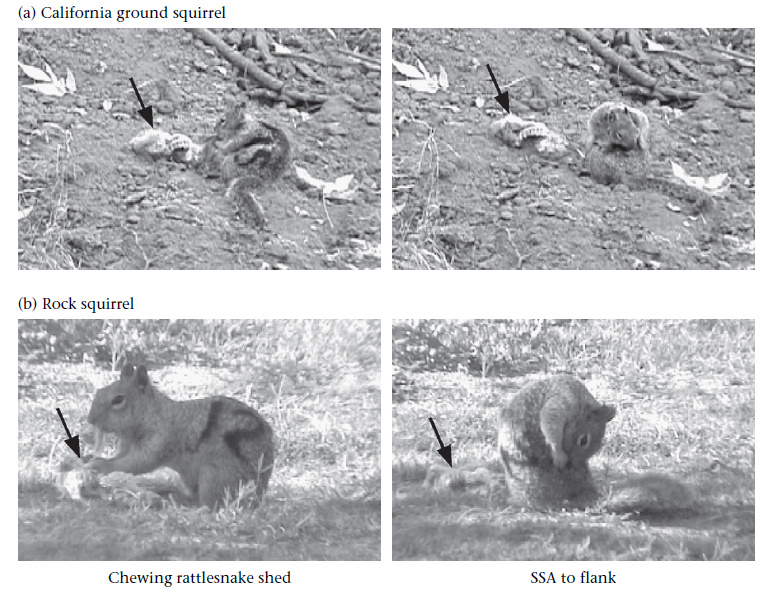
In addition to employing highly effective perception and vigilance advertisement behaviors, those darn squirrels have also evolved to anoint their fur with rattlesnake scent! They get this odor from chewing up shed rattlesnake skins. Barbara Clucas showed that the snake scent application did not deter other squirrels or help reduce ectoparasites, bolstering the case that it is a form of olfactory camouflage that serves to reduce squirrel detectability to snake predators or to repel other rattlesnakes motivated to avoid hunting in the same area as a conspecific.

Figure from Clucas et al. 2008

By now, I imagine the snake biologists in the audience are itching to see a snake actually get one for once. Here you go:


If you want to see more videos and stay current on the Clark lab's research, subscribe to their Youtube channel or to Strike, Rattle, & Roll, a rattlesnake behavior blog published by Clark lab PhD student Bree Putman.

ACKNOWLEDGMENTS

Thanks to Rulon Clark for his helpful review of this article.

REFERENCES

Barbour, M. A. and R. W. Clark. 2012. Ground squirrel tail-flag displays alter both predatory strike and ambush site selection behaviours of rattlesnakes. Proceedings of the Royal Society B: Biological Sciences doi:10.1098/rspb.2012.1112. <link>

Clark, R. W., S. Tangco, and M. A. Barbour. 2012. Field video recordings reveal factors influencing predatory strike success of free-ranging rattlesnakes (Crotalus spp.). Animal Behaviour 84:183-190. <link>

Clucas, B., D. H. Owings, and M. P. Rowe. 2008. Donning your enemy's cloak: ground squirrels exploit rattlesnake scent to reduce predation risk. Proceedings of the Royal Society B: Biological Sciences 275:847-852. <link>

Coss, R. G. and D. H. Owings. 1978. Snake-directed behavior by snake naive and experienced California Ground Squirrels in a simulated burrow. Zeitschrift für Tierpsychologie 48:421-435. <link>

Owings, D. H. and R. G. Coss. 1977. Snake mobbing by California ground squirrels: adaptive variation and ontogeny. Behaviour 62:50-69. <link>

Rundus AS, Owings DH, Joshi SS, Chinn E, Giannini N (2007) Ground squirrels use an infrared signal to deter rattlesnake predation. Proceedings of the National Academy of Sciences 104:14372-14376 <link>


Creative Commons License

Life is Short, but Snakes are Long by Andrew M. Durso is licensed under a Creative Commons Attribution-NonCommercial-NoDerivs 3.0 Unported License.

Tuesday, August 21, 2012

Goo-eating snakes and the eggs that evade them


I have just returned from attending the Seventh World Congress of Herpetology (WCH7) in Vancouver, Canada. This meeting is held once every four years, always in the same year as the Summer Olympics, from which it differs in several important ways. Although many celebrities attend each, the WCH primarily consists of scientific, rather than physical, displays of prowess. Until a gold medal is given in lizard noosing, herpetologists will continue to present their research at the WCH, as I had the opportunity to do this year. Because of the large number of excellent talks highlighting new research in snake biology, I have decided that the next several articles on LISBSOL will constitute a series inspired by the work of the many herpetologists whom I saw presenting at WCH7. If you want to learn more about the WCH, check out the June 2012 issue of Herpetological Review, or follow the Twitter hashtag #wch2012, with which I will tag all posts in this series (disappointing though it is that herpetologists should be forced to 'tweet' their research rather than 'hiss' or 'croak' it [I couldn't figure out how to spell the sound that alligators make]).

One tradition at WCH meetings is to open each day with a plenary talk, which is an hour-long presentation by a distinguished herpetologist. Of the several plenaries at WCH7, the one that impressed me the most was given on the first day by Karen Warkentin, a herpetologist at Boston University who studies environmentally-cued hatching of amphibian eggs. One of the foundations of her research is that the timing of hatching, a critical life-stage transition in the life of an amphibian (or reptile), should be flexible in order to maximize the likelihood of survival of the young animals. That is, if the egg is safe from predators and pathogens, hatching should be delayed as long as possible (typically until the embryo is as large as it can get without leaving the egg). However, if the egg is in danger, hatching should speed up, as long as the embryo is capable of living outside of the egg. This phenomenon is observed in a variety of reptiles and amphibians, including  the Agalychnis (red-eyed) treefrogs that Dr. Warkentin studies. These frogs lay their eggs on leaves overhanging pools in the Neotropical rain forests, so that when they hatch the tadpoles can drop into the water.

Agalychnis callidryas in amplexus
The primary predators of Agalychnis eggs are wasps and snakes. In the wild, snakes consume as much as 50% of all Agalychnis eggs laid, so it makes sense that there would be strong selection for eggs that could escape snake predation. If a snake or wasp attacks a clutch of eggs, the vibrations trigger the eggs to hatch almost immediately. If that sounds impossible, check out this video of a Parrotsnake (Leptophis) attacking a clutch of eggs:


Look at those little guys hatch! You can see other videos at Dr. Warkentin's website, where you can compare the feeding behavior of Leptophis with that of the Cat-eyed Snake (Leptodeira). Embryos in the last third of their development escape from snake attacks with about an 80% success rate by hatching up to 30% early, which is really remarkable. Furthermore, they can distinguish snake attacks from other sources of vibration, so that they don't hatch every time it rains. To do this, they respond to several non-redundant vibrational cues, including frequency, duration, and their interaction. These cues propagate throughout the jelly matrix of the eggs, so that eggs that have not yet been touched by the snake can escape. In two species of Agalychnis that have reduced jelly, escape success is much lower, because the signals do not propagate as well.

Vibration profile of a snake attack

According to Dr. Warkentin, the snakes do not appear to prefer younger eggs (which would be incapable of hatching early) or to forage preferentially in the rain (when their vibrations might be masked by raindrops). Along with Leptophis and Leptodeira, two other snake genera, Sibon and Dipsas, possess morphological and behavioral adaptations for feeding on frog eggs and other prey items that are essentially 'goo'. Not unlike the southeast Asian pareatids I've covered before, these Neotropical snakes have numerous, long, slender teeth on the dentary (lower jaw), and they have many skeletal and muscular modifications that allow for jaw flexibility beyond even that normally seen in snakes. Extinction of many frogs due to chytrid fungus in Central America has caused dietary shifts and changes in abundance of these snakes.

Sibon argus eating frog eggs

Environmentally-cued hatching in response to vibrations also occurs in the eggs of other treefrogs, centrolenid glass frogs, and African reed frogs. It can also occur in response to other environmental dangers, such as flooding (in salamander and some turtle eggs) and disease (in frog eggs and also in painted turtle hatchlings, which often overwinter in the nest but are more likely to emerge early when infected with sarcophagid fly larvae). This last example comes from the thesis work of Julia Riley at Laurentian University, who presented preliminary results at the WCH. She also found that turtles hatching in nests that were on steeper slopes were more likely to emerge early, possibly to avoid collapse of the nest over the winter. Whether research will one day show that snake eggs also possess environmentally-cued hatching plasticity is an open question, but I suggest that a good system to start looking would be the Nicrophorus beetle hosts. Maybe we'll be hearing about that at WCH8 in Hangzhou, China!

ACKNOWLEDGMENTS

Thanks to Otto Monge, Brad Wilson, and the Warkentin lab website for providing photos and videos.

REFERENCES

Caldwell MS, McDaniel JG, Warkentin KM, 2009. Frequency information in the vibration-cued escape hatching of red-eyed treefrogs. J Exp Biol 212:566-575. <link>

Caldwell, M. S., J. G. McDaniel, and K. M. Warkentin. 2010. Is it safe? Red-eyed treefrog embryos assessing predation risk use two features of rain vibrations to avoid false alarms. Animal Behaviour 79:255-260 <link>

Gomez-Mestre I, Warkentin KM, 2007. To hatch and hatch not: similar selective trade-offs but different responses to egg predators in two closely related, syntopic treefrogs. Oecologia 153:197-206. <link>

Gomez-Mestre I, Wiens JJ, Warkentin KM, 2008. Evolution of adaptive plasticity: risk-sensitive hatching in neotropical leaf-breeding treefrogs. Ecol Monogr 78:205-224. <link>

Lips KR, Brem F, Brenes R, Reeve JD, Alford RA, Voyles J, Carey C, Livo L, Pessier AP, Collins JP, 2006. Emerging infectious disease and the loss of biodiversity in a Neotropical amphibian community. Proc Natl Acad Sci USA 103:3165-3170. <link>

Ray JM, Montgomery CE, Mahon HK, Savitzky AH, Lips KR, 2012. Goo-eaters: Diets of the Neotropical snakes Dipsas and Sibon in central Panama. Copeia 2:197-202. <link>

Savitzky AH, 1983. Coadapted character complexes among snakes: fossoriality, piscivory, and durophagy. American Zoologist 23:397-409. <link>

Warkentin, KM, 2005. How do embryos assess risk? Vibrational cues in predator-induced hatching of red-eyed treefrogs. Animal Behaviour 70:59-71. <link>

Warkentin KM, Caldwell MS, McDaniel JG, 2006. Temporal pattern cues in vibrational risk assessment by embryos of the red-eyed treefrog, Agalychnis callidryas. J Exp Biol 209:1376-1384. <link>

Warkentin KM, Caldwell MS, Siok TD, D'Amato AT, McDaniel JG, 2007. Flexible information sampling in vibrational assessment of predation risk by red-eyed treefrog embryos. J Exp Biol 210:614-619. <link>

Warkentin KM, Currie CR, Rehner SA, 2001. Egg-killing fungus induces early hatching of red-eyed treefrog eggs. Ecology 82:2860-2869. <link>


Creative Commons License

Life is Short, but Snakes are Long by Andrew M. Durso is licensed under a Creative Commons Attribution-NonCommercial-NoDerivs 3.0 Unported License.